
Industrial solar plant for self-consumption: why it's sized to your load profile
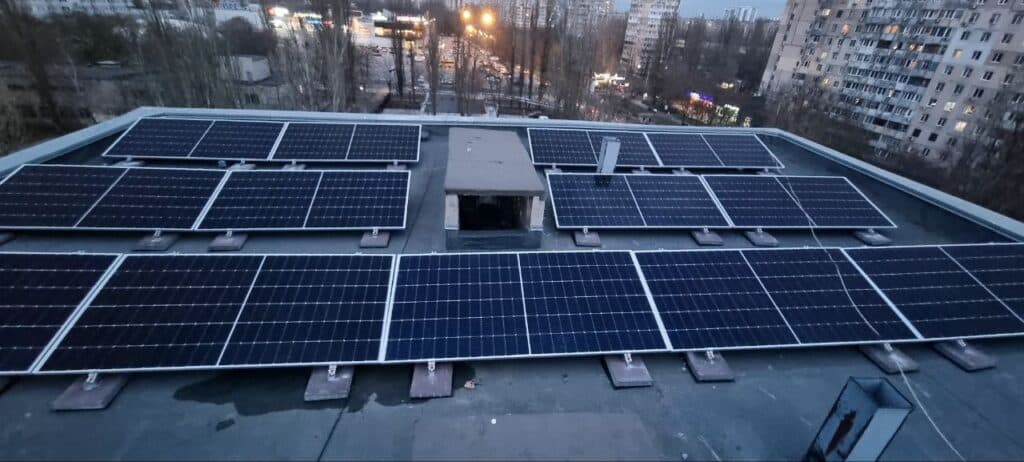
In brief. The main benefit of an industrial solar plant for a business isn't "selling to the grid" — it's self-consumption: every kWh generated and consumed on site is a kWh you don't buy from the grid at your tariff. That's why the plant is designed around the enterprise's real load profile, not "around the roof area."
"For self-consumption" vs. "for the roof"
- "For the roof": you install the maximum number of panels — and the daytime surplus goes to the grid, where it's credited at the market price rather than the retail tariff you pay for consumed energy. This means part of the potential savings is lost.
- "For consumption": capacity is sized so that daytime generation matches your daytime consumption as closely as possible. This is what delivers the main savings — you replace, with your own generation, the energy you would otherwise buy from the grid.
How the load profile is measured
We analyze your daily and seasonal consumption pattern (from an interval meter or metering system). Onto this, we overlay the calculated solar generation curve for your region, based on multi-year insolation data. Comparing the two curves shows what capacity makes sense to install and what share of daytime consumption on-site generation will actually cover. Without this analysis, capacity is chosen "blind" — and the plant ends up either undersized or feeding more into the grid than the site consumes.
What daytime generation delivers
During the day, the plant covers part of your consumption — and for that part, you buy less from the grid at your tariff. The effect is greater the more of your consumption falls during daylight hours: manufacturing, warehouses, cold-chain logistics, retail, offices, and other sites with predominantly daytime load typically operate during the day, and their profile maps well onto the generation curve.
Surpluses: the self-generation mechanism (net-billing)
If, in certain hours, the plant generates more than the site consumes, the surplus is exported to the grid. Under the self-generation mechanism (often called net-billing in Ukraine), this surplus is credited to a virtual account at the market price — for universal-service customers, based on the day-ahead market (DAM) price. These funds go toward paying for the energy you draw from the grid and for distribution services.
The key point is that this is compensation for the value of the energy exported, not a fixed income: the market price changes hourly, and in periods of generation surplus it can even go negative. That's why it's economically more advantageous to design the plant so that energy is consumed on site, rather than "for sale to the grid."
An enterprise acquires active-consumer status through a self-generation purchase-sale contract — this is an addendum to the existing supply contract, and no separate licence is needed for it. If the plant operates within your permitted capacity, new technical conditions for connection are generally not needed — the generation feeds into your internal network. At the same time, for non-household active consumers the permitted feed-in capacity is capped at 50% of the site's permitted (contracted) capacity (household and small non-household consumers are an exception) — cl. 4.13.1 of the Distribution System Code, para. 13; the exact value is fixed by the DSO in the connection point passport (cl. 4.12.1, para. 9). This caps the feed-in capacity, not the volume of generation; the exact conditions are checked against current rules for your site. So the surplus isn't unlimited — one more argument for designing the plant around self-consumption.
When a storage system (BESS) is needed
If a significant share of consumption falls on evening or night hours, or if a production stoppage is unacceptable, a storage system is added to the plant. BESS shifts daytime generation to the evening consumption peak and provides a reserve for critical load.
Here it's important to understand a technical limitation: an ordinary grid-tie solar plant without storage disconnects during a grid outage. This isn't an installation flaw — it's a safety requirement: the inverter is required to cut off output when grid voltage disappears (anti-islanding protection, per ДСТУ EN 50549-1:2022 / -2:2022), so as not to feed voltage onto a line where people may be working. That's why backup and uninterrupted power during outages are provided by a configuration with storage (BESS) — typically via a hybrid inverter, which, paired with the battery, forms an island for the dedicated load.
cos φ and permitted capacity
Any generation changes the flow of active and reactive power through your connection point, so both issues are accounted for in the project.
Reactive power and cos φ. This isn't "a problem the plant creates" — quite the opposite: modern grid-tie inverters operate with a controllable power factor and, when needed, can be set to supply or absorb reactive power within the distribution system operator's (DSO's) requirements. With correct configuration, the plant doesn't worsen cos φ at the balance boundary; for a separate task, the inverters can even partially offload an existing reactive-power compensation installation. The key is to agree on the operating mode with DSO requirements at the project stage.
Permitted (contracted) capacity. This is the capacity within which your site is entitled to consume from the grid under contract. The solar plant is designed so that its operation doesn't push the power flow beyond these limits or violate the terms of the contract with the DSO. When the plant's capacity and operating mode are accounted for at the project stage, it operates within your connection terms, without surprises from the operator.
Where to start
Give us your consumption profile (or average monthly consumption and load characteristics), input capacity / permitted capacity, and site type — and we'll calculate a configuration for your site.
→ Calculate a plant for self-consumption.
Frequently asked questions
What share of consumption will the solar plant cover?
It depends on your load profile and how closely it matches daytime generation; we calculate this individually. Indicative figures are provided in the financial model — this is a guideline, not a guarantee.
Will we earn money selling surpluses?
Under the self-generation mechanism, the surplus is compensation for its value at the market price, not a fixed income (the price changes hourly and is sometimes low). The main benefit is self-consumption, which is why the plant is designed around it.
Is a licence or new technical conditions needed?
Active-consumer status is arranged via a self-generation purchase-sale contract (an addendum to the supply contract), with no separate licence. Within permitted capacity, new technical conditions are generally not needed; if a separate connection for greater capacity is required, that's calculated separately.
Will there be power during a grid outage?
For an ordinary grid-tie solar plant without a battery — no: the inverter shuts down as a safety requirement (anti-islanding protection). A configuration with storage (BESS) is needed for backup during outages.
See also: Building a solar power plant · Industrial solar plants for businesses · Investing in industrial solar · Industrial solar plant project: scope & documents
See also
Need an engineer’s advice?
Have a task involving power supply, switchgear or solar plants — write to us and we’ll answer to the point.
+380 67 104 94 91How to choose an industrial solar contractor: an 8-point checklist
A practical checklist for owners and managers: what to look at, which questions to ask and where the risks hide when you build a solar plant from 30 kW to several MW.
- 8 criteria for choosing a contractor — with “why it matters” notes and red flags;
- questions worth asking before signing the contract;
- how to tell a design “for your load profile” from one “for your roof area”;
- what to check about grid connection, warranty and service.
Enter your work email — the download link will open right away. No spam.