
Solar Power Plant for a House or Cottage
A lower electricity bill, and in the hybrid version with a battery — power during outages. From 6 to 30 kW, turnkey from the manufacturer.
Solar Power Plant for a Private House
A solar power plant for a private house does two things. First: during the day the house runs on its own energy — the electricity bill goes down. Second, if you add a battery: the house has power even during outages. LK Energy (Odesa) designs and installs home power plants, roughly from 6 to 30 kW, turnkey — from the site visit to grid connection and paperwork. A backup power kit without panels is a separate option — from UAH 96 900 turnkey.
Kits and prices
- Backup kit without panels — from UAH 96 900 turnkey
- A 6 kW inverter plus a 5 kWh battery. When the grid goes down, the kit switches the house to the battery on its own — lights, fridge, boiler and internet keep running for as long as the charge lasts. Solar panels can be added later: the kit is ready for them.
- 6 kW solar plant — backup kit plus 6 kW of panels
- The same backup kit (a 6 kW inverter and a 5 kWh battery) with 6 kW of panels added. We give the exact figure in a quote within 24 working hours.
- Solar plant 8–12 kW — from UAH 239 000 turnkey
- A 10 kW inverter, 10 kW of solar panels and a 10 kWh battery. During the day the house runs on solar, the surplus charges the battery, at night and during outages it runs off the battery.
- Solar plant 15–20 kW — from UAH 644 900 turnkey
- A 20 kW inverter, 26 kW of solar panels and a 20 kWh battery. For a large house with a well pump, a boiler and air conditioning.
Prices are for a turnkey kit: equipment, installation and commissioning. The exact figure depends on the roof, the distance and the connection layout — we calculate it after a site visit.
Timeline: quote — 24 working hours · installation — 2–3 weeks.
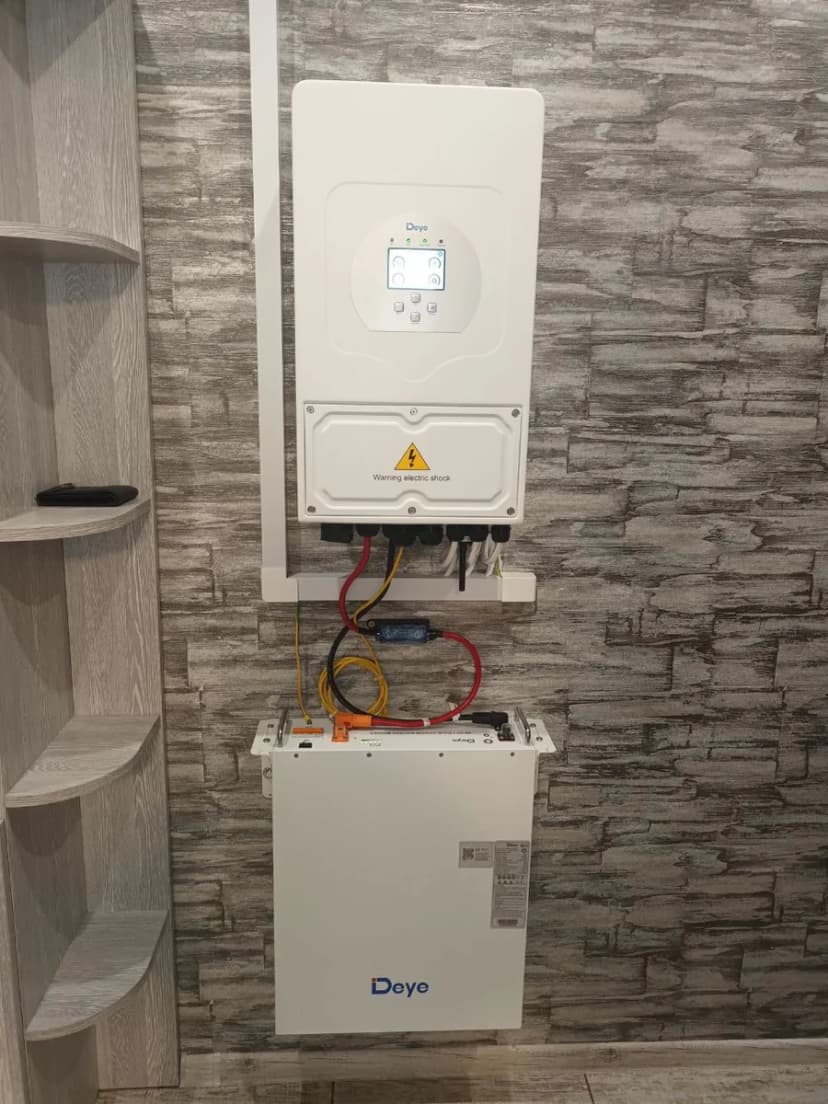
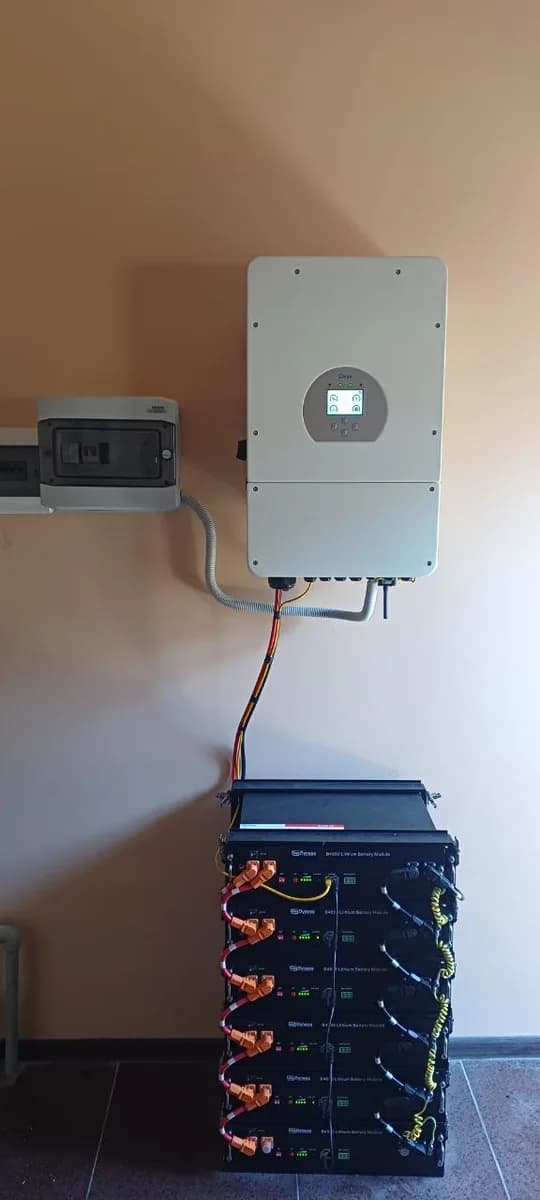
Our installations
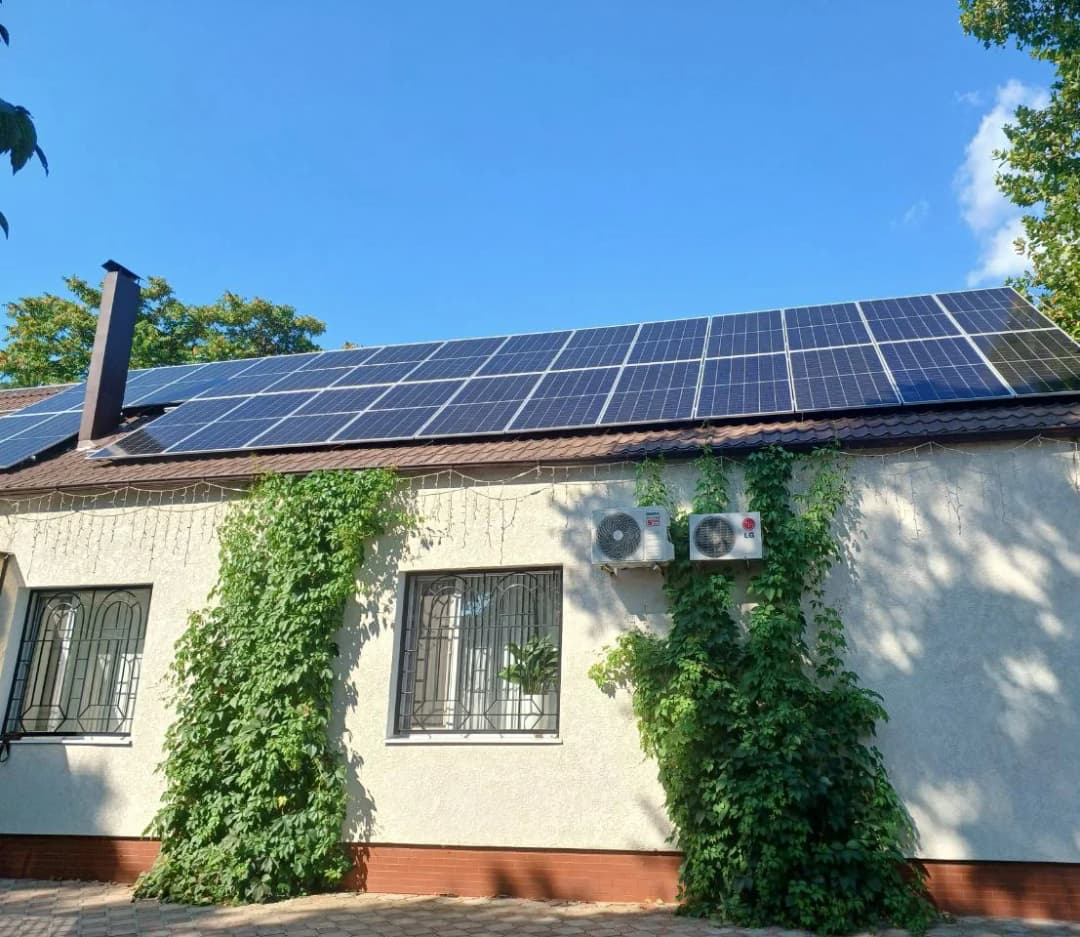
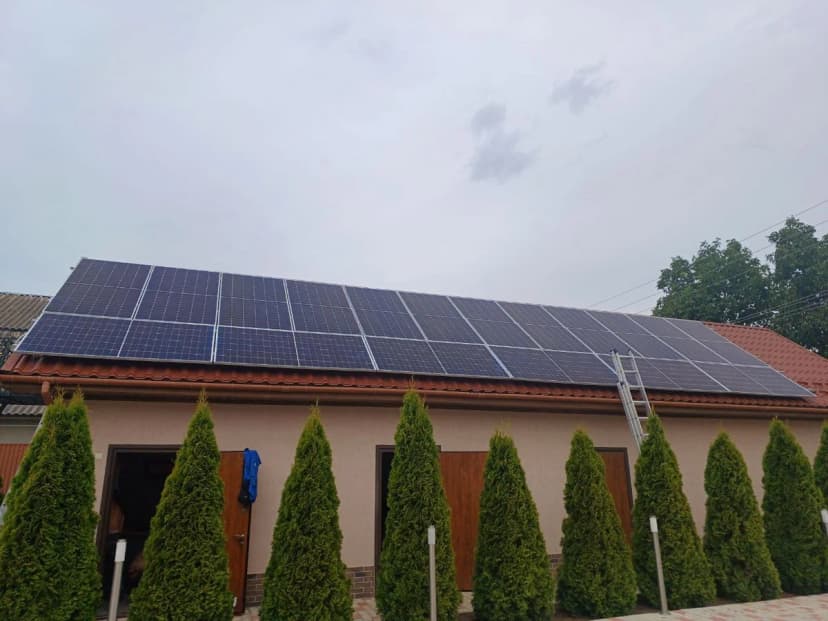
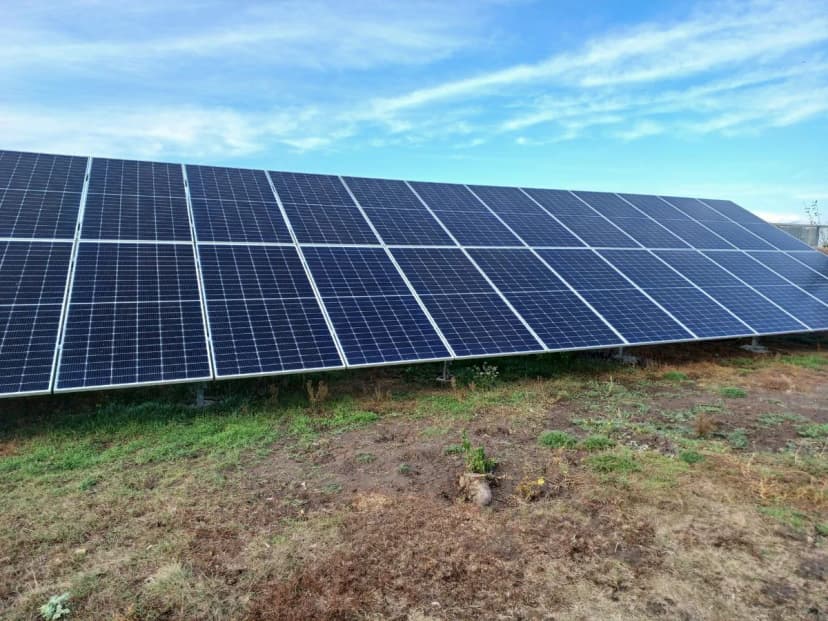
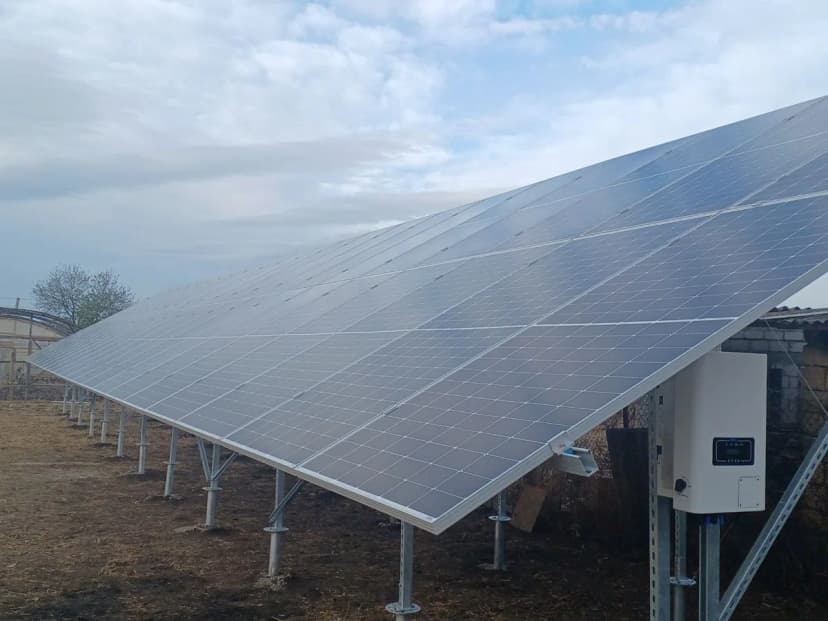
The main choice: with a battery or without
- Grid-tied plant (without a battery)
- Cheaper. Reduces the bill through daytime solar consumption. An important honest point: when the grid goes down, this type of plant shuts off and provides no power — this is a grid safety requirement.
- Hybrid plant (with a battery)
- More expensive, but does both things: reduces the bill and keeps the power on during outages — the refrigerator, boiler, internet and lighting run off the battery.
Not sure which to choose? We'll calculate both options — you compare the numbers and decide.
How the plant reduces your bill
During the day the house consumes energy from its own roof instead of the grid. If the plant generates more than the house consumes, the surplus goes to the grid — either under the green tariff or under the self-generation mechanism (Net Billing), depending on your contract with the supplier. This is a nice bonus, not guaranteed income — the main savings still come from your own consumption.
Generation is lower in winter and higher in summer — that's why we calculate the annual balance: we look at your bills for 12 months and show what share of your annual consumption the plant will cover on your specific roof. In winter, the grid makes up the difference — the house is never left without power.
We calculate payback and savings from your own consumption profile — that is the only way to get an honest figure. Send us an electricity bill and we will show the calculation for your specific site.
How the installation process works
We visit the site → assess the roof (pitched or flat, or a plot near the house) and consumption → calculate the capacity and cost estimate → design → installation → connection. We handle the paperwork for connecting the plant to the grid ourselves. The timeline depends on the roof and capacity — we'll state it together with the cost estimate.
Why LK Energy
LK Energy is a manufacturer of electrical switchgear equipment with its own factory in Odesa (in production since 2015) and a full-cycle contractor operating since 2005. We manufacture the switchgear and protective automation for your plant ourselves. Among our completed projects are about 100 solar power plants of various scales — from private rooftops to an industrial 4.95 MW plant. Take a look at real projects: rooftop and private plants in "Examples of Work" →
This page is about the home. If backup power is needed for a business (office, store, production facility) — that's a different solution with different requirements: Backup power for business →
Backup power without the sun: an inverter with a battery
The backup power kit is a hybrid inverter with a battery: the battery charges from the grid, and when the power goes out the kit switches the house to the battery on its own — solar panels are not needed for that. Backup kit without panels — from UAH 96 900 turnkey.
This is what a backup power system looks like: you can install it now and add panels later.
Green tariff and Net Billing: what happens to the surplus
The green tariff is the mechanism under which the universal service supplier buys electricity generated by a private household's plant. What is bought is not the whole output, but only the volume exceeding your monthly consumption: the plant covers the house first, and only the surplus goes to the grid.
Technically, the ordinary meter is replaced by a bidirectional one, which counts separately what is drawn from the grid and what is fed into it. The settlement period is a month, and the difference shows up in your account with the supplier.
For household solar installations the limit is 30 kW. A condition applies to plants commissioned from 2024 onwards: there must be a building within the household, and there must be actual consumption — the tariff is not intended for a plant built purely to sell.
In parallel, the market is moving to Net Billing — the self-generation mechanism, under which the value of the energy fed into the grid is offset against the value of the energy consumed instead of being paid at a fixed rate. Households up to 30 kW can use it too.
Rates and conditions are set by the national regulator (NKREKP) and revised periodically, so we do not quote figures here. We will size the plant against your consumption and help you work through the procedure — which regime is available to you depends on when the plant is commissioned and on your contract with the supplier.
What the work includes
- Site visit, capacity calculation and cost estimate for your house — free of charge
- We supply the panels, and manufacture the switchgear and protective automation at our own factory — controlling quality and timelines
- Handling the plant's grid connection — we take care of the paperwork
- Warranty and service support after commissioning
FAQ
How much does a solar power plant for a house cost?
Will there be power during outages?
What about winter, when there's little sun?
What capacity does my house need?
How long does installation take?
Why order from the equipment manufacturer?
Does the kit work without solar panels?
Let’s discuss your project:
Solar Power Plant for a House or Cottage
Send us your address and approximate monthly electricity bill — within 24 business hours we'll get back to you with a capacity calculation and cost estimate: options with and without a battery.
+380 67 104 94 91