
What Is a Solar Plant (SES): How a Solar Power Plant Works, in Plain Terms
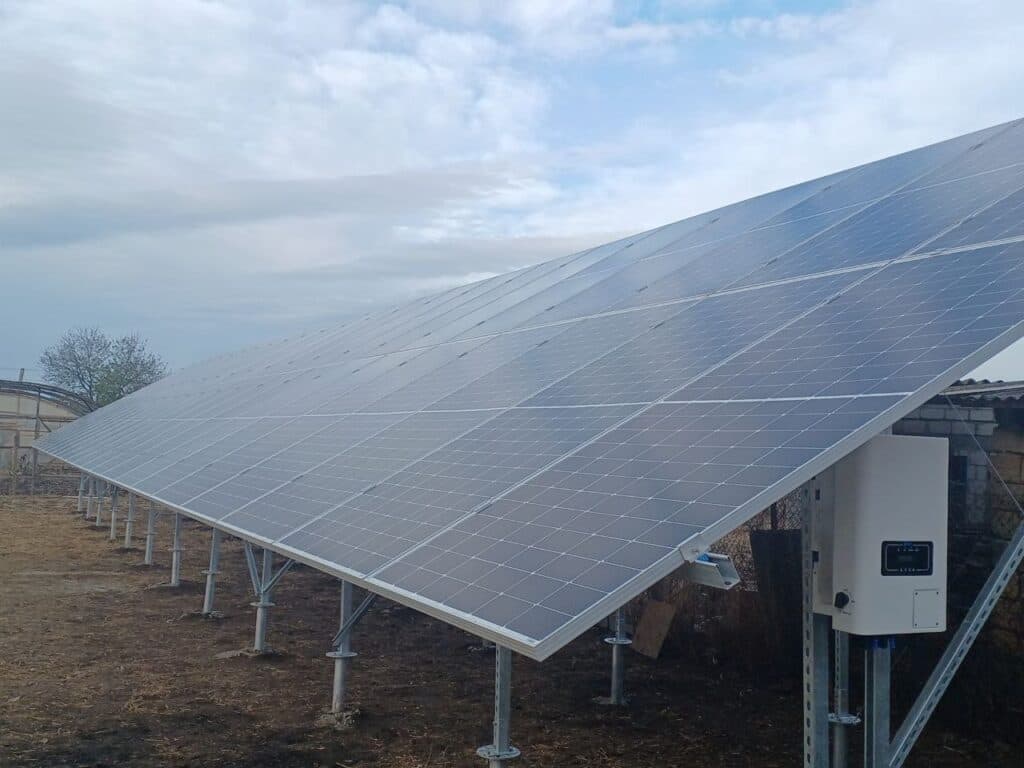
In brief. SES stands for solar power plant: an installation that converts sunlight into electricity. It consists of more than panels: to get usable electricity out of the sun you need an inverter, switchgear, protection and a correct connection to your network. Below is how it actually works: in engineering terms, step by step.
Decoding: СЕС and СЭС
The abbreviation is written in different ways, and the confusion here is routine:
- СЕС (Ukrainian) — сонячна електростанція, a solar power plant.
- СЭС (Russian) — the same thing, "солнечная электростанция".
- PV / photovoltaic (English) — a photovoltaic installation, the same principle.
Sometimes "SES" is used both for a 5 kW household installation on the roof of a private house and for an industrial plant of several megawatts in a field. The physics is identical, but the engineering, the paperwork and the cost are different. In this article we explain the general principle, and we cover the details of industrial plants separately.
How it works: from light to the socket
The chain is simple, and it has four steps:
- Photovoltaic modules ("panels") convert sunlight into direct current (DC). The more light falling on a module, the higher the current. Cloud cover reduces output, but does not stop it completely.
- The inverter converts direct current into alternating current (AC) — the same current as in your network: 230/400 V, 50 Hz. A grid inverter synchronises with the grid: it monitors voltage and frequency and switches off if they go outside the permitted limits, while keeping the modules at their maximum power point (MPPT). Holding voltage and frequency on its own — that is, powering the site without the grid — can only be done by a hybrid inverter with storage.
- Switchgear (switchboards, circuit breakers, protection, and for large plants packaged transformer substations and switchgear assemblies) feeds this electricity into the site's internal network. This is the most critical part: it is here that the plant "meets" your electricity.
- The site's loads take this electricity first. Only what you have not consumed right now goes further — into the grid or into storage (if there is any).
The key point that is often misunderstood: energy from a solar plant goes to your own consumption first, it is not "sold". Every kWh generated and consumed on site is a kWh you did not buy from the grid. That is the core economic point of a plant for a business.
What a solar plant consists of
- Photovoltaic modules — the main "area" of the plant.
- An inverter (or several) — DC→AC conversion, protection, monitoring.
- Mounting structures — roof mounts or ground-mounted tables/piles.
- Switchgear — DC and AC switchboards, circuit breakers, surge protective devices, relay protection; for large plants — packaged transformer substations and 6/10/35 kV switchgear.
- Cable lines, earthing, lightning protection.
- Commercial metering — a meter; if the plant exports surpluses to the grid, bidirectional metering is required.
- Storage (BESS) — optional, only if backup power or time-shifting of generation is needed.
- A monitoring system — so you can see output and faults.
Three types of plant — and the main difference between them
The difference between the types is fundamental, and it is exactly the thing most often misunderstood.
1. Grid-tie solar plant. The most common option for a business. It works in parallel with the grid, covers the site's consumption during the day and exports surpluses to the grid. There are no batteries. 🔴 Important: if voltage in the grid disappears, a grid-tie solar plant switches off and does not power the site — even in bright sunshine. This is not a fault but a safety requirement: the inverter has an anti-islanding protection function (standards ДСТУ EN 50549-1:2022 / -2:2022, Ukrainian national standards) so as not to feed voltage into a de-energised line where a repair crew may be working. That is why "solar panels so there is light during an outage" do not work without storage.
2. Hybrid solar plant (with storage, BESS). This is the option that really does provide power during outages: a hybrid inverter with a battery separates your site from the lost grid and powers it from the storage and the sun. The backup is limited by the battery capacity and the inverter's power, so the critical load is defined separately for it — exactly what has to keep running when the grid is down.
3. Off-grid solar plant. There is no grid at all: all power comes from the sun and batteries, often plus a generator. For an enterprise with a grid connection this is almost always more expensive and impractical; it is an option for remote sites.
> A simple rule: energy independence comes not from the sun but from the storage. Panels save on daytime consumption; a plant can work during a grid outage only in a configuration with BESS.
Rooftop or ground-mounted
- Rooftop — takes no land, sits closer to the load, cheaper on the site side. Constraints: the load-bearing capacity and condition of the roof, the area, the orientation of the slopes, shading.
- Ground-mounted — free orientation and tilt, easier to maintain, capacity limited only by the plot. Requires land, foundations (piles), fencing.
For orientation: 1 kW of installed capacity needs roughly 4–5 m² of module area (depending on module efficiency); on a roof, with walkways and setbacks, you allow for more.
What output depends on
Output is not "nameplate capacity × 24 hours". In reality it is affected by:
- The region and solar radiation — the south of Ukraine is more productive than the north.
- Orientation and tilt angle — south is optimal; east/west give less, but more evenly across the day.
- Shading — even partial shading (a tree, a chimney, a neighbouring building) hits output disproportionately hard.
- Temperature — in heat the modules' efficiency drops, so a plant more often shows its maximum instantaneous power not in summer heat but on cool sunny days; even so, the highest daily and monthly output still falls in summer.
- Soiling and the season — in winter output is several times lower than in summer.
As a rough guide, in Ukraine a solar plant delivers about 1,000–1,300 kWh per year from each installed kW (in the south, with optimal orientation — up to ~1,350), given good orientation and no shading. This is a benchmark for understanding the order of magnitude, not a promise: real output is calculated for the specific site.
A household solar plant and an industrial one — the real difference
The difference is not in the panels (they are the same), but in the electrical part and the paperwork:
| Parameter | Household (a few kW) | Industrial (from tens of kW to MW) |
|---|---|---|
| Connection | into the household switchboard, 0.4 kV | into the site's network, possibly via a packaged transformer substation and 6/10/35 kV switchgear |
| Switchgear | standard | designed: switchboards, relay protection, packaged transformer substation |
| Design | minimal | full design documentation |
| Grid connection | within the permitted capacity, on an application for the installation of a generating unit | depends on capacity: from operating within the permitted capacity to separate technical conditions |
| Export to the grid | limit = the full permitted capacity (household and small non-household consumers) | no more than 50% of the permitted (contracted) capacity (non-household consumers; cl. 4.13.1 of the Distribution System Code, the value is fixed by the DSO in the connection point passport) |
| Who builds it | an installation crew | designers + electrical installation + approvals with the grid operator |
That is exactly why an industrial solar plant is, above all, a design and a grid connection: the main money and the main risks sit in the electrical part, not in the panels.
What to read next
- Industrial Solar Plant Design: what it includes and which documents are required — the contents of the design, permits, building codes.
- Grid Connection for a Solar Plant: TU, steps, documents — how a plant lawfully "enters" the grid.
- An industrial solar plant for self-consumption — how a plant is sized against your load profile.
Frequently asked questions
What is a solar plant (SES) in plain terms?
SES is a solar power plant: a set of photovoltaic modules, an inverter and switchgear that converts sunlight into electricity and feeds it into your network. The panels are only part of the plant; its performance and safety depend on the electrical part.
Does a solar plant work during a power outage?
An ordinary grid-tie solar plant — no: when voltage in the grid disappears, the inverter switches off automatically (this is a safety requirement). Only a plant with storage (BESS) and a hybrid inverter can power the site during outages — for a pre-agreed critical load.
Does a solar plant work in winter and in cloudy weather?
Yes, but less. In cloudy weather output falls; in winter it is several times lower than in summer. That is why a plant is sized by its annual output and against your consumption profile, not by peak sunny days.
How much electricity does a solar plant produce?
Roughly 1,000–1,300 kWh per year from each installed kW (in the south, with optimal orientation — up to ~1,350) — depending on the region, orientation, tilt and shading. The exact figure comes from a calculation for the specific site.
How much space does a solar plant need?
Roughly 4–5 m² of modules per 1 kW of installed capacity; on a roof, allowing for walkways and setbacks — more. For a ground-mounted plant, the plot area is larger than the module area because of the spacing between the rows.
Can I sell electricity from a solar plant?
Surpluses can be exported to the grid — for non-household consumers this works through the self-generation mechanism (net-billing): the value of the exported energy is credited in your settlements with the supplier. This is compensation of value, not a guaranteed income, which is why a plant is designed for self-consumption.
See also: Industrial solar plant project · Grid connection for solar plants · 30 kW solar plant for business · Industrial solar plants for business
See also
Need an engineer’s advice?
Have a task involving power supply, switchgear or solar plants — write to us and we’ll answer to the point.
+380 67 104 94 91How to choose an industrial solar contractor: an 8-point checklist
A practical checklist for owners and managers: what to look at, which questions to ask and where the risks hide when you build a solar plant from 30 kW to several MW.
- 8 criteria for choosing a contractor — with “why it matters” notes and red flags;
- questions worth asking before signing the contract;
- how to tell a design “for your load profile” from one “for your roof area”;
- what to check about grid connection, warranty and service.
Enter your work email — the download link will open right away. No spam.