
VFD or soft starter for a borehole pump: how to choose
Author: Volodymyr Ledok, technical director for manufacturing at LK Energy Group.
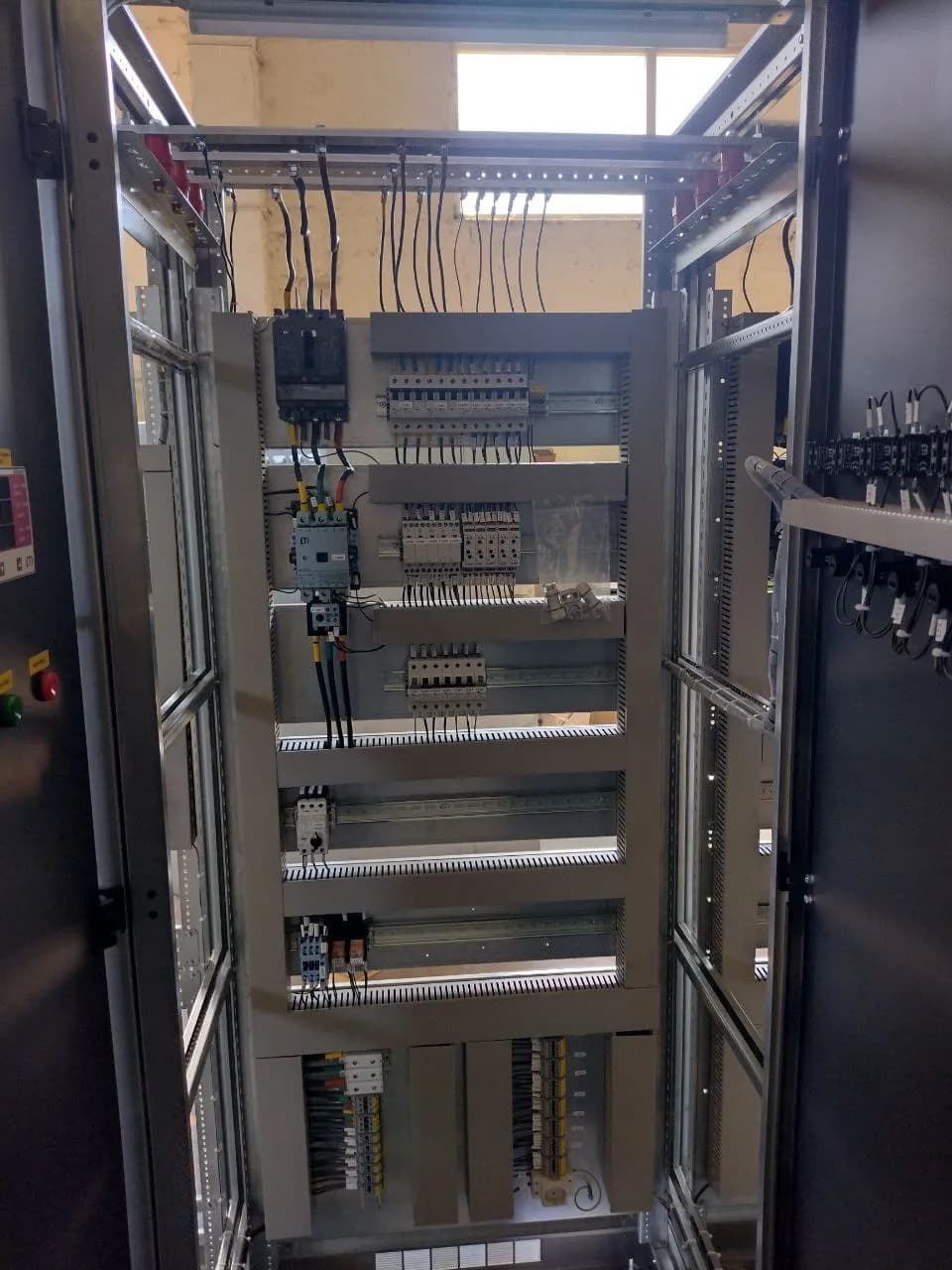
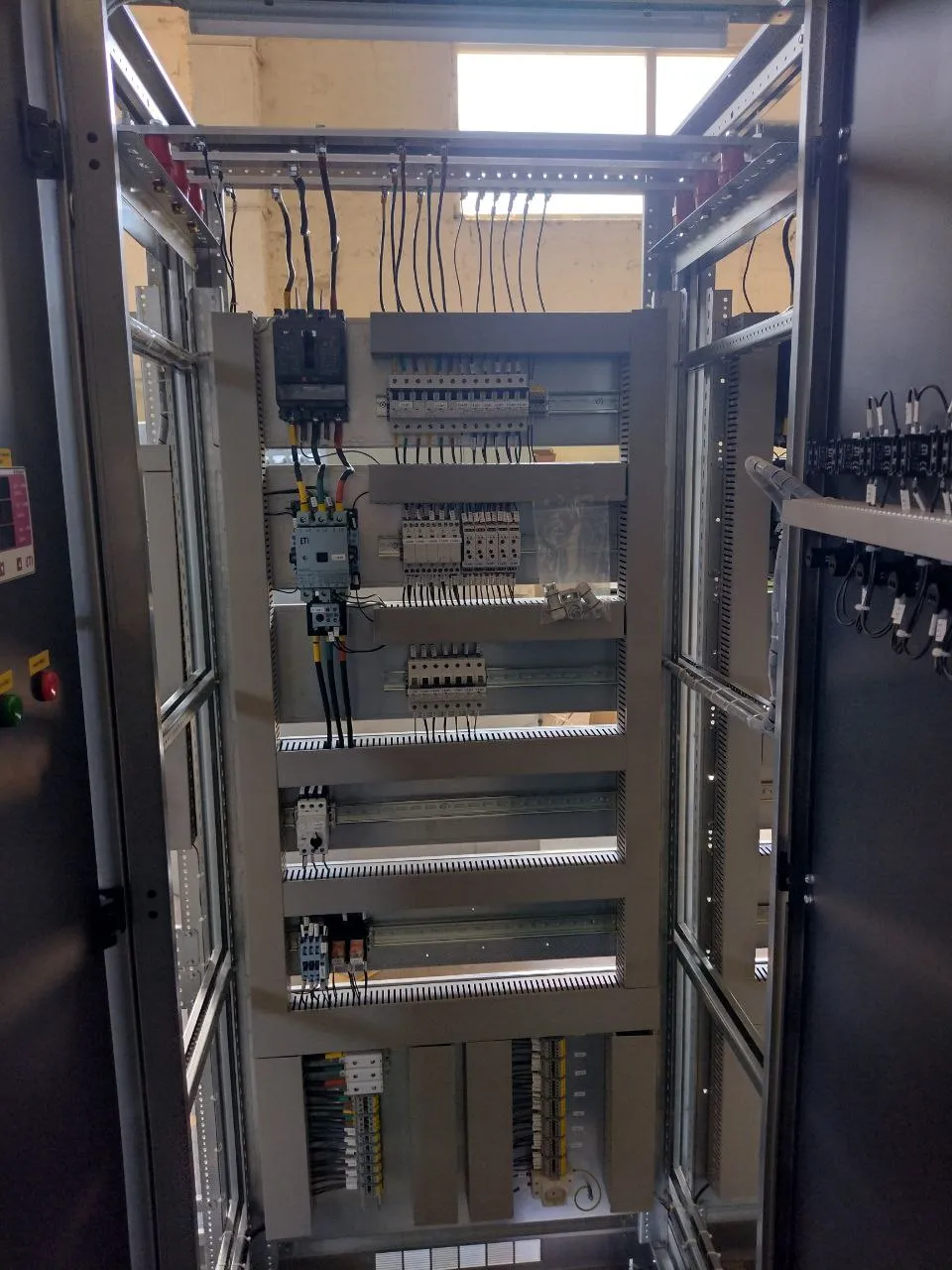
Responsible for switchgear manufacturing — LV assemblies, MV switchgear, ATS and control cabinets. Matching starting equipment to the specific motor is part of the factory build of every cabinet.
Short answer (for those in a hurry)
The rule we build borehole cabinets by:
- pump up to and including 11 kW — a soft starter;
- pump above 11 kW — a variable frequency drive (VFD);
- pressure has to be regulated (the pump feeds the network directly, not just the tower) — a VFD, regardless of rating.
And separately, the thing a VFD is wrongly expected to do: on a borehole it does not save 30–50% of the electricity. Why — below.
What happens on a direct-on-line start
A direct-on-line start of a submersible pump means an inrush current 5 to 7 times the rated value. For the grid that is a voltage dip, for the motor a thermal shock, for the hydraulics a sharp pressure surge in the pipeline.
The real cost is not the inrush itself but what it turns into at a rural water intake:
- water hammer in ageing networks — on every start and every stop;
- wear on the most expensive component. The submersible pump sits at depth, and replacing it means pulling the riser column, a crane and days of downtime — always more expensive than any starting equipment;
- inability to start from an off-grid source — an inverter simply will not carry that inrush.
Soft starter: what it does and what it does not
What it does. A soft starter limits inrush to roughly 2.5–3 times rated current. Going lower is not an option: the pump will not break away against head — the motor stalls during the ramp and trips on protection.
A controlled ramp-up and, just as importantly, a controlled ramp-down eliminate water hammer: the water in the discharge pipeline does not stop instantaneously.
Once up to speed, the current bypasses the power thyristors through a bypass contactor — in steady state the device neither heats up nor adds losses.
What it does not do. A soft starter does not control speed. After the ramp the pump runs at its rated frequency: pressure and flow are whatever they are. Regulating network pressure with it is impossible.
So for the classic "borehole → tower" scheme, where network pressure is set by the height of the tower rather than by the pump, a soft starter covers the task completely — and costs noticeably less than a VFD.
VFD: when it is mandatory
1. Pump above 11 kW. From this rating even a softened inrush of 2.5–3 times rated current is too much — both for the grid and for the inverter in off-grid mode. A VFD ramps the pump up from a low frequency within rated current: there is practically no start-up event at all.
2. Pressure has to be held. If the pump feeds consumers directly and not only the tower, stable pressure can only come from speed control with feedback from a pressure sensor.
3. The borehole yield has to be matched. The pump can be "throttled" so that delivery does not exceed inflow — a working method of dry-run protection on low-yield boreholes.
What a VFD does not do: the 30–50% saving myth
In industrial pumping systems a VFD really does deliver large savings — there the cube law applies: flow is proportional to speed while absorbed power is proportional to the cube of speed. Cut speed by 20% and power drops roughly by half.
But this only holds where the head is dynamic, i.e. created by the flow itself (pipeline friction losses). In a borehole the static head dominates — the constant lift height from depth. That cannot be "reduced by slowing down": to lift water 90 metres you still have to lift it 90 metres. Reduce the speed and you reduce the flow proportionally, while the specific consumption per cubic metre barely changes — and beyond a certain point the pump stops overcoming the head altogether and simply spins for nothing.
In short: a VFD is fitted on a borehole for controllability and equipment life, not for percentage savings. Savings at a water intake come from other things — own generation and aligning the pump's schedule with the solar schedule. That is no longer a job for starting equipment but for remote monitoring and control.
What a VFD brings along on a borehole
This is the part price lists leave out and site work reveals.
A long cable to the motor. A submersible motor sits tens — often more than a hundred — metres of cable away from the cabinet. A VFD feeds it pulse-width-modulated voltage with very steep edges, and on a long line the reflected wave effect appears: voltage at the motor terminals ends up noticeably higher than at the drive output. For the winding insulation of a submersible motor that is a direct path to breakdown.
The cure is not "better cable" but an output filter (dV/dt or sine-wave), installed in the same cabinet. Submersible motor and drive manufacturers require a filter on long runs in their own manuals, and for 380 V systems and above a sine-wave filter is the recommended norm.
Space and heat. A VFD plus a filter means physical size and kilowatts of heat inside the cabinet that have to be removed. In an uninsulated outdoor box without properly designed ventilation this turns into summer overheating and winter condensation.
Harmonics. A drive is a non-linear load; on weak rural networks this is worth accounting for at the selection stage rather than after the neighbouring equipment starts complaining.
This is exactly why we do not sell "a VFD on its own": starting equipment, filter, protection and climate control have to be calculated together.
A special case: starting with no grid
If the borehole runs off a solar plant with batteries, the requirement on starting equipment gets stricter. A hybrid inverter holds 2–3 times rated current for short periods — meaning a softened start fits its capability only when the inverter is sized with headroom for the inrush of that specific pump.
In a blackout the inverter has to start the pump on its own, with no grid behind it. That is why the pairing of "soft starter + correctly sized inverter" (and a VFD from 11 kW up) is not an option but a condition for the whole backup chain to work: sun → batteries → tower → generator.
Selection table
| Situation on site | What we fit |
|---|---|
| Pump up to and including 11 kW, feeding a tower | Soft starter |
| Pump above 11 kW | Variable frequency drive |
| Pump feeds the network directly, pressure must be held | VFD (regardless of rating) |
| Low borehole yield, delivery must match inflow | VFD |
| Operation from PV / batteries during a blackout | Soft starter or VFD + inverter sized with inrush headroom |
| Long cable to the submersible motor with a VFD | Output filter (dV/dt or sine-wave) in the cabinet — mandatory |
FAQ
Does a VFD save electricity on a borehole?
Not in the percentages advertised. The classic saving from reduced speed applies where head is created by flow, whereas in a borehole the static head dominates — a constant lift height. A VFD is fitted here for controllability, pump life and the ability to hold pressure.
The pump is exactly 11 kW — what do we fit?
Up to and including 11 kW — a soft starter. Above that — a VFD. One exception: if pressure has to be regulated on that same pump, we fit a VFD at lower ratings too.
Can a VFD be fitted to an old pump?
Usually yes, on two conditions: check the state of the motor insulation, and always fit an output filter on a long cable run. A motor that has run on a clean sine wave for ten years is not ready for steep PWM edges.
Is a soft starter really necessary, or will direct-on-line do?
Technically the pump will start direct-on-line. The question is how long it will last that way and what water hammer will do to an ageing rural pipeline. And for running off an inverter during a blackout, direct-on-line is simply not a workable option.
Is a bypass contactor needed with a soft starter?
Yes, it is the standard solution: after the ramp the current bypasses the power semiconductors and the device does not heat up in continuous operation. In our cabinets the bypass is standard.
What to do next
Starting equipment is not a standalone purchase but part of a package: inverter, batteries, starter, filter, protection, climate control and remote monitoring all have to be matched to one another. We build all of it into a single insulated vandal-resistant cabinet of our own manufacture — the whole plant room in one box, with no building work on site.
👉 The complete borehole package: what is inside the cabinet — system composition, battery sizing and VodoZir remote monitoring.
See also: The Rozhnovsky water tower: how much energy it stores.
Send us the pump rating, the depth and the cable length — we will select the starting equipment and cost the package free of charge.
See also
Need an engineer’s advice?
Have a task involving power supply, switchgear or solar plants — write to us and we’ll answer to the point.
+380 67 104 94 91