
The Rozhnovsky water tower: how much energy it stores and how to digitalise it
Author: Sviatoslav Yurdyk, quality engineer at LK Energy Group.
Over 1,000 units of equipment accepted at the factory (QC department) and 200 electrical installation sites under technical supervision, including power systems for community water intakes.
Short answer (for those in a hurry)
A Rozhnovsky water tower does not store electricity. What it does store is water that has already been lifted — which is the same thing as storing the energy spent on lifting it.
For a borehole with a typical total head of 80–100 m, every cubic metre in the tank represents ≈0.4–0.5 kWh of electricity already "stored" as elevated water. In other words:
- a 25 m³ tank — 10–12 kWh;
- a 50 m³ tank — 20–23 kWh of "virtual battery".
A lithium battery of that capacity costs real money. The tower is already standing and was paid for long ago.
There is one practical conclusion: the tower decouples the pump's schedule from the consumption schedule. The pump can run when it is cheap (during the day, on solar), while the village draws water when it needs to (morning and evening). Below — the numbers behind this, and what it takes to turn the tower from "just a tank" into a managed asset.
What a Rozhnovsky tower is
It is a steel water tower built to a standard design (the classic one being TP 901-5-29) — the type that rural Ukraine was built out with from the middle of the last century onwards. The design is extremely simple, which is exactly why it is still in service:
- the tank — the storage vessel at the top;
- the cylindrical support column — not merely a leg: in the classic Rozhnovsky design it is also filled with water and connected to the tank. The large mass of water in the column cools down slowly, which is what allowed the design to survive our winters without heating;
- gravity feed — water is distributed into the network by height alone, with no pump.
Sizes. Catalogues list them as VBR-15, VBR-25, VBR-50: a 15 / 25 / 50 m³ tank on a 10–18 m support. That height is enough to distribute water by gravity at ~1.0–1.8 bar (10 metres of water column ≈ 1 bar) — no pump is needed for distribution.
It is this last property that makes the tower valuable during a blackout: gravity feed works when there is no electricity at all.
How much energy the tower stores
The energy in the tank is calculated not from the volume but from the total head — the height the pump actually lifts the water to. That is not the height of the tower: total head includes the dynamic water level in the borehole, the height of the tower above ground and pipeline losses. For artesian boreholes this typically works out at 80–100 m.
At that head, every cubic metre lifted "costs" ≈0.4–0.5 kWh of electricity. So this is what a full tank already holds:
| Tower size | Tank volume | Energy stored |
|---|---|---|
| VBR-15 | 15 m³ | ≈6–7 kWh |
| VBR-25 | 25 m³ | 10–12 kWh |
| VBR-50 | 50 m³ | 20–23 kWh |
At a lower head the figure is proportionally lower — we account for this in the calculation for each specific site.
An important piece of honesty: the tower stores water (and the night-time kilowatt-hours the pump does not have to buy), not electricity. It will not put lights in people's homes — only continuity of water supply. Everything below is about that continuity and about the electricity bill, not about backup power for the village.
Why it works: night-time draw and decoupled schedules
A village draws water unevenly: peaks in the morning and in the evening, while the night-time draw is typically 10–20% of the daily total (based on statistics from our sites). Which means a tank filled in the evening carries the village through the night without a single kilowatt-hour from the grid.
Hence the simple logic behind the whole design:
- the sun pumps during the day — exactly when PV output is at its highest;
- the tower covers the night — and the morning peak as well, before the pump is needed again;
- the pump starts on a schedule, not "whenever the float switch clicks".
For larger villages we verify by calculation whether the tank volume is sufficient — 25 m³ for a thousand households will not deliver anything.
What the tower will not do (honest limits)
To keep expectations realistic, three limits we state upfront:
- This is not backup power for the village. The tower delivers water, not electricity.
- The volume is finite. The reserve in the tank is measured in hours, not days. Exactly how many is calculated from actual daily consumption.
- Without a generator, the system will not cover multi-day winter cloud cover indefinitely, and we do not promise that it will. The honest limit of water-supply autonomy is a sunny day + batteries + the tank reserve; beyond that a diesel generator is required.
How digitalisation turns the tower into a managed asset
On its own, the tower is a passive reserve: a float switch starts the pump when the level drops and stops it when the tank is full. The float knows nothing about PV output, about a leak, or about a loss of delivery.
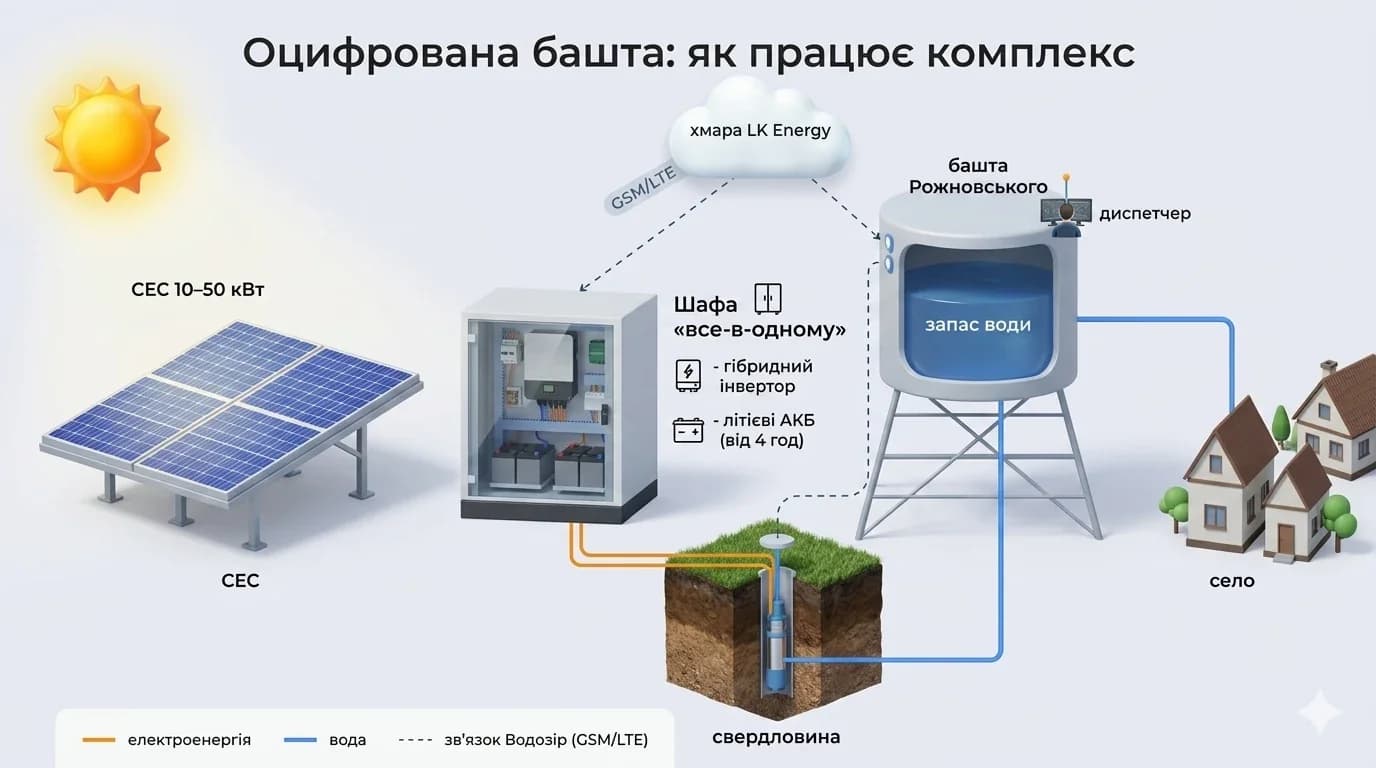
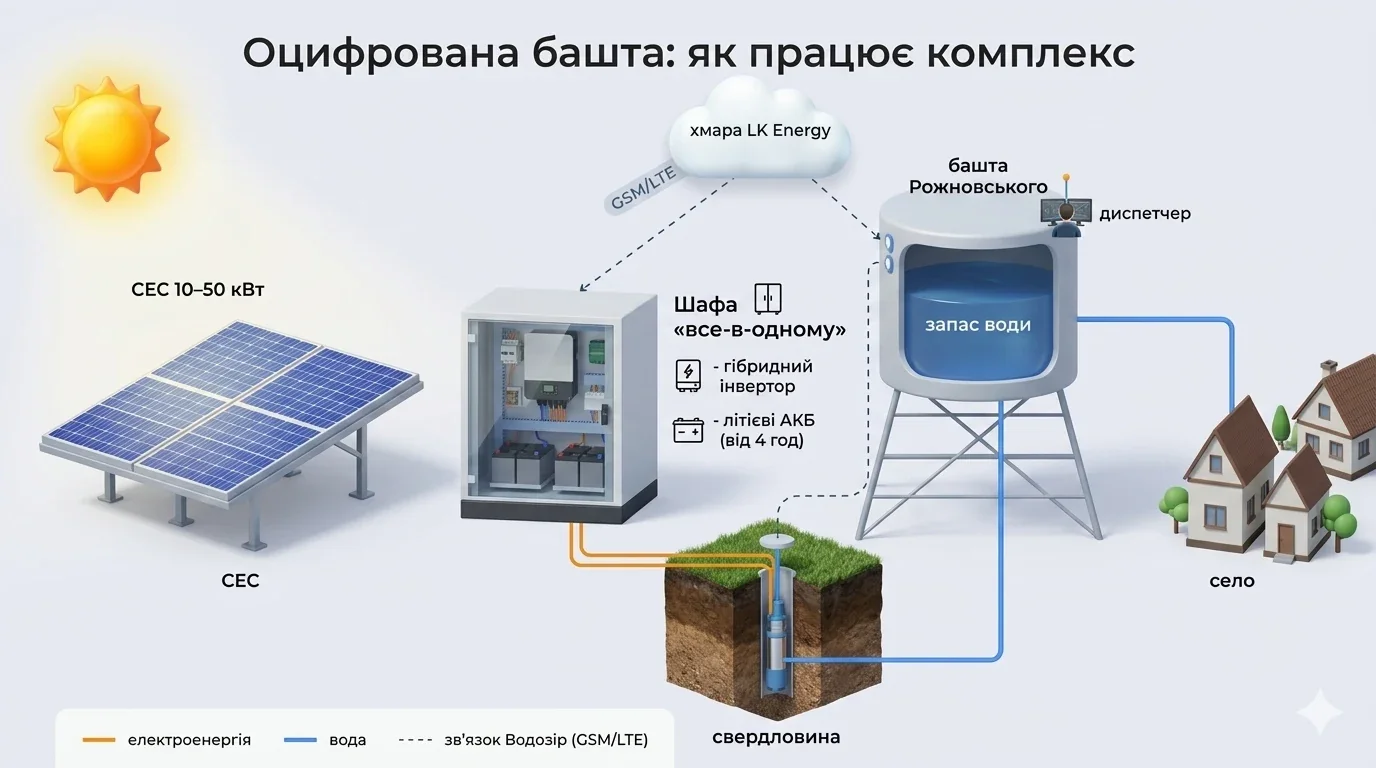
"Digitalising the tower" means adding a "source" (a solar plant) and a "brain" (remote monitoring and control) to the tank that is already there. In our systems the brain is the VodoZir unit developed in-house by LK Energy. Here is what it changes:
1. Meter readings — remotely. The electricity meter, the water flow meter, the tank level and/or pump running hours — all visible from a phone. Monthly drives around the towers just to copy down numbers are no longer needed (scheduled equipment inspections still are).
2. Faults — as an alert, not as a phone call from residents. Pump running but no flow — loss of delivery or a broken pipe. Level dropping while the pump is running — a major leak. Dry running. Cabinet opened. The dispatcher finds out first.
3. Pump operation shifted into the solar window. Draw statistics build a typical daily consumption profile for the village. The controller plans how much water to lift per day and schedules the pump during daylight hours, topping the tank up before the evening peak. If the level falls to the emergency threshold, the pump starts regardless of the sun.
Point three is where the money is. A site with no storage and no control self-consumes about 50–60% of its own solar output. Batteries combined with a dispatch schedule raise that share to a calculated 75–85% — where the site's operating regime allows it. The gap between those two figures is what the "brain" of the system pays back.
4. Backup cascade — automatic. Sun → lithium batteries (sized for at least 4 hours of pump operation) → the tower reserve → a diesel generator last, if there is one on site. Switching happens without human involvement; the dispatcher sees the transfer to backup on the panel and learns about the blackout at the borehole before the first resident calls.
Technically all of it — hybrid inverter, batteries, soft starter or variable frequency drive, and the VodoZir unit itself — goes into a single insulated vandal-resistant cabinet of our own manufacture: the entire plant room in one box, with no building work on site.
FAQ
How much water does a Rozhnovsky tower hold?
Standard towers hold 15, 25 or 50 m³ (VBR-15 / VBR-25 / VBR-50) on a 10–18 m support. Larger versions exist, but these three are the most common in rural water supply.
What pressure does a water tower provide?
Roughly 1.0–1.8 bar, depending on the height of the support (10 metres of water column ≈ 1 bar). That is enough to distribute water by gravity, without a booster pump.
How much electricity does a 25 m³ tower store?
10–12 kWh — for a borehole with a total head of 80–100 m. A 50 m³ tank holds 20–23 kWh. At a lower head, proportionally less.
Will the tower give light to homes during a blackout?
No. The tower is a reserve of water, not of electricity. Lighting is a separate task requiring separate equipment.
Will there be water during a blackout?
Yes, within the cascade: during the day the pump runs on solar, then on batteries (sized for 4 hours of its operation), plus the reserve in the tower itself, with a diesel generator starting last if one is present on site. The system will not cover multi-day winter cloud cover without a generator — that is the honest limit.
Does the pump have to be replaced in order to "digitalise" the tower?
No. The system connects to the existing submersible pump: up to and including 11 kW we fit a soft starter; above 11 kW, or wherever pressure has to be regulated, a variable frequency drive. The working pump does not need to be replaced.
Where to start
If your hromada or farm has a Rozhnovsky tower, half the work of an energy-independent borehole is already done. What remains is to add a source and control.
We do this calculation free of charge on your tower's data: pump rating, annual consumption, tariff — and you see the savings and the payback period based on your own figures rather than market averages.
👉 Solar plants for artesian boreholes with remote monitoring — system composition, calculations for five sizes and a month-by-month balance.
A related solution for water utilities — pumping station SCADA. See also: VFD or soft starter for a borehole pump.
The technical reference values (head, volumes, pressure) are typical for Rozhnovsky towers in rural water supply; for a specific site the parameters are confirmed from the borehole datasheet and actual measurements.
See also
Need an engineer’s advice?
Have a task involving power supply, switchgear or solar plants — write to us and we’ll answer to the point.
+380 67 104 94 91