
OPU: the substation control building — what it is and what it contains
Author: Volodymyr Ledok, Production Technical Director at LK Energy Group.
He is responsible for manufacturing switchboard equipment and block-modular products — NKU units, auxiliary supply panels, DC boards and substation control buildings (OPU) for substations and solar power plants.
OPU (the substation control building) is a separate building or room on the site of an electrical substation that houses the control, relay protection and automation devices, electricity metering, communications and the auxiliary supply boards. If the switchgear and the power transformers are the “muscles” of a substation, the OPU is its brain and nerve centre: the control cables from all the primary equipment come together here, and from here the personnel and the automation monitor the state of the substation and control it.
What an OPU is and why a substation needs one
At a 35–110 kV substation the primary equipment is spread across the site: transformers, circuit breakers, disconnectors and current and voltage transformers stand in the open switchyard or in separate cubicles. Each of these devices has secondary circuits — protection, control, signalling, measurement. Controlling a substation “at each device” is impossible and unsafe, so all the secondary circuits are brought together in one place — the substation control building.
An OPU solves several tasks at once:
- A single control centre
- the state of all the substation’s connections can be seen from one room; from here circuit breakers are closed and opened, readings are taken and alarms are acknowledged.
- Normal conditions for the equipment
- microprocessor relay protection terminals, communications equipment and the process control system are sensitive to temperature, moisture and dust — in the heated OPU room they operate within their rated conditions.
- A workplace for personnel
- at substations with duty personnel the operating point is located in the OPU; at substations without permanent staffing a mobile operations team comes here.
- Survivability of the secondary systems
- the OPU houses a battery with a DC board — the protections and the circuit breaker controls keep their supply even if the substation loses AC voltage entirely.
What is installed in an OPU: the equipment
The specific list is set by the design of the substation, but a typical set for a 35–110 kV substation looks like this.
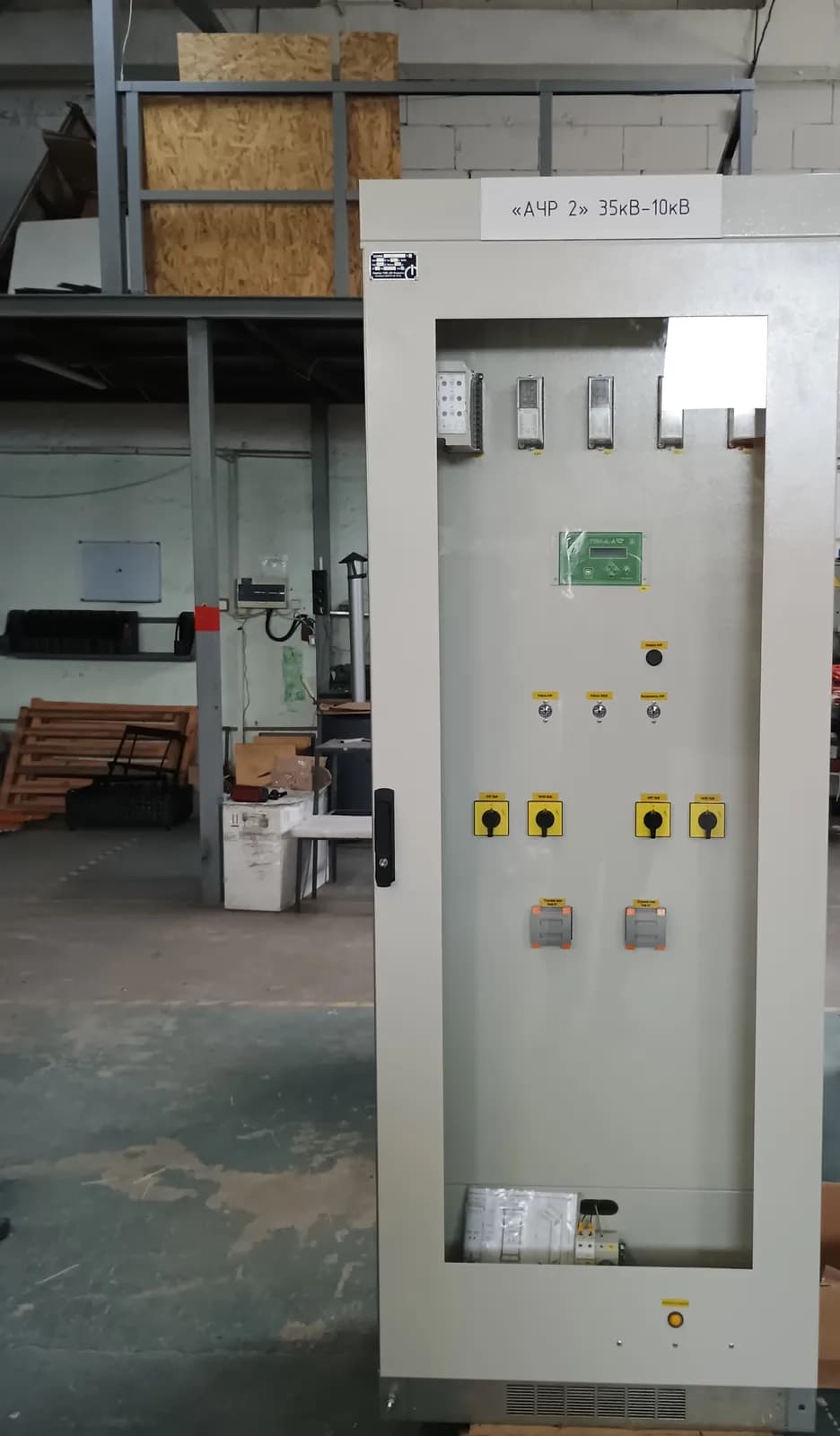
Relay protection panels. Relay protection and automation cabinets for the transformers, lines and busbars: protection against short circuits and overloads, auto-reclosing, and automatic transfer of the auxiliary supply. At modern facilities these are microprocessor terminals; at older substations relay panels with electromechanical relays are still in service.
Control and signalling panels. Circuit breaker control switches, the substation mimic diagram, and central signalling of alarm and warning events. At new substations these are increasingly replaced by an operator workstation within the process control system.
The 0.4 kV auxiliary supply board. It distributes AC power for the substation’s own needs: heating of circuit breaker drives and outdoor cabinets, lighting, ventilation, and supplies for the battery chargers. It is fed from auxiliary transformers, as a rule from two, with redundancy.
The DC board and the battery. The source of operating current is most often 220 V DC. The battery with its charging equipment supplies the protection, control and signalling circuits and the emergency lighting. This is the most critical system in the OPU: without operating current the substation goes blind — the protections will not clear a fault.
ASKOE. Commercial electricity metering cabinets: meters for each connection and a data collection and transmission device for settlements on the electricity market.
Communications, telemechanics, process control. Equipment for transmitting telesignalling, telemetering and telecontrol to the network dispatcher, communication channels (fibre, radio, and at older substations power-line carrier communication), and the servers and controllers of the substation’s process control system.
Auxiliary systems. Heating, ventilation or air conditioning, working and emergency lighting, and intruder and fire alarm systems.
| Equipment in the OPU | Purpose |
|---|---|
| Relay protection panels | Protection of transformers, lines and busbars against short circuits and abnormal conditions; emergency automation |
| Control and signalling panels / operator workstation | Switching operations, monitoring the state of the connections, alarm and warning signalling |
| 0.4 kV auxiliary supply board | AC supply for drive heating, lighting, ventilation and battery chargers |
| DC board plus battery | 220 V operating current for the protection, control and emergency lighting circuits — regardless of whether AC voltage is present |
| ASKOE cabinets | Commercial electricity metering and data transmission for market settlements |
| Communications and telemechanics equipment, process control system | Transmission of telesignalling, telemetering and telecontrol to the dispatcher; automated control of the substation |
| Life-support systems | Heating, ventilation, lighting, and intruder and fire alarms for the room |
Construction: a permanent building or a block-modular OPU
Historically an OPU is a permanent building of brick or reinforced concrete erected on the substation site. This option is still used, but it has a long construction cycle with wet processes, and the installation and setting-up of the equipment can only start once construction is finished.
The modern alternative is a block-modular OPU: a building with a steel frame and sandwich panels, made up of one or several transportable modules. The main advantage is factory readiness: the relay protection panels and the auxiliary supply and DC boards are installed, interconnected between cabinets and checked while still at the works. On site it remains to place the modules on a prepared foundation, join them and connect the external cables through cable ducts or a raised floor. This noticeably shortens the construction cycle on site and moves the bulk of quality control into factory conditions.
Where OPUs are used
A substation control building is a feature of substations where the volume of secondary circuits no longer fits inside the switchgear cabinets themselves:
- 35 kV and 110 kV substations
- network and consumer substations of industrial enterprises — the classic application for an OPU, either as a separate building or as a room in a building shared with the indoor switchgear.
- Power export substations of generating plants
- at large solar and wind power plants the OPU is built at the 35/110 kV step-up substation; the plant’s process control system, through which the dispatcher manages power export, is also located here.
- Reconstruction of existing substations
- when obsolete relay protection panels and boards are replaced, the whole OPU is often renewed; the block-modular version makes it possible to place a new control building next to the existing one and transfer the connections in stages.
Manufacturing an OPU for a project
An OPU is a project-specific product: the set of panels, the auxiliary supply scheme, the type of operating current, the layout of the rooms and even the number of modules depend on the particular substation. The working order is as follows: the design or the questionnaire sheet → the layout of the building and the single-line diagrams of the boards → manufacturing of the panels and the block-modular building → factory assembly, interconnection and checking → delivery and installation on the customer’s foundation. We manufacture substation control buildings (OPU) at our own production facility in Odesa — together with the auxiliary supply boards, DC boards and the rest of the internals to the customer’s design.
Frequently asked questions
How does an OPU differ from indoor switchgear?
Indoor switchgear is a room with KSO or KRU power cubicles carrying the primary current: this is where the electricity itself is switched and distributed. An OPU works with the secondary circuits — protection, control, metering, communications. At many substations the two are combined in one building: some rooms hold the switchgear cubicles, others the OPU with its relay protection panels and boards.
Does every substation have an OPU?
No. At small 6–10/0.4 kV substations and KTP units a separate control building is not needed — protection, control and metering fit inside the switchgear cabinets themselves. An OPU appears where the volume of secondary systems is large: as a rule at substations of 35 kV and above and at the power export substations of generating plants.
What operating current is used in an OPU?
The most common solution for 35–110 kV substations is 220 V DC operating current from a battery with charging equipment: the protection and circuit breaker control circuits stay in service even if the substation loses AC voltage entirely. At simpler facilities rectified or AC operating current is also used — the type is determined by the design.
LK Energy Group manufactures block-modular substation control buildings and the switchboard equipment for them — auxiliary supply panels, DC boards, metering cabinets — at its own production facility in Odesa. The details are on the substation control buildings (OPU) page; we will price one for your project from a questionnaire sheet — get in touch.
See also
Need an engineer’s advice?
Have a task involving power supply, switchgear or solar plants — write to us and we’ll answer to the point.
+380 67 104 94 91