
Relay Protection and Automation (RPA) Cabinets
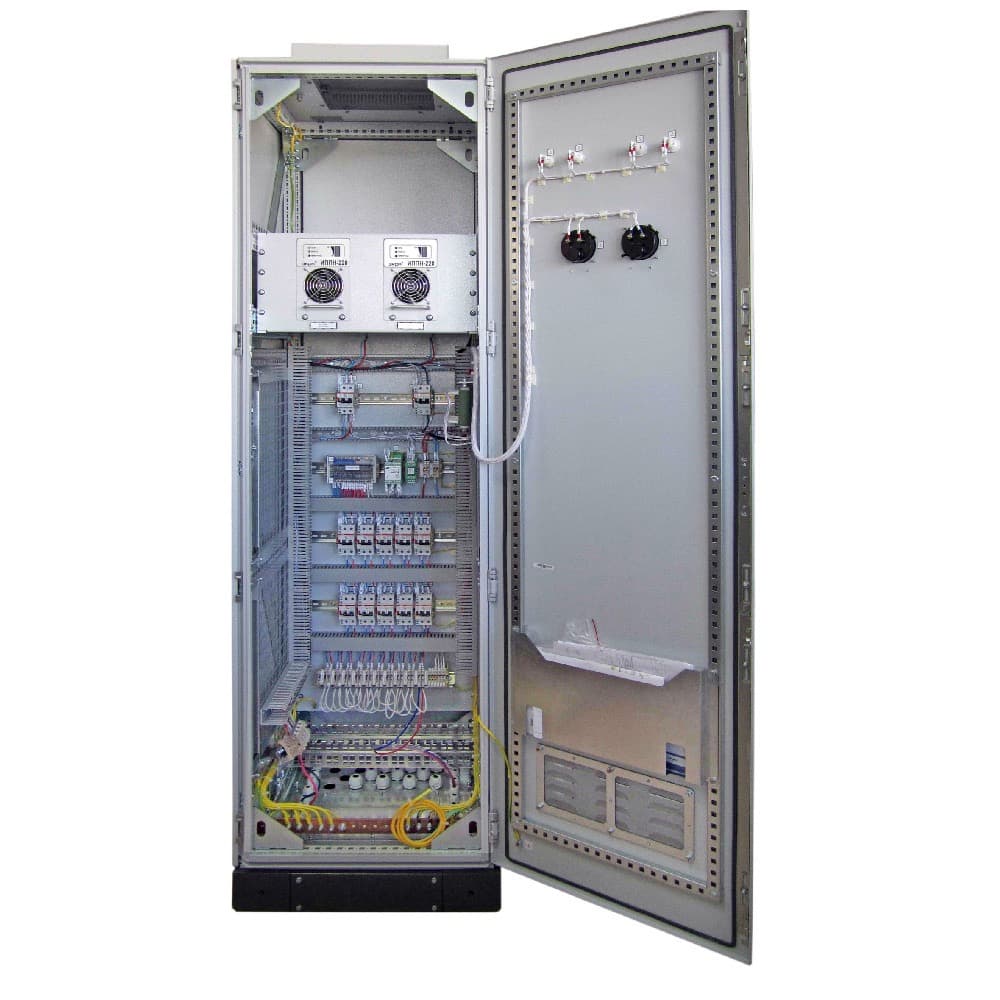
General information
Relay protection and automation cabinets (RPA)
Relay protection, automation, and signaling cabinets (hereinafter — relay protection and automation cabinets) are designed for implementing relay protection, automation, signaling, telemechanics, interlocking, and control circuits for switching apparatus of OPU of power facilities and technological processes at various industrial sites.
Depending on the implemented circuits, functions, configuration, design, layout, and the technical specification for manufacture (or inquiry sheet), relay protection and automation cabinets vary in purpose, design, and circuit configuration.
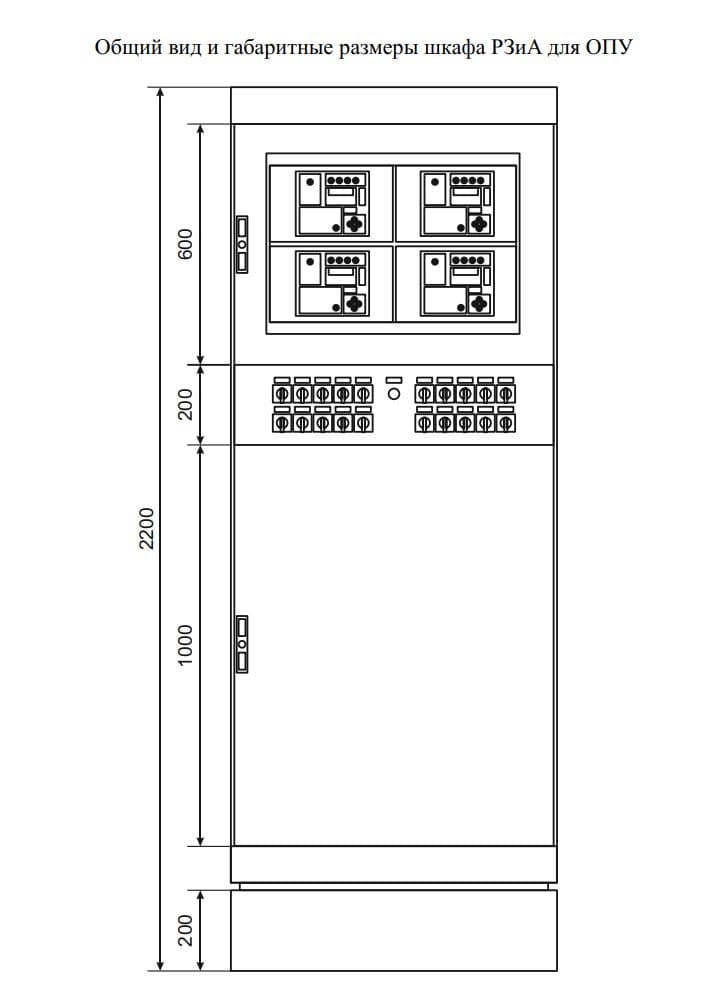
Overall dimensions of relay protection and automation cabinets
| Height, mm | 1600, 1800, 2000, 2200 |
|---|---|
| Width, mm | 600, 800 |
| Depth, mm | 400, 600, 800 |
Relay protection and automation cabinets are a metal structure with the circuit elements mounted on it. Design options:
- single-side or double-side maintenance access;
- indoor or outdoor installation — U(UHL)1, U(UHL)3;
- with heating of the cabinet or individual devices;
- floor-standing or wall-mounted design;
- open design (front degree of protection IP20) or protected design (degree of protection up to IP54).
On the front doors or false panel of the relay protection and automation cabinets (depending on the placement category), control and signaling equipment is located. Cable entry is provided through openings or cable glands in the bottom of the cabinet, or through cable glands at the top (on request).
Connection of relay protection and automation cabinets to external circuits is made via terminal blocks. Rows of contact terminals are designed for connecting one or two conductors with a total cross-section of up to 6 mm² inclusive.
Cabinets are fitted, on request, with digital or electromechanical relay protection and automation devices. Microprocessor-based units are programmed according to the operation logic in accordance with the circuits and technical specification.
The central signaling cabinet (hereinafter — ShTsS) is designed for use at substations, distribution points, and in switchgear equipped with digital or electromechanical relay protection and automation devices, in various branches of power engineering and industry. The ShTsS makes it possible to collect, process, visually display, and promptly transmit information on the status of the facility, generate summarized alarm signals, and quickly and conveniently reconfigure the signaling system.
ShTsS performs the following functions:
- reception and display of emergency alarm signals with repeat-action capability;
- reception of signals with a central time delay and repeat-action capability;
- reception and display of signals from individual sensors;
- transmission of information on changes in the state of signal contacts;
- issuing summarized alarm signals "Audible signal", "Sensor fault";
- event logging.
ShTsS can be manufactured on an electromechanical basis or according to the customer's circuits.
Relay protection and automation cabinets comply with the requirements of DSTU EN 61439-1, DSTU EN 60529:2018 (degree of protection IP).
The layout and configuration of relay protection and automation cabinets is carried out according to the customer's plans and diagrams. When placing an order, it is sufficient to provide a technical specification for manufacture or an inquiry sheet. In each specific case, a general arrangement drawing and an electrical schematic diagram of each relay protection and automation cabinet are sent to the customer for approval.
Non-standard NKP can be manufactured either as open panels (similar to standard NKP) or as cabinets. The front of a relay protection and automation cabinet may be closed with single-leaf doors with acrylic glass, providing visual monitoring of the equipment status with the doors closed. The rear of the cabinet is closed with double-leaf doors.
The degree of protection of relay protection and automation cabinets per DSTU EN 60529:2018 is IP20, IP21, IP41, and others upon customer request. Relay protection and automation cabinets are manufactured using both domestically produced and foreign-made structural components.
Diagram grid
Description and Purpose
RPA cabinets are secondary-circuit cabinets (relay protection, automation, signaling) for substations, distribution points and industrial facilities. The cabinet itself has no "voltage class" of its own: it is a 0.4 kV enclosure for control circuits that protects primary equipment of any voltage class (0.4–35 kV and above). The set of protection functions and settings is defined by the protection device/relay terminal inside — so the design is highly variable and built per project. The enclosure protection rating (IP20…IP54) is selected according to the installation site. Layout is strictly per your technical specification or questionnaire. LK Energy Group is a switchgear manufacturer based in Odesa, in business since 2005, with its own factory since 2015: in-house design documentation, assembly, and drawing/schematic approval for every cabinet.
Technical Data Sheet (PDF) ↓Questionnaire for Calculation →
The warranty for RPA cabinets is 2 years (extended to 5 years by agreement); enclosure metalwork — 10 years.
Find the right equipment for your site
Answer them and we will come back with a configuration and a ballpark price for your site.
FAQ
What voltage class does an RPA cabinet have?
What protection functions and settings can be implemented?
What is the enclosure protection rating (IP)?
Which relay terminals are the cabinets built on?
Do you make standard cabinets or only custom orders?
Price request:
Relay Protection and Automation (RPA) Cabinets
Send us your single-line diagram or specification — we will estimate the configuration, lead time and price. Preliminary estimate within 24 business hours.
+380 67 104 94 91