
Switchboard equipment: types and classification
Author: Sviatoslav Yurdyk, Quality Engineer at LK Energy Group.
He checks that the switchboard equipment of our own manufacture complies with DSTU EN IEC 61439 — from incoming inspection of components to the acceptance testing of finished products.
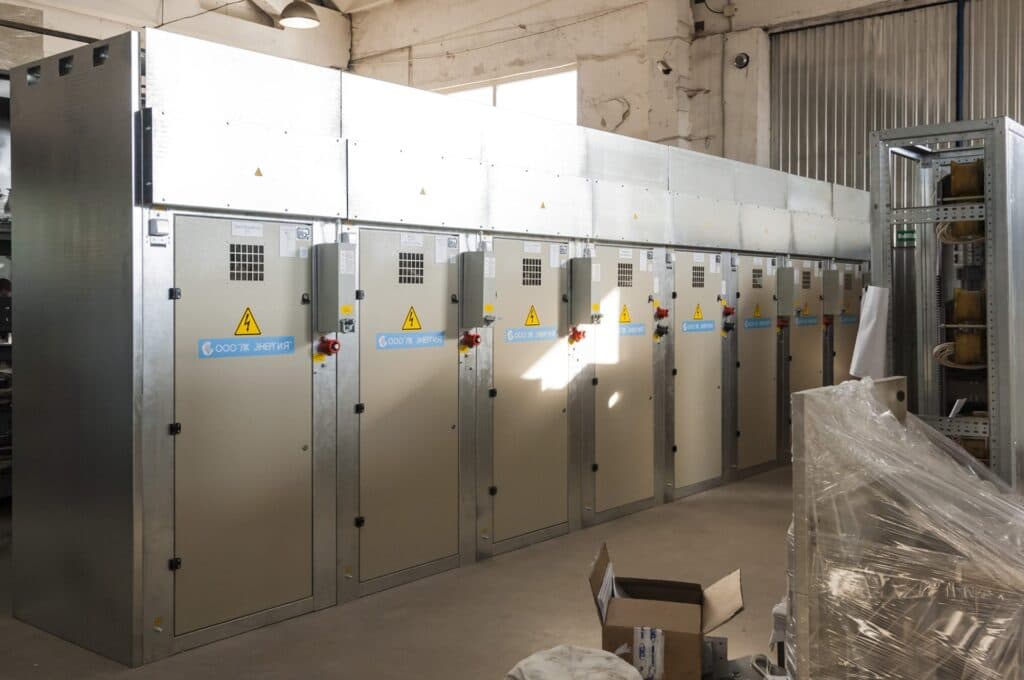
Switchboard equipment refers to assemblies in metal enclosures that receive, distribute and meter electricity, protect networks and consumers against fault conditions, and control electrical installations. This includes 0.4 kV distribution boards and cabinets, 6–10 kV cubicles and cells, package transformer substations, automation cabinets and reactive power compensation units. In this article we look at how this equipment is classified, how the types differ from one another and which criteria to choose it by.
What switchboard equipment is
Functionally, any switchboard is a node of the electrical network assembled at a factory into a finished structure: the enclosure, busbars, switching and protective devices, and the measuring, metering and control circuits. Instead of installing dozens of devices separately on site, the designer specifies a factory-built assembly, which the manufacturer assembles and tests at its own works.
In the standards, switchboard equipment falls into two large groups:
- NKU — low-voltage assemblies for voltages up to 1 kV (0.4 kV in distribution networks). The requirements are set by DSTU EN IEC 61439: temperature rise, withstand against short-circuit currents, clearances, and the degree of protection of the enclosure. These are ShchO-90 boards, RUNN, AVR and UKM cabinets, and incoming-metering boxes.
- KRP — package switchgear for medium voltage of 6–35 kV: KSO cubicles, KRU cells, distribution points. Package transformer substations gravitate to this same group by voltage, combining a high-voltage device, a power transformer and 0.4 kV switchgear in one unit.
Classification by voltage
The voltage class is the first and the main axis of classification, because it determines the design, the safety requirements and the range of manufacturers capable of building such equipment at all.
- 0.4 kV (up to 1 kV). The largest group — distribution boards and cabinets for buildings, production facilities and street networks: ShchO-90, RUNN, VRP, AVR, UKM, YaVU. The main parameters are the rated busbar current (from tens of amperes up to 4000–5000 A) and the short-time withstand current.
- 6–10 kV. Switchgear for substations and distribution points: KSO cubicles with fixed apparatus, KRU cells with withdrawable elements, package distribution points. This is where vacuum circuit breakers, instrument transformers and relay protection appear.
- 35 kV. Equipment for supplying large industrial sites and power facilities: KRU-35, KTPB 35/10(6) kV substations. Dimensions, insulation clearances and testing requirements are considerably stricter here.
Main types of switchboard equipment
KSO — single front-access switchgear cubicles
6–10 kV switchgear with fixed-mounted apparatus: load-break switches, vacuum circuit breakers, disconnectors, voltage transformers. They are serviced from the front, so they are placed against a wall and save floor space. Typical use — distribution points and substations of distribution networks. An example — KSO-E cubicles.
KRU — package switchgear with withdrawable elements
6–10 kV cells with a withdrawable element: the circuit breaker is mounted on a truck that is rolled out of the cell for repair or inspection without dismantling the busbars. This means faster replacement of the apparatus and a higher level of personnel safety, which is why KRU is chosen for critical sites where downtime must be kept to a minimum. For outdoor installation there is the KRUN version.
KTP — package transformer substations
A ready-made substation “in a single product”: the 6–10 kV high-voltage device, the power transformer and the 0.4 kV switchgear. Versions — indoor, outdoor kiosk-type, pole-mounted and concrete (BKTP). KTP 10(6)/0.4 kV — the standard solution for supplying a single building, production facility or site.
RP — distribution points
A 6–10 kV network node that takes the supply from a feeding centre and distributes it across lines without transformation. It is assembled from KSO cubicles or KRU cells with sectionalising and relay protection. The factory-built version is package switchgear in a block enclosure.
ShchO-90 — distribution switchboard panels
The classic of 0.4 kV switchgear: single front-access panels from which a board of the required configuration is assembled — incoming, outgoing, sectionalising, and panels with AVR equipment. ShchO-90 panels are made for currents up to 4000 A and are used in substation RUNN units and in the main boards of buildings.
AVR — automatic transfer switching cabinets
Automation that transfers the load to a backup feed or a generator when voltage disappears on the main incomer. AVR cabinets are mandatory for consumers of reliability categories I and II — where an interruption of supply is not acceptable.
UKM — reactive power compensation units
Capacitor units that maintain the specified cos φ and reduce the charge for reactive energy flows. UKM units are installed at enterprises with motor loads; the controller automatically switches capacitor steps in as the load changes.
YaVU — incoming-metering boxes
Compact enclosures with an incoming device and a place for a meter to measure the electricity of an individual consumer — a house, a workshop, a small facility. YaVU is the most widespread “small” member of the 0.4 kV switchboard family.
Worth a separate mention are RUNN cabinets — low-voltage switchgear within a KTP that receives 0.4 kV from the transformer and distributes it across the outgoing lines.
Summary table of types
| Type | Voltage | Purpose |
|---|---|---|
| KSO | 6–10 kV | Switchgear with fixed apparatus, serviced from the front |
| KRU / KRUN | 6–10 (35) kV | Switchgear with withdrawable circuit breakers for critical sites |
| KTP / BKTP | 6–10(35)/0.4 kV | Package substation: intake, transformation and distribution |
| RP (KRP) | 6–10 kV | Distribution of power across network lines without transformation |
| ShchO-90 | 0.4 kV | Distribution switchboard panels up to 4000 A for RUNN units and main boards |
| RUNN | 0.4 kV | Low-voltage switchgear within a KTP |
| AVR | 0.4 kV | Automatic transfer to the backup supply |
| UKM | 0.4 kV | Reactive power compensation, maintaining cos φ |
| YaVU | 0.4 kV | Incoming supply and metering for an individual consumer |
How to choose switchboard equipment
In practice the choice comes down to three successive questions.
- Voltage. A 0.4 kV connection point — choose among the NKU family (ShchO-90, VRP, AVR, YaVU). A connection at 6–10 kV — KSO or KRU are needed, and if transformation down to 0.4 kV is also required, then a KTP. For 35 kV there is a separate class of equipment.
- Current and short-circuit withstand. The rated current of the busbars and of the incoming devices is chosen from the calculated load with a margin for growth, while the short-circuit withstand is chosen from the calculation of short-circuit currents at the point of installation. These are exactly the parameters confirmed by type testing to DSTU EN IEC 61439.
- Purpose and conditions. Distribution, metering, backup or compensation — each task has its own type in the table above. Next come the degree of protection of the enclosure (IP31 for dry rooms, IP54 and above for outdoors and dusty workshops), the method of installation (indoor/outdoor), the main circuit diagram and the single-line diagram from the design.
For non-standard tasks — unusual dimensions, combined functions, fitting into an existing room — there is only one right way: give the manufacturer the single-line diagram and the questionnaire sheet rather than forcing the design to fit a catalogue item.
Manufacturing or resale: why it matters
Both manufacturers and intermediaries reselling other companies’ products operate on the switchboard equipment market. For the customer the difference is practical:
- Responsibility for the product. The manufacturer sources the components, assembles and tests the board itself, issues the data sheet and carries the warranty obligations without intermediate links.
- Non-standard solutions. Only a company with its own design office and workshop can change dimensions, a circuit or a layout — an intermediary sells only what is in the catalogue.
- Timelines and price. Without an intermediary’s mark-up and with in-house metal cutting, timelines and cost stay under control.
LK Energy Group manufactures 0.4–35 kV switchboard equipment at its own plant in Odesa: metal cutting and bending, powder coating, assembly and acceptance testing of every product — within a single production cycle.
Frequently asked questions
How does an NKU differ from a KRP?
By voltage class and by the applicable standards. NKU are assemblies up to 1 kV, with requirements set by DSTU EN IEC 61439. KRP are medium-voltage switchgear for 6–35 kV, with different requirements for insulation, switching apparatus and testing.
Which to choose for a substation: KSO or KRU?
For typical distribution networks, where a planned outage for maintenance is acceptable, KSO is usually enough — they are more compact and cheaper. KRU with withdrawable elements is chosen where the time to replace a circuit breaker is critical and a higher level of work safety is needed: critical industrial sites and feeding centres.
Can a board be ordered to a custom diagram?
Yes. The standard types (ShchO-90, KSO, KTP) are the structural base, while the internals are assembled to the single-line diagram of the specific project: the set of devices, ratings, sectionalising, metering. To place an order, a single-line diagram or a completed questionnaire sheet is enough.
LK Energy Group is a manufacturer of 0.4–35 kV switchboard equipment: KSO, KRU, KTP, ShchO-90, AVR, UKM. The full catalogue with specifications is in the “Equipment” section. About the plant’s manufacturing capabilities — on the service page “Manufacture of switchboard equipment”. Send us a single-line diagram or a questionnaire sheet and we will price the product for your project.
See also
Need an engineer’s advice?
Have a task involving power supply, switchgear or solar plants — write to us and we’ll answer to the point.
+380 67 104 94 91