
Grid connection project: technical conditions, documents, stages
Author: Volodymyr Ledok, Production Technical Director at LK Energy Group.
He oversees the technical side of power supply projects and the manufacturing of LK Energy switchboard equipment — NKU, KRU, KSO and KTP units. Connection projects pass through his hands twice: first as a single-line diagram, then as the finished board or KTP assembled at the plant in Odesa.
A grid connection project is the set of technical documentation developed to fulfil the technical conditions issued by the distribution system operator (DSO), and under which a site is physically and legally connected to the electricity networks: from the connection point to the incoming board and on to the consumers. Without it the DSO will not approve the external networks and will not energise the connection. The connection procedure is set by the Distribution System Code (NEURC resolution No. 310 of 14.03.2018, as amended — in particular by the amendments that took effect on 1 January 2026). Below is the whole path from application to energisation.
What connection is and when it is needed
Connection is a service of the DSO (your regional utility) that creates the possibility of supplying a site from the public networks. Typical cases:
- a new site — a house, a shop, a service station or a workshop that does not yet have an incoming supply;
- an increase in capacity — the existing incomer is no longer enough: equipment has been added, heat pumps or charging stations installed;
- a change to the supply scheme — a higher reliability category (a second incomer), a change of connection point or of voltage class;
- connection of generation — a solar plant or other generating installation operating in parallel with the grid.
One nuance: if you change equipment inside the site without exceeding the capacity already permitted, a new connection service is usually not required — a proper internal design is enough.
The steps of connection: how it works
Step 1. Application to the DSO. The customer submits an application for connection — in person at a service centre or through the operator’s online account. Already at this point the requested capacity and the reliability category have to be determined correctly — the cost and the whole subsequent scheme depend on these figures.
Step 2. The connection contract and the technical conditions (TU). The DSO prepares a draft connection contract, with the technical conditions as an integral annex. The TU set out the capacity supply point, the connection point, the amount of capacity, the voltage level, the reliability category and the requirements for the metering point. The TU are at the same time part of the design brief: the project is developed to meet them.
Step 3. The design. Documentation is developed for the external power supply (from the supply point to the connection point) and the internal one (from the connection point to the consumers): the load calculation, the single-line diagram, cables and protective devices, the metering point and, where required, a KTP or switchgear. Who designs the external part depends on the type of connection — see below.
Step 4. Approval. The external power supply design is approved by the DSO for compliance with the technical conditions. This is usually where “paper” designs get stuck.
Step 5. Construction and installation works. The external networks are built (a line and, where required, a substation) and the internal installation is carried out: the incoming device, the boards and the site’s distribution networks.
Step 6. Putting into operation. The commercial metering point is installed, the electrical installation passes inspection and clearance, contracts with the consumer are concluded — and the DSO energises the connection point.
| Stage | What the customer does | What the DSO does |
|---|---|---|
| Application | Submits the application with documents, determines the capacity and the reliability category | Registers the request, checks that it is complete |
| Contract + TU | Signs the contract, pays the connection charge | Prepares the connection contract and issues the technical conditions |
| Design | Orders the internal power supply design; for a non-standard connection may also order the external network design | For a standard connection, arranges the design of the external networks itself; approves the design documentation |
| Construction | Builds the internal networks from the connection point (boards, cables, metering) | Arranges construction of the networks up to the connection point |
| Energisation | Prepares the installation for inspection, concludes supply contracts | Installs and seals the metering, grants clearance and energises the connection |
Standard or non-standard connection: what the difference is
The Distribution System Code divides connections into two types, and both the cost and the extent of your involvement depend on this.
A standard connection applies to electrical installations (other than generating ones) with a capacity of up to and including 50 kW, where the distance from the connection point to the nearest point of the DSO’s existing networks of the relevant voltage class does not exceed 300 metres in a straight line. The charge follows fixed rates approved annually by NEURC for each operator. The main advantage for the customer: all the works from the supply point to the connection point — the design and construction of the external networks — are carried out by the DSO itself on a turnkey basis. The customer is left with the internal part.
On 1 January 2026 the updated provisions of the Code on standard connection took effect: it is carried out under the third reliability category and is structured into four capacity steps with fixed values of requested capacity and corresponding ratings of the incoming devices. The minimum level for a standard connection is now 5 kW; if the customer states an intermediate value, the operator selects the next higher one from the scale. So before applying it is worth checking the current scale — so that the requested capacity both covers your needs and does not make you overpay.
A non-standard connection is everything that does not fit the criteria of a standard one: capacity above 50 kW, a distance over 300 m, the first or second reliability category, and also any connection of generating installations — solar plants are not connected under the standard procedure. Here the cost is determined by calculation, and the customer has a choice: entrust the design of the external networks to the operator or order it independently from a design organisation to fulfil the TU. For a business the second option is often more advantageous — a good design makes it possible to optimise the route, choose appropriate equipment and avoid paying for anything unnecessary.
What documents are needed for the application
The exact list is set by the Distribution System Code and by the forms of the particular DSO, but the basic set looks like this:
- an application for connection on the operator’s form;
- documents confirming ownership or use of the site or the land plot (or a copy of the urban planning conditions and restrictions for new construction);
- a site plan showing the location of the facility and the desired connection point;
- for individuals — a passport and taxpayer registration number; for legal entities — the company’s registration details;
- a power of attorney if the documents are submitted by a representative.
For non-standard connections and for generation the operator may request additional materials. It is better to check the list with your regional utility before submitting: an incomplete application is the most banal reason for lost time.
The designer’s role: where they save you money
Formally the designer appears at step 3. In practice it is worth involving them before the application is submitted, and here is why.
Calculating the capacity before the application. The requested capacity is the key figure of the whole procedure. Understate it and you will go through the connection process again; overstate it and you pay for surplus kilowatts straight away. An engineer calculates the load to the standards rather than by eye.
A design that is approved first time. The DSO checks the design for compliance with the TU and the Code. A designer who works with these requirements daily builds them in from the start — without cycles of “comments — revision”.
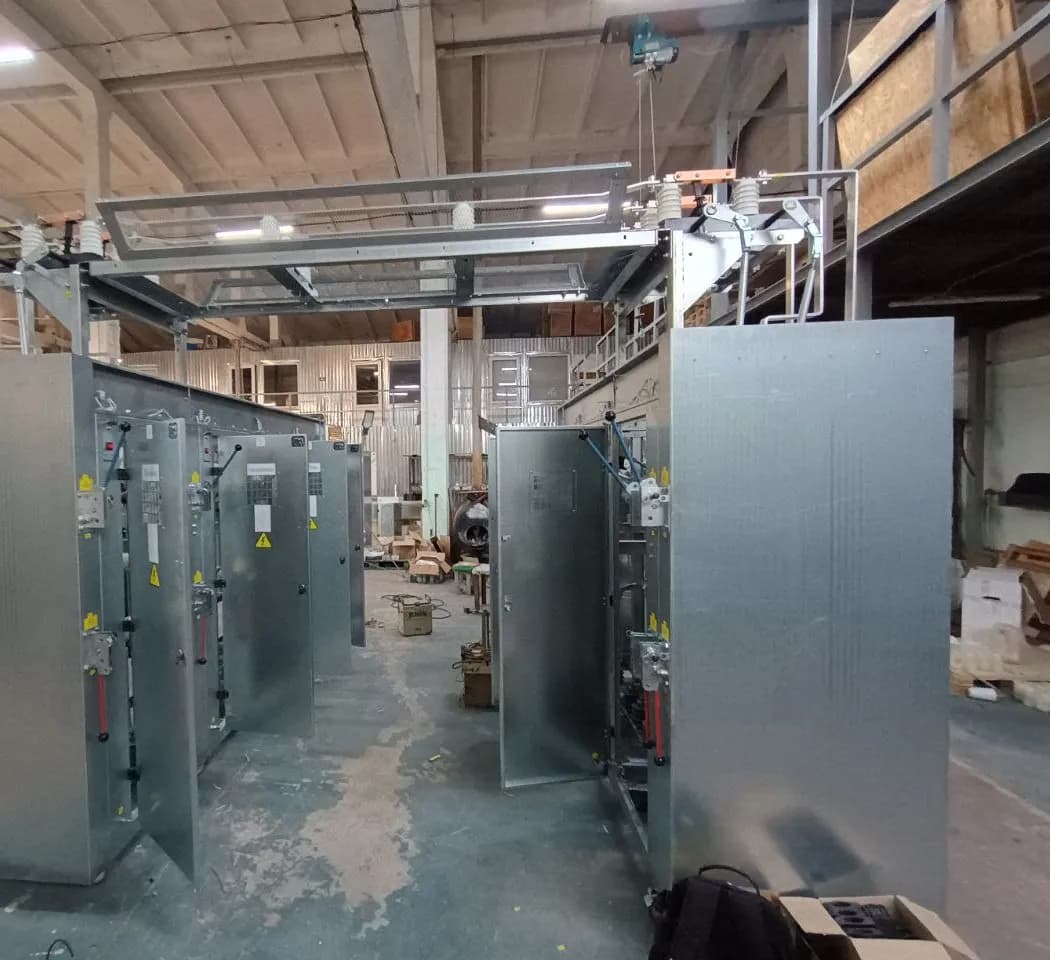
Linking the design to the hardware. At LK Energy the connection design is not divorced from delivery: the single-line diagram is immediately checked for buildability, and the incoming-distribution devices, metering boards or KTP units are then assembled to it at our own plant in Odesa. This removes the classic problem where the design specifies equipment that is not available, or a layout that physically cannot be assembled.
Support all the way to energisation. A design is complete not when the album is printed, but when the approvals are through, the metering is cleared and there is electricity on site.
Frequently asked questions
How much does connection to the grid cost?
For a standard connection there are fixed charge rates, which NEURC approves annually for each distribution system operator separately — the current values are on the website of your regional utility and on the regulator’s website. For a non-standard connection the cost is determined by calculation and depends on the scope of network construction — so the quality of the design decisions has a direct effect on the amount.
Can a solar plant be connected under the standard procedure?
No. Standard connection applies to electrical installations intended for consumption — generating installations are connected under the non-standard connection procedure regardless of capacity. A separate case is generation within your own networks and within the capacity already permitted for the site: under certain conditions it does not require a separate connection service at all, but this has to be checked for the specific site against the current wording of the rules.
How long does connection take?
The Distribution System Code sets statutory time limits for each stage — from issuing the contract with the TU to the operator completing the works — and they depend on the type of connection, the capacity and the scope of network construction. In practice the overall time depends most on two things: how quickly the design is developed and approved, and whether new networks and substations have to be built. A properly prepared application and a design with no comments are the most effective way to shorten it.
Need to obtain technical conditions and get through the connection process without stalling on approvals? Take a look at how our service is set up: connecting projects to the electricity networks at LK Energy. We will calculate the capacity before the application is submitted, develop the design and get it approved by the DSO, and assemble the boards, metering points or KTP units for it at our own plant in Odesa.
See also
Need an engineer’s advice?
Have a task involving power supply, switchgear or solar plants — write to us and we’ll answer to the point.
+380 67 104 94 91