
Why an inverter and batteries will not run a pump directly: anatomy of a complete cabinet
Author: Volodymyr Ledok, technical director for manufacturing at LK Energy Group.
Responsible for switchgear manufacturing — LV assemblies, MV switchgear, ATS and control cabinets. Selecting and matching the equipment inside the cabinet to the specific motor is part of the factory build.
Short answer (for those in a hurry)
"I will buy an inverter and batteries and wire them to the pump" looks cheaper right up to the moment the system fails to start. Three things break it on a real site:
- Inrush current. On a direct start the pump draws a multiple of its rated current — the inverter trips instead of starting the pump. A soft starter or a VFD has to sit between them.
- Frost. Lithium batteries must not be charged below 0 °C — the BMS blocks charging. An uninsulated box in winter means a battery with no charge and zero reserve exactly when blackouts are most likely.
- The generator. It is connected to the inverter, not to the pump. The inverter is the brain of the cascade: sun → batteries → generator, switching automatically with nobody on site.
Hence the conclusion: this is not a shopping basket but an engineered system, where every component is matched to the one next to it. Below — point by point.
1. A pump is not wired straight into an inverter
On a direct-on-line start a submersible pump draws 5 to 7 times its rated current. A hybrid inverter holds 2–3 times rated current for short periods — so a direct start is either cut off by protection or handled right at the limit, with voltage dips and restarts.
That is why a starting device is mandatory in the chain:
- up to and including 11 kW — a soft starter, limiting inrush to roughly 2.5–3 times rated current (going lower is not an option: the pump will not break away against head);
- above 11 kW, and anywhere pressure has to be regulated — a variable frequency drive: it ramps the pump up from a low frequency within rated current, so there is practically no start-up event at all.
But the starting device alone does not close the issue. Even a softened inrush of 2.5–3 times rated current fits the inverter's capability only when the inverter is sized with headroom for that particular pump. In a blackout the inverter has to start the pump on its own, with no grid behind it — and that is the moment when an inverter "saved on" in rating turns the whole system into a non-starter.
What this means in practice: inverter, starting device and pump are selected together, by one pair of hands, rather than bought as three separate decisions.
2. Lithium batteries simply switch off in frost
This is the most common and most expensive mistake of an assembled-from-boxes system: the batteries go into an ordinary outdoor steel enclosure.
Lithium must not be charged below freezing. Charging LiFePO4 below 0 °C causes metallic lithium plating on the anode — capacity is lost irreversibly, and the damage accumulates with every cycle. So a functioning BMS in frost simply blocks charging. It does not warn — it blocks.
The consequence for a borehole: in winter, when a blackout is most likely, an uninsulated box leaves you with a flat battery and zero reserve. The sun is shining, the inverter is running, and no charge is going in.
That is why heating in our cabinet is a functional requirement, not a comfort feature. The construction that delivers it:
- a 50 mm sandwich panel wall — the cabinet holds heat rather than "heating the outdoors";
- thermostatically controlled heating — switched by temperature, not running permanently;
- ventilation — in summer it keeps the lithium from overheating (overheating shortens service life just as effectively);
- temperature sensors that all of this is controlled by.
The cost is modest and is built into the calculation: in deep frost the heating draws on the order of 1–2 kWh per day — against the battery capacity we size for the site. Insulation eats single-digit percentages of the reserve; without it there is no reserve at all.
3. The generator connects to the inverter, not to the pump
The classic rural arrangement — "someone brought a generator and ran a cable to the pump" — has three flaws: somebody has to drive out and start it, the generator has to be deliberately oversized (to swallow the inrush), and it runs at part load, burning fuel inefficiently.
In a complete system the generator is connected to the inverter's AC input. From there the logic is:
- the inverter decides when to start it. Hybrid inverters provide a dry-contact output for auto-start: the generator starts at a configured battery state of charge, not when a resident phones in;
- the pump start stays soft. The pump is started through its own soft starter or VFD from the inverter — the generator never has to swallow the inrush;
- the inverter supports the generator. In support mode the inverter adds power from the batteries to the generator's output — so the same job usually needs a smaller genset;
- the generator also charges the batteries while it runs, rather than just turning the pump.
This is how the inverter becomes the brain of the cascade: sun → batteries → (tower reserve) → generator. Switching is automatic, with no human involvement, and the dispatcher sees the transfer to backup on the VodoZir panel.
The honest limit here is the same one stated on the main solution page: the generator is the last line of defence, and without it the system will not cover multi-day winter cloud cover indefinitely. We do not promise that it will.
4. Anatomy of the cabinet: what is inside and why
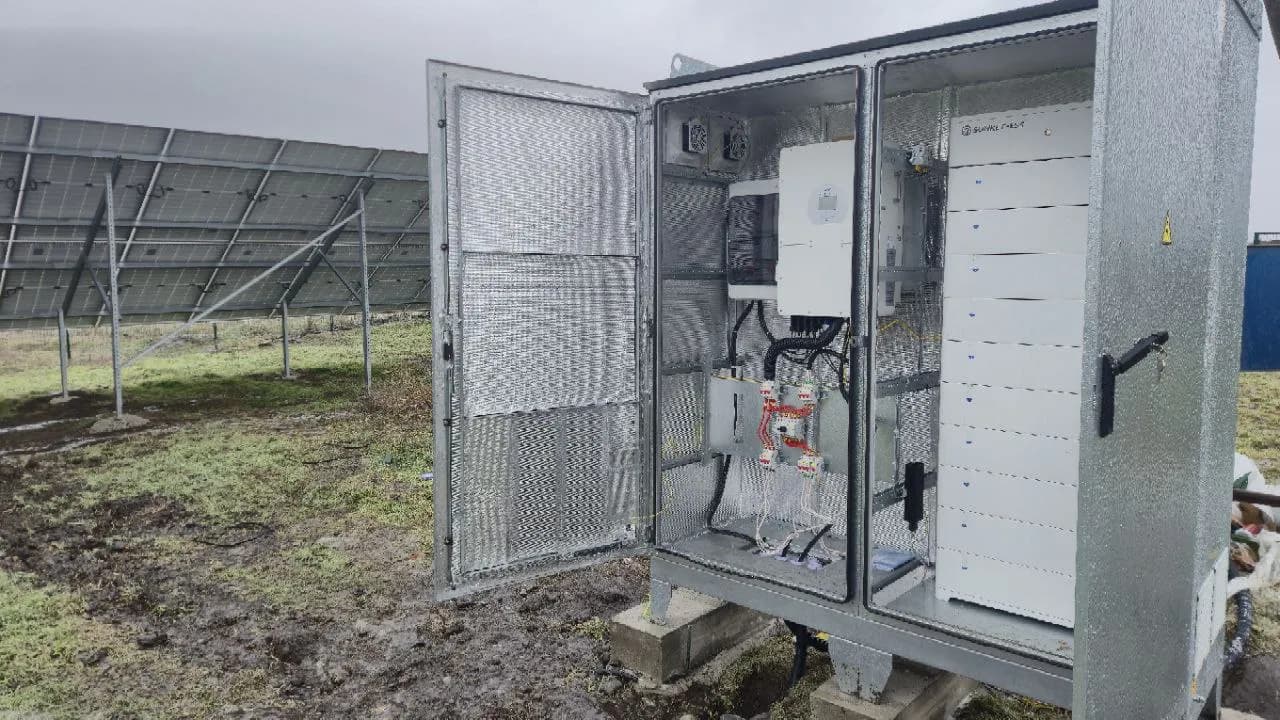
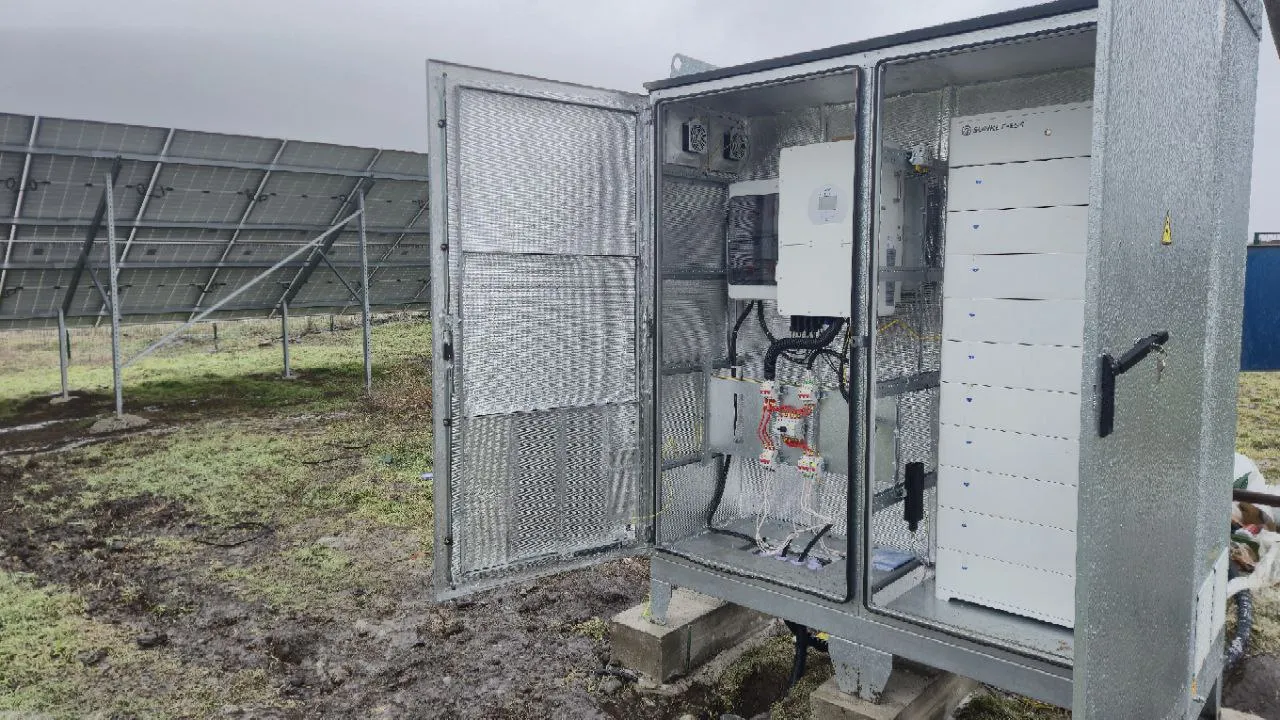
Now let us put it all in one box. Here is what goes into an insulated vandal-resistant cabinet of our own manufacture, and the job each component does:
| Component | Why it is there |
|---|---|
| Hybrid inverter | The brain of the system: runs on solar, grid and batteries, manages the cascade and the generator auto-start |
| Lithium batteries (LiFePO4) | Reserve sized for at least 4 hours of operation of that specific pump |
| Soft starter or VFD | Up to and including 11 kW — soft starter; above 11 kW, or where pressure must be held — VFD |
| VodoZir remote monitoring unit | Meter readings, alarms, tank level, pump scheduling around the solar window |
| Climate control: heating + ventilation + sensors | Keeps the batteries in their working temperature window all year round |
| Enclosure: 50 mm sandwich panel, vandal-resistant | The site stands unattended in an open field |
| Intrusion alarm | Unauthorised access reported to the same dispatch panel |
Together this is what we call "the plant room in a single cabinet": no building work is needed on site to house the equipment.
5. Why this has to be one product rather than a shopping basket
Every component can be bought separately. The question is who calculates them together. What has to be matched:
- inverter rating against the inrush of that specific pump — otherwise the system does not start in a blackout;
- battery capacity for 4 hours of that pump — rather than "whatever fitted the budget";
- the cabinet's thermal balance — the inverter and the drive give off heat, the batteries need warmth in winter and cooling in summer; that is one calculation, not three;
- output filter and cable run to the submersible motor if a VFD is fitted;
- the backup logic — the sun → batteries → generator sequence has to be configured, not left to chance.
And above all — accountability. When a package is assembled from five boxes from five suppliers, any failure turns into an argument about whose component is at fault. When the cabinet is a product from one factory, the question has one address.
We build these cabinets ourselves: electrical installation since 2005, in-house switchgear manufacturing since 2015 — more than 3,000 units produced.
FAQ
Can a pump be connected directly to a hybrid inverter?
The terminals exist; in practice, no. The pump's inrush is 5–7 times rated current while the inverter holds 2–3 times rated for short periods. A soft starter (up to and including 11 kW) or a VFD (above 11 kW, or where pressure must be regulated) is needed in between, and the inverter itself must be sized with headroom for the start.
Why can't the batteries go in an ordinary outdoor enclosure?
Because lithium must not be charged below 0 °C — in frost the BMS blocks charging and you are left without reserve in winter. An insulated enclosure with thermostatically controlled heating and ventilation is required.
How much electricity does cabinet heating consume?
In deep frost, on the order of 1–2 kWh per day, against battery capacity in typical packages. This is accounted for when sizing the batteries.
How is the generator connected?
To the inverter's AC input, with auto-start based on battery state of charge. The inverter can support the generator with battery power, so a smaller genset is usually sufficient, and the pump still starts softly through its own starting device.
Could the same thing be assembled from separate components?
It could. But then you take on the inverter sizing for the start, the capacity calculation, the cabinet's thermal balance, the filters on the cable run, the backup logic — and responsibility for every interface between them.
Where to start
Send us three figures — pump rating, borehole depth and annual consumption — and we will size the package: inverter for the start, battery capacity for 4 hours, the type of starting device and the cabinet configuration. Free of charge.
👉 All-in-one insulated cabinet — composition, build, dimensions. 👉 Solar plants for artesian boreholes with remote monitoring — the full system, savings calculations and a month-by-month balance.
See also: VFD or soft starter for a borehole pump · The Rozhnovsky water tower: how much energy it stores.
See also
Need an engineer’s advice?
Have a task involving power supply, switchgear or solar plants — write to us and we’ll answer to the point.
+380 67 104 94 91