
Author: Volodymyr Ledok, Production Technical Director at LK Energy Group.
He is responsible for manufacturing switchboard equipment — the assembly and quality control of KRU, KRUN, KSO and NKU units and busbars. Every KRUN undergoes factory assembly, setting-up and checking before it is shipped to site.
What KRUN is
KRUN (outdoor package switchgear) is switchgear for 6–10 kV (individual series go up to 35 kV) that is fully assembled at the factory in an insulated metal enclosure and is designed to operate in the open air — with no building and no separate room. The letter “N” in the name stands for outdoor installation: unlike ordinary KRU, which needs an enclosed electrical room, a KRUN is delivered to site as a finished block, placed on a foundation and connected up — and the unit works in the open air at any time of year.
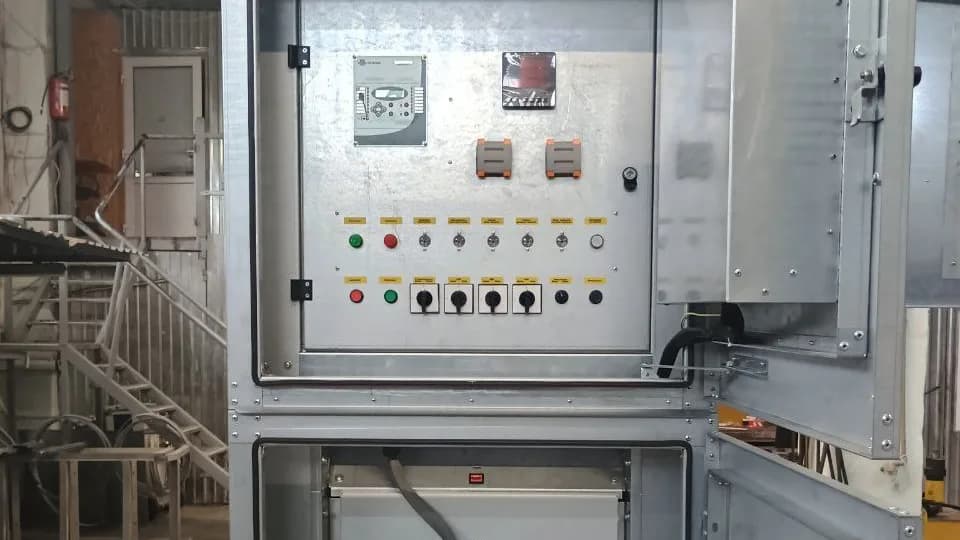
Inside the enclosure are the same functional elements as in “indoor” switchgear: cubicles with switching apparatus, busbars, current and voltage transformers, relay protection and automation devices, and metering circuits. The difference is in the enclosure and the climatic version.
KRUN vs KRU: outdoor against indoor installation
KRU and KRUN are close relatives: both are factory-built package switchgear. There is one fundamental difference — where the unit will stand. KRU is designed for installation inside a building (climatic version U3): its cubicles are not rated for rain, snow, condensation and temperature swings. KRUN is for an open site (climatic version U1): the cubicles are protected by a sealed insulated enclosure with heating, lighting and, depending on the version, a maintenance corridor.
| Parameter | KRU | KRUN |
|---|---|---|
| Place of installation | An enclosed electrical room (building, substation) | An open site, in the open air |
| Climatic version | U3 | U1 (approximately from −45 to +40 °C) |
| Enclosure | The cubicle enclosure; the building protects against precipitation | Its own insulated sealed enclosure |
| Heating | Local (where required, in the drives and relay compartments) | Mandatory: anti-condensation heating of the enclosure and the apparatus |
| Civil works | A building or a room is required | Only a foundation (frame, piles or slab) |
| Installation on site | Installing the cubicles in the room, joining the busbars | Placing the finished block, connecting the cables |
| Typical voltage | 6–10 kV | 6–10 kV (individual series — 35 kV) |
The practical consequence of this difference is cost and time. A KRUN does not require a switchgear building to be erected: instead of a permanent structure there is a foundation and a ready-made factory block. On sites where a separate building is not envisaged or is not worth the money, this reduces both the civil works budget and the time to energisation.
Design and configuration
A typical KRUN is a metal block module (one or several, joined together on site) with the cubicles installed inside. The main components are:
- Enclosure
- A welded or bolted metal frame with insulated panels, a sloping roof to shed precipitation, lockable doors and ventilation louvres. The enclosure protects the apparatus from rain, snow, dust and solar radiation.
- 6–10 kV cubicles
- Incomers, outgoing lines, a section circuit breaker and disconnector, and cubicles for voltage and auxiliary transformers. The main circuit diagram is assembled from standard cubicles to the single-line diagram of the specific site.
- Switching apparatus
- In modern KRUN units the main apparatus is a vacuum circuit breaker on a withdrawable element: it needs no oil maintenance, has a long switching life and works reliably at low temperatures. It is complemented by disconnectors, earthing switches and fuses in the voltage transformer circuits.
- Relay protection and metering
- Microprocessor relay protection terminals (overcurrent protection, instantaneous overcurrent trip, earth-fault protection and so on), current and voltage transformers, and commercial metering meters. To the customer’s specification — telemechanics and data transmission to the control centre.
- Heating and the internal climate
- Automatic electric heating is a mandatory element specifically of outdoor installation: it prevents condensation forming on the insulation and the apparatus when the temperature changes. In addition there is lighting, heating of the drives and relay cabinets and, where required, a maintenance corridor so that personnel work with the apparatus in a space sheltered from precipitation.
What to consider when choosing: not just “outdoors or indoors”
The choice between KRU and KRUN is not always obvious, so at the design stage it is worth going through several questions. First, maintenance: if personnel will work with the apparatus regularly, a version with a maintenance corridor makes sense for outdoor installation, so that switching operations and inspections do not depend on the weather. Second, transport: a KRUN travels to site as an oversized block, so long schemes with many cubicles are divided into transport modules that are joined on the foundation. Third, the environment: for sites with a chemically aggressive atmosphere or high dust levels, the design of the enclosure and the ventilation is agreed separately. These are all standard questions in the questionnaire sheet, which the manufacturer settles before the unit goes into production.
Where KRUN units are used
A KRUN makes sense anywhere 6–10 kV switchgear is needed but building a separate room for it is not worthwhile:
- Solar power plants
- The power collection point of an industrial solar plant: the outgoing lines from the inverter substation blocks are collected in the KRUN, from where the plant is connected to the grid. There is usually no building on a solar plant field site — outdoor installation is the natural solution here.
- Distribution and transformer substations
- The 6–10 kV switchgear of open 35–110 kV substations, the reconstruction of existing substations without building new structures, and line sectionalising points.
- Industry and infrastructure
- Supplies for pumping and compressor stations, quarries, grain elevators, construction sites and other facilities where the load is spread across the territory and there is no electrical room.
Manufactured to the project
A KRUN is not a boxed product off the shelf: the main circuit diagram, the number and purpose of the cubicles, the protection settings, the metering, the telemechanics and even the dimensions of the enclosure are determined by the design of the specific site. The proper way to order therefore starts from the single-line diagram: the manufacturer selects the cubicles to match it, assembles and tests the unit at the factory, and a finished block arrives on site that only has to be placed and connected.
LK Energy manufactures KRUN units of the KRUN-E series at its own production facility in Odesa: assembly of the enclosure, installation of cubicles with vacuum circuit breakers, secondary circuit and relay protection diagrams to the customer’s specification, and factory setting-up and checking before shipment. The design department adapts the unit to the single-line diagram of the project — from the standard version to non-standard layouts.
Frequently asked questions
How does a KRUN differ from a KRU?
By the place of installation. KRU is intended for an enclosed electrical room (climatic version U3), KRUN for operation in the open air (U1): its cubicles are installed in an insulated sealed enclosure with heating, and it needs no separate building.
What voltages are KRUN units made for?
The main classes are 6 and 10 kV; there are also outdoor series for 35 kV. The specific diagram and the rated currents are determined by the design of the site.
Is a building needed to install a KRUN?
No — that is the whole point of outdoor installation: a KRUN is placed on a prepared foundation (a frame, piles or a slab) in the open air. The civil works come down to the foundation and the cable entries.
LK Energy Group manufactures KRUN-E outdoor package switchgear to the single-line diagram of your project — with vacuum circuit breakers, relay protection and factory setting-up. Send us a single-line diagram or a questionnaire sheet — get in touch and we will price the configuration.
See also
Need an engineer’s advice?
Have a task involving power supply, switchgear or solar plants — write to us and we’ll answer to the point.
+380 67 104 94 91