
Why a solar field exceeds the grid injection point: sizing storage on a 4.95 MW plant
The task you cannot see on the datasheet
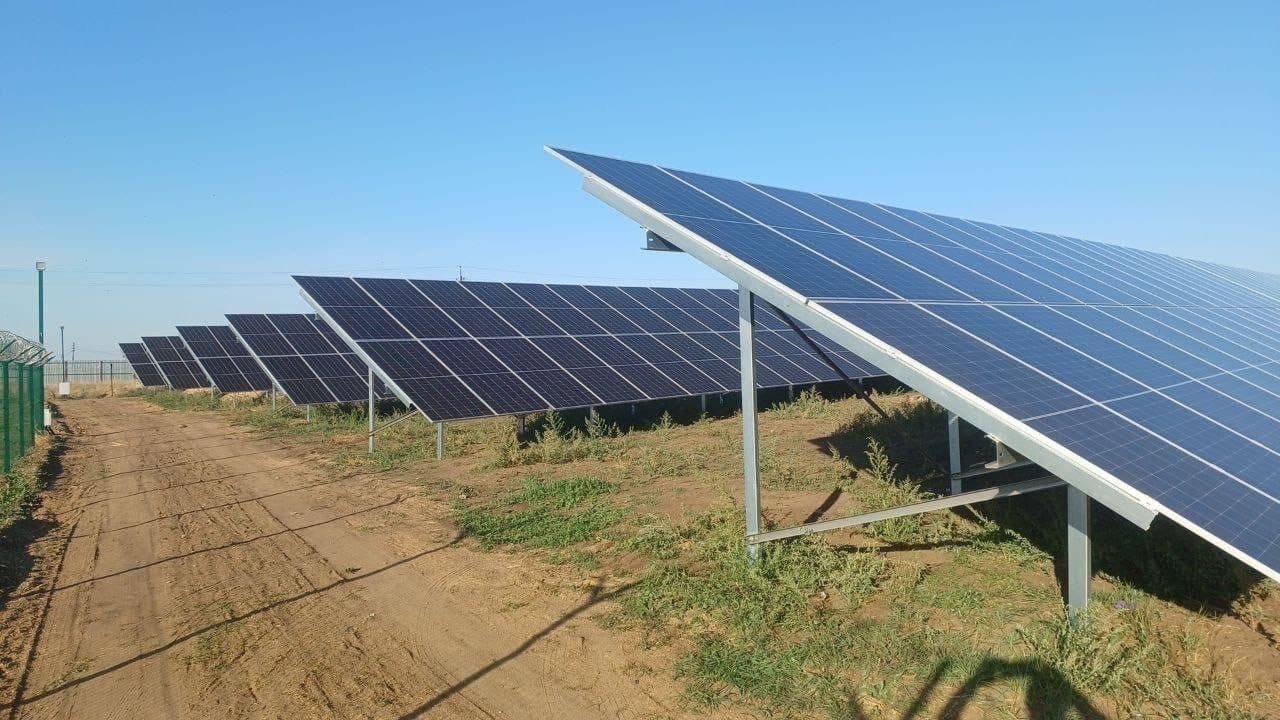
At an industrial solar plant in the Odesa region the grid injection point is 4.95 MW: that is 45 inverters of 110 kW each, plus two spares. The field beneath them is 10,200 modules totalling 6.48 MW. The one-and-a-half megawatt gap looks like a designer’s mistake: why pay for modules whose energy the grid physically will not take?
It is not a mistake. It is a deliberate decision, and this article walks through how it was calculated.
First, two things not to confuse
Clipping is an internal limit of the plant. An inverter has its own AC ceiling. When the modules at clear midday deliver more than the inverter can convert, the surplus simply is not converted. It is a property of the equipment set, known at the design stage.
Curtailment is an external limit from the system operator. The dispatcher may ask for reduced output when the grid has a surplus or a substation is overloaded. It is not a permanent state and not a “minus X% of annual generation”: limits apply for hours under specific conditions, not all year round.
Both have the same consequence: in certain hours the plant could produce more than it delivers. And one way not to waste that energy is to put it into storage.
Why the field is deliberately larger
The ratio of field power to inverter power is called the DC/AC ratio. On this site it worked out at 6.48 MW ÷ 4.95 MW ≈ 1.31.
The field is 31% more powerful than the conversion stage. The logic is simple: modules deliver their rated power only in a narrow window — clear midday, clean glass, moderate temperature. For the rest of daylight, output is lower. Size the field exactly to the inverter and the plant runs at full power for a handful of hours a year, while under-loading expensive equipment all morning and evening.
A wider field lifts the lower part of the curve: the plant reaches full output earlier in the morning and drops off it later in the evening. The price is a clipped peak at midday.
Where the 20 MWh came from
Storage on the site consists of containerised systems totalling 5 MW / 20.064 MWh. These two figures answer two different questions.
The 5 MW rating is how much the storage can absorb at any moment. It follows from how far the field exceeds the injection point: the surplus has to go somewhere in the very second it appears.
The 20.064 MWh capacity is how much it can hold. Divide one by the other: 20.064 ÷ 5 ≈ 4.0 hours at full power.
That is the design window: the storage is sized not for daily autonomy but to collect the daytime surplus and release it in another part of the day. For an industrial plant with on-site consumption and grid export, a four-hour window is a working reference point, not a universal constant: a different consumption profile and connection scheme give a different figure.
What the storage delivers here
- The peak is not wasted: what the inverter cannot convert, or the grid is not ready to accept, goes into the battery instead of never being produced at all.
- Output is smoothed: the plant delivers a flatter curve rather than a saw-tooth with a midday spike. For the grid operator that is a simpler object.
- Delivery shifts in time: energy collected during the day can be released when it is more useful — in the evening, or in hours when no limits apply.
What to take away
- A field sized exactly to the inverter is not the optimum. The DC/AC ratio is chosen for the site’s generation profile, not so the numbers look tidy.
- Power and capacity of storage are different problems. The first follows from the instantaneous surplus, the second from how many hours you want to shift delivery by.
- Grid limits are not a reason to multiply annual generation by a reduction factor. They are a reason to design in something that captures the surplus.
The specific figures for your site are calculated at the scheme selection stage: from the consumption profile, the connection conditions and the site itself.
The full object datasheet — equipment, serial numbers, installation photos — is on the case page: 4.95 MW solar plant with battery storage. EPC for plants from 500 kW to 5 MW — Industrial solar plants 500 kW – 5 MW.
Need an engineer’s advice?
Have a task involving power supply, switchgear or solar plants — write to us and we’ll answer to the point.
+380 67 104 94 91How to choose an industrial solar contractor: an 8-point checklist
A practical checklist for owners and managers: what to look at, which questions to ask and where the risks hide when you build a solar plant from 30 kW to several MW.
- 8 criteria for choosing a contractor — with “why it matters” notes and red flags;
- questions worth asking before signing the contract;
- how to tell a design “for your load profile” from one “for your roof area”;
- what to check about grid connection, warranty and service.
Enter your work email — the download link will open right away. No spam.