
Industrial solar plants, 500 kW – 5 MW: turnkey EPC with in-house switchgear
A plant of this size is no longer about "putting up panels". It means design, approvals, grid connection, a substation, switchgear, relay protection and commissioning. LK Energy runs such projects as the general contractor: one company, one contract, one point of responsibility — from the first calculation to servicing. The switchgear we build at our own factory in Odesa.
What it costs
We do not quote an average price: without your consumption profile it would be a guess. Two plants of the same capacity cost differently depending on the roof, the grid connection scheme and how the site operates.
Send us an electricity bill and the site input data. The timeline depends on those inputs — once we have them, we set the schedule in the contract.
What the quote covers: site survey · feasibility study · design · equipment · installation · commissioning · grid connection support. Grid operator works are priced separately — we say so upfront, not at the end. There are no hidden items.
Who this page is for
You are in the right place if you have your own site or roof from 500 kW and one of the following three:
- a production facility with high daytime consumption — the plant covers the load during the day, the surplus goes to the grid;
- a site for generation — land or a roof you want to turn into a generating asset;
- a project already under way — you have the technical conditions and the design, and you need a contractor to take it to commissioning.
If the capacity is lower, this is your page: industrial solar plants for businesses, 30–500 kW. For a private home — a 5–30 kW plant.
What the EPC scope covers
Six stages, all of them in-house:
- Survey and calculation. The site, the daily consumption profile, the connection point, a preliminary equipment list.
- Design. Technical solutions, single-line diagrams, relay protection, the bill of materials, the cost estimate, passing expert review.
- Approvals and grid connection. The application, technical conditions, the contract, dealing with the DSO and the TSO, the distribution point certificate.
- Manufacturing of the switchgear. KTP units, switchgear assemblies and relay protection cabinets — at our own factory, to our own design.
- Construction and installation. Support structures, modules, inverters, the substation, cable lines — by our own crews.
- Commissioning and service. Testing, setting the operating modes, putting the plant into operation, ongoing maintenance.
In-house switchgear — where the line runs between us and installers
Anyone can put up a solar field today: modules and inverters are bought-in items, and they are the same for everyone. The difference begins where the plant meets the grid.
The connection point, the substation, switchgear for 0.4–35 kV, relay protection and automation — that is what determines how the plant behaves during faults, switching operations and voltage dips. This part we design and build ourselves: KTP units, packaged concrete substations, switchgear assemblies and relay protection cabinets — from our factory in Odesa, which has been running since 2015.
In practice this means three things: the switchboard line-up is calculated by the same engineer who runs the project; the manufacturing lead time depends on our own shop floor rather than someone else's price list; service and spare parts are ours as well.
Grid connection: what actually drives the schedule
More often than not, the schedule slips at the connection stage rather than during installation. Worth knowing in advance:
- Standard connection means up to 50 kW and up to 300 m. A plant from 500 kW never falls under it: the connection will be non-standard, and if the generating unit is installed within your own networks, a connection service may not be required at all — instead there is a procedure with an application and an inspection.
- Technical conditions are issued within 10 working days, or within 20 if approval by the transmission system operator is required.
- Statutory lead times for the connection service depend on capacity: 280 calendar days for 400–1000 kW and 350 for 1000–5000 kW. For capacities above 5 MW there is no statutory lead time at all. This is the duration of the connection procedure itself, not idle waiting: design, equipment manufacturing and installation run in parallel with the approvals.
- No licence is required to sell surplus energy if the capacity at a single metering site does not exceed 5 MW.
These are statutory lead times, that is, the upper limit for the operator, not a promise from us. The real schedule is calculated for your site and your connection point.
How much you may feed into the grid
For an active consumer operating under the self-production mechanism there is a limit: up to 50% of the permitted (contracted) capacity may be fed into the grid. This is not about the size of the plant — the plant may be larger; it is about how much it is allowed to export.
The limit can be raised — by obtaining a connection service or by meeting specific technical requirements of the operator. This is worked out at the survey stage: if your consumption profile is such that the plant mostly works "for itself", the limit may not be a bottleneck at all.
The compensation for the energy fed in under this mechanism follows the market price and is credited against what you consume — it is not a fixed rate, and the price is hourly.
Two different models — do not mix them up:
- Active consumer (self-production): the plant primarily supplies your own site; the surplus goes to the grid, up to 50% of the permitted (contracted) capacity. Compensation follows the hourly market price and is credited against consumption.
- Selling on the market (day-ahead market / bilateral contracts): the plant is built to sell electricity — the 50% limit does NOT apply here. This is a different model of participation: separate metering and sales through a trader or a balancing responsible party. Its economics we calculate separately in the feasibility study.
Delivered: 4.95 MW with storage
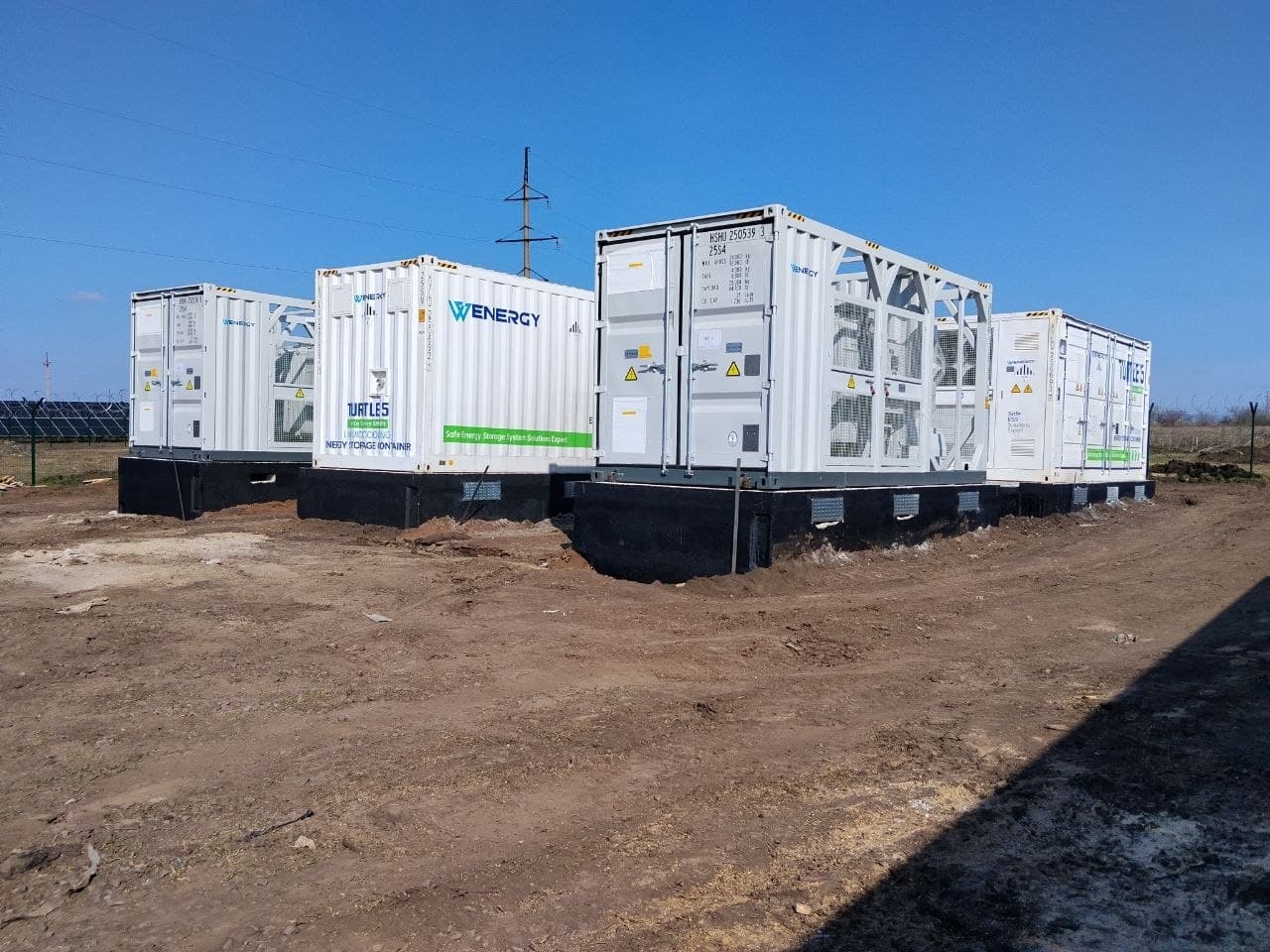
Our largest site is a 4.95 MW (AC) solar power plant in the Odesa region with an energy storage system of 5 MW / 20 MWh. The solar field is about 6.48 MW (DC): it is deliberately larger than the export point, so the plant runs at full output for longer.
LK Energy acted as the EPC contractor: design, equipment, construction, commissioning. The packaged KTP units, the 6 kV switchgear and the switchboards are of our own manufacture. The plant is in commercial operation.
See the case study: a 4.95 MW solar plant with BESS →
What determines the cost of a 500 kW – 5 MW solar plant
No two plants of this size are alike, so the honest answer to “how much does a 500 kW solar plant cost” is the list of factors that shape the price of your specific site:
- Roof or ground. A ground-mounted plant needs foundations and more land; a rooftop one needs a load-bearing check of the roof and its condition.
- Grid connection point. Spare capacity nearby is one price; a new transformer substation, cable lines or switchgear reconstruction is another. We manufacture substations and switchgear at our own factory, so this part of the budget stays under our control rather than a middleman contractor’s.
- Export power limit. An active consumer is limited in how much surplus it may sell — this determines whether the plant is designed for full generation or for on-site consumption.
- Energy storage (BESS). Backup for outages and peak-tariff operation add to the budget but change the project’s economics.
- Design and permits. Feasibility study, design documentation, grid connection terms and agreement — the scope depends on the site.
Included in our price: site survey, feasibility study with payback calculation, design, equipment, installation, commissioning, paperwork. Priced separately: works on the grid operator’s side and reconstruction of the site’s existing networks, if required.
The exact figure comes only from a site-specific calculation — we prepare a preliminary feasibility study free of charge based on your consumption data.
Feasibility study: what we calculate before you sign anything
Before the design stage we prepare a feasibility study for the specific site. It covers:
- generation — from the climate data for your location and the chosen field configuration;
- own consumption — from your actual daily and seasonal profile, not from an industry average;
- the balance — how much the plant covers itself and how much goes to the grid, taking the export limit into account;
- CAPEX and OPEX — based on the real equipment list, including the switchgear and the grid connection;
- financial metrics — NPV, IRR, LCOE, and DSCR as well for projects with external financing.
There are deliberately no payback figures on this page: they depend on your consumption profile, your tariff and your sales model, and any "average" number would be misleading. We calculate it individually.
If you are looking at the plant as an investment: a solar plant as an asset — metrics, risks, revenue streams.
We calculate payback and savings from your own consumption profile — that is the only way to get an honest figure. Send us an electricity bill and we will show the calculation for your specific site.
Where to next
Plant cards by capacity are in the Solar plant catalogue: from 6 kW to 5 MW section, including Hybrid solar power plant with BESS, 500 kW capacity, Hybrid Solar Power Plant with BESS, 1 MW and Hybrid Solar Power Plant with BESS, 5 MW Capacity.
FAQ
How much space does a 1 MW plant need?
Does such a plant work during a grid outage?
How long does the whole project take?
What happens to the surplus the plant feeds into the grid?
Is a licence required?
Do you manufacture the equipment or resell it?
Can we start with a feasibility study, with no commitment?
Let’s discuss your project:
Industrial solar plants, 500 kW – 5 MW: turnkey EPC with in-house switchgear
Get a preliminary feasibility study and payback estimate — send us your consumption profile and the site address
+380 67 104 94 91