
STP or pole-mounted KTP: the difference and when to use each
Article author: Sviatoslav Yurdyk, Quality Engineer at LK Energy Group.
He verifies that in-house manufactured switchgear complies with DSTU EN IEC 61439 — from incoming inspection of components to acceptance testing of finished products.
An STP (single-pole transformer substation) is a 10(6)/0.4 kV transformer substation in which all the equipment — the power transformer, the protective devices, the metering cabinet — is mounted directly on an overhead line pole or on a separately installed pole. A mast-type KTPM does the same job, but it is installed not on the line poles but on a foundation or a supporting frame (steel structure) at least 1600 mm high, with a maintenance platform — and carries a transformer of up to 400 kVA. In technical specifications, designs and everyday conversation the names "single-pole", "pole-mounted" and "column-type substation" are often used interchangeably, even though the two versions differ in structure and in their application limits. Let us look at the difference and the selection criteria.
What an STP and a KTPM are: the common basis
Both substations belong to the same class — packaged outdoor substations with an overhead incomer that need no substation building. They have a lot in common:
- 10(6) kV overhead incomer — the substation is connected directly to the conductors of the overhead line, and the arrangement is usually a dead-end one: the STP or KTPM is the end point of a tap-off;
- the same electrical scheme — the VN incomer, protective devices on the 10(6) kV side, the power transformer, and a cable drop to the 0.4 kV RUNN cabinet with metering and outgoing feeders;
- no substation building — an STP is fixed to the overhead-line poles, so there is no separate foundation for the enclosure, only for the pole; a KTPM is installed on a foundation or a supporting frame at least 1600 mm high;
- no fence — the high-voltage equipment is placed at a height that cannot be reached without special equipment, so a separate fenced area is not required;
- full factory readiness — the substation arrives on site as a complete set: the frame with the VN devices, the transformer, the RUNN cabinet, the brackets; all that remains on site is mounting on the poles or frame and connection.
The difference begins where the common part ends — in the supporting structure.
STP or pole-mounted KTPM: three structural differences
1. Supporting structure
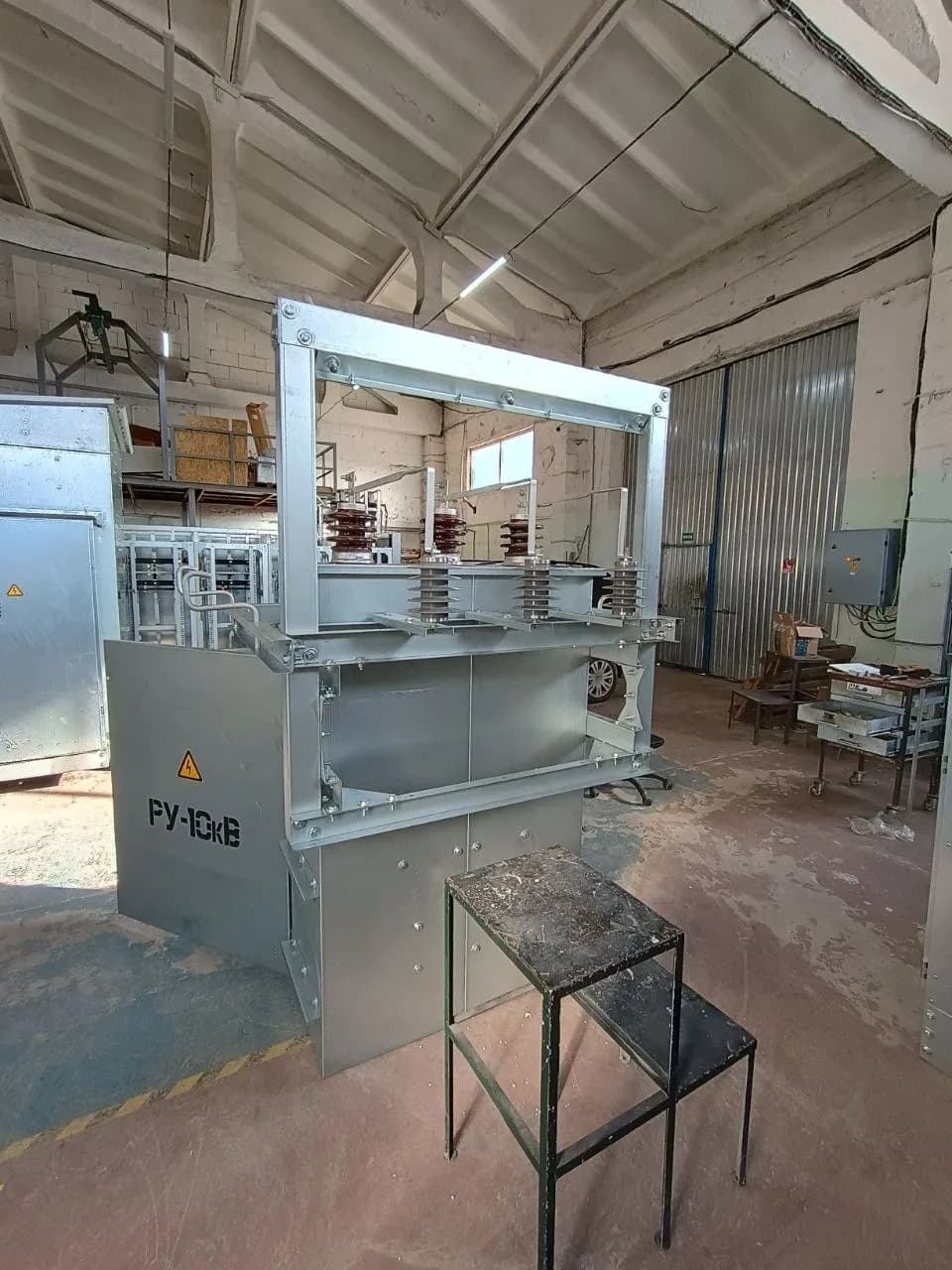
An STP is installed directly on the poles of a 10(6) kV overhead line. Up to 63 kVA it is a single pole, usually a reinforced-concrete one, carrying — from top to bottom — the incomer with insulators, the surge arresters, the high-voltage fuses, the transformer on brackets and the RUNN cabinet; 100–250 kVA units use two poles with a maintenance platform (the STP2 version). A KTPM is not mounted on line poles: it is a cabinet with the transformer and an HV incoming mast, installed on a pre-prepared foundation or a steel frame at least 1600 mm high, with a maintenance platform, handrails and stairs.
2. Transformer rating
This is the main practical criterion. According to the factory catalogue, an STP is made for 25–250 kVA: up to 63 kVA on a single pole, 100–250 kVA on two. A single pole with the required strength margin carries only a transformer of modest mass. A KTPM is supplied with transformers from 25 to 400 kVA. If the calculated load calls for even more, this is no longer a mast-type version but a substation of another class: an indoor KTP, a KTPGS or a KTPMM.
3. Maintenance
A single-pole STP (up to 63 kVA) has no platform — the transformer and the VN devices are serviced from a telescopic lift or a truck-mounted aerial platform. A two-pole STP2 (100–250 kVA) and a KTPM have a maintenance platform with handrails and a ladder: personnel work on the equipment without special vehicles, which for the operating company often becomes the decisive argument.
The terms are, however, often confused: a two-pole STP2 is frequently called a mast-type KTPM. In the factory catalogue these are different products: an STP2 stands on two line poles, a KTPM on a foundation or a frame. That is why what matters in the questionnaire is not only the name but the specifics: the rating, the installation method (line poles or a foundation/frame), the RUNN content.
| Criterion | STP (single-pole) | KTPM (pole-mounted) |
|---|---|---|
| Transformer rating | 25–250 kVA: up to 63 kVA on one pole, 100–250 kVA on two (STP2) | 25–400 kVA |
| Installation | Overhead-line poles: one pole, or two with a platform | Foundation or supporting frame ≥1600 mm with a maintenance platform |
| Base | No separate foundation for the enclosure, only for the pole | Foundation or steel frame; no substation building needed |
| Maintenance | One pole — from an aerial lift; STP2 — from a platform | From a platform with a fixed ladder |
| VN incomer | Overhead, 10(6) kV | Overhead, 10(6) kV |
| Typical application | A single small consumer: a borehole, a farm, a village street | Rural networks, farms with a higher load |
The ratings are given for standard versions; the specific configuration is determined by the questionnaire.
Scope of supply: what an STP and a KTPM include
The equipment content is the same in both versions in terms of logic and differs only in layout:
- High-voltage side: incomer insulators on the cross-arm, a line disconnector (RLND) with a drive — if the design provides for one, OPN surge arresters (RVO spark-gap arresters in older standard solutions) and high-voltage fuses that protect the transformer against short circuits.
- Power transformer — a sealed oil-filled TMG unit, 10(6)/0.4 kV, of the appropriate rating, on mounting brackets or on the platform.
- 0.4 kV cable drop — from the transformer terminals to the RUNN cabinet, in a protective conduit or flexible metal hose.
- 0.4 kV RUNN cabinet — the incoming circuit breaker, the metering unit (a meter, with a remote data transmission module if required), outgoing feeders on circuit breakers, 0.4 kV OPN surge arresters; on request, a street lighting control unit.
- Steel structures and base: cross-arms, frames, brackets, a platform with a ladder (for the STP2 and KTPM); for an STP — reinforced-concrete poles fixed in the ground, for a KTPM — a supporting frame or foundation.
As an example, a typical single-pole substation order from our production practice is an STP1-63 kVA 10/0.4 U1: a TMG-63 transformer with a D/Yn-11 vector group, 10 kV OPN surge arresters, high-voltage fuses, and a RUNN cabinet with a 100 A incoming circuit breaker, metering and outgoing group feeders.
Where single-pole and pole-mounted substations are used
Both versions are in their element in extensive 10(6) kV overhead networks with small, dispersed consumers:
- rural distribution networks and street lighting;
- farms, grain stores, livestock facilities;
- pumping stations, boreholes, irrigation systems;
- dacha and cottage developments with overhead supply;
- remote and seasonal facilities, temporary power supply.
The selection logic is simple. A load of up to 63 kVA and a single small consumer — an STP on one pole is enough: minimum steelwork and quick installation. 100–250 kVA — an STP2 on two poles with a maintenance platform. Up to 400 kVA, or a substation that has to stand on its own site rather than on the line poles — a KTPM on a foundation or frame. The price depends on the rating, not on the enclosure type. If, however, the network is a cable one, a KTPN with a cable incomer is considered; if the consumer needs two transformers, an AVR scheme or more than 400 kVA — an indoor KTP, a KTPGS, a KTPMM or a BKTP: that is already a different class of substation.
Manufacturing of STPs and KTPMs
LK Energy Group manufactures single-pole and pole-mounted transformer substations at its own plant in Odesa: steel structures — from cutting and bending through to powder coating — and in-house assembled RUNN cabinets with acceptance testing of every unit. The standard range in the factory catalogue: STP — from 25 to 250 kVA (up to 63 kVA on one pole, 100–250 kVA on two), KTPM — from 25 to 400 kVA on a foundation or frame. Our design office selects the configuration on the basis of the questionnaire: transformer rating, VN protection scheme, outgoing feeder content, metering unit to suit the network operator's requirements. We help designers fill in the questionnaire and provide standard diagrams for site adaptation.
Frequently asked questions
Are STP and KTPM the same thing?
No, although they are often confused: both are substations with an overhead incomer and no substation building. The technical difference is in the installation: an STP is mounted on the line poles (up to 63 kVA on one pole, 100–250 kVA on two, STP2), while a KTPM is a cabinet with the transformer on a foundation or a supporting frame at least 1600 mm high, with a maintenance platform, 25–400 kVA. When ordering, go by the rating and the installation method, not only by the abbreviation.
Why is a transformer above 63 kVA not installed on a single pole?
Because of the mechanical load. As the rating grows, the mass of an oil-filled transformer increases, and together with the switching devices, the RUNN cabinet and ice and wind loads, a single reinforced-concrete pole no longer provides the strength margin required by the codes. That is why, according to the factory catalogue, a 100–250 kVA STP is mounted on two poles with a maintenance platform (STP2), while a KTPM of up to 400 kVA is installed on a foundation or a supporting frame.
Do an STP or a KTPM need a foundation and a fence?
For an STP there is no separate foundation for the enclosure, only for the pole: the poles are fixed in the ground in the standard way, like overhead line poles. A KTPM is installed on a pre-prepared foundation or a steel frame at least 1600 mm high, with a maintenance platform; no substation building or kiosk enclosure is needed. A fence is not required: the live parts are placed at a height that cannot be reached without special equipment. Land matters and the protection zone are defined by the site-adaptation design.
LK Energy Group is a manufacturer of 10(6)/0.4 kV transformer substations: single-pole STPs, pole-mounted KTPMs and kiosk-type KTPNs — with RUNN cabinets of our own manufacture. The full catalogue is in the Equipment section. Send us your technical conditions or a completed questionnaire and we will select the version and price the substation for your site.
See also
Need an engineer’s advice?
Have a task involving power supply, switchgear or solar plants — write to us and we’ll answer to the point.
+380 67 104 94 91