
AVR and the generator: what a genset needs for an automatic start
Author of the article: Sviatoslav Yurdyk, Quality Engineer at LK Energy Group.
Responsible for quality control of switchgear at the plant — acceptance testing of NKU assemblies, verification of secondary-circuit diagrams and the operation of AVR automation before shipment. Every AVR panel has its transfer logic checked on a test bench.
The power goes out — the generator is supposed to start on its own, pick up the load, and when the grid comes back, hand the load over and shut down. That is how it works at sites where downtime costs money.
But between "I bought a generator" and "it starts by itself" there is a separate condition, and people usually learn about it after the purchase: not every generator will start automatically. The AVR (ATS — automatic transfer switch) panel can issue the start command — but there is no one to issue it to if the generator has nothing that will accept that command.
This article is about exactly that junction. How the panel itself works we covered separately: AVR panel (ShAVR): how it works and when it is needed. Here we look at what the generator has to be, and how much power actually needs backing up.
Who is responsible for what: the generator and the panel
The confusion starts because both parts get called "the automation". In practice the responsibility is split like this:
| Task | Who does it |
|---|---|
| Detect a problem on the main incomer (voltage lost, sagging, a broken phase) | AVR panel |
| Hold a delay so the system does not react to every flicker | AVR panel |
| Issue the "start" command to the generator | AVR panel |
| Crank the starter, reach rated speed and voltage | generator's own controls |
| Report "I am ready, load can be applied" | generator's own controls |
| Transfer the load to the generator and keep the two sources apart | AVR panel |
| Return the load to the grid once it is steady again | AVR panel |
| Run at no load to cool down before stopping | generator's own controls |
The right-hand column is precisely what a cheap generator does not have. The panel may be perfect: with no counterpart on the engine side it will not start anything.
What the AVR panel needs from the generator: five points
1. An automatic start unit (genset controller). This is the main one. The controller drives the starter and the fuel valve, watches oil pressure, temperature, speed and voltage, and stops the engine itself on a fault. Without it the generator is a manual device, no matter how much automation you put in the panel.
2. A remote start input and a feedback signal. Physically these are "dry contacts": the panel closes the "start" circuit, and the generator returns a "running / ready to take load" signal. It is that signal, not a timer, that tells the panel to transfer the load. With no feedback signal the scheme works blind: it will apply load to an engine that has not reached its operating mode yet.
3. A starter battery with automatic charging. A standby generator sits idle for months, and the most common reason for "it would not start" is a flat battery. So the package must include a charger that runs off the grid and keeps the battery charged for the whole waiting period.
4. Engine heating for cold starts. In winter a cold diesel takes longer to start and wears more while doing it. A coolant heater keeps the engine warm in standby — that is the difference between "started on the first attempt" and "cranking in the frost".
5. Fuel and fuel level monitoring. The automation will start the engine as many times as the tank allows. For sites with long outages a day tank and a level sensor are installed with the generator, and the "low fuel" signal is routed to the same place as the other alarms.
A quick check before buying: if the generator description does not mention "automatic start", "AVR", "remote start" or "interface for external control", it cannot be automated as standard.
A household generator with a manual starter: the honest answer
The most common situation: the generator has already been bought — petrol, with a recoil starter or a push-button electric starter — and now the owner wants to "add an AVR to it".
That does not work. Such a generator has no controller, no remote start input and no battery charging. Retrofitting it with external automation produces a home-made assembly that nobody is answerable for, and at the same time the most dangerous point in the whole scheme.
What can actually be done:
- Keep manual switching, but do it properly. A changeover switch (manual transfer panel) with mechanical interlocking guarantees the main thing: voltage from the generator will never reach the external grid, where a repair crew may be working. The interruption lasts as long as it takes a person to get there — but it is an honest solution with no surprises.
- Change the generator if automation is what you need. For that you take a standby-rated model with a controller and a remote start input.
We manufacture switchboards and automation, not generators: the particular model is chosen with your supplier or with our engineer, based on the site's parameters. Reference points on generator classes, power, cooling and noise are collected on the backup power page.
How many kW to back up: you count the critical load, not the building
The second mistake after "any generator will do" is "a generator for the full incomer rating". That is expensive and harmful: a diesel that constantly runs at low load cokes up and uses up its service life faster than a loaded one.
The count goes differently:
- Write down what genuinely cannot be switched off. Pumps, the boiler house, cold rooms, the server room, security and fire systems, emergency lighting. Office air conditioning and second-priority process equipment usually do not belong on that list.
- Add the motor starting current. This is where people miss most often. On direct-on-line starting a motor briefly draws several times its rated current — by our own reference figures for backup power that is a 5–8 times starting current. The generator and the panel's devices have to withstand that surge, otherwise nothing will start under load at all.
- Reduce that surge if it is what drives the whole rating. A soft starter or a variable frequency drive removes the starting peak — and the generator you need becomes smaller and cheaper. We covered that choice separately: a VFD or a soft starter for a pump.
- Decide whether any interruption is acceptable. The classic "grid — generator" scheme gives an interruption for the duration of the start; by our reference figures for a "diesel + AVR" scheme that is roughly 5–15 seconds. For computers, servers and control automation such a dip means a reboot — so the critical part is additionally fed through a UPS, and the generator picks up behind it.
A special case: a single-phase generator on a three-phase incomer
A question asked regularly on forums: the incomer to the house is three-phase, the generator bought is single-phase — can it be fed to all three phases?
No. Tying the three phases of the board together to "spread" one generator phase across them is not allowed: a three-phase load (a pump, a compressor, a machine tool) will not work from such a supply, and the scheme itself becomes dangerous. There are two workable options:
- Separate a single-phase critical group. Lighting, the boiler, circulation pumps and communications are moved to a dedicated section, and that section is what gets backed up — with its own single-phase AVR. The rest of the house is not part of the backup.
- Install a three-phase generator if the critical list contains three-phase consumers.
This is a circuit decision, and it is made up front rather than "later" — the composition of the panel and the number of outgoing feeders both depend on it.
What this means for the panel
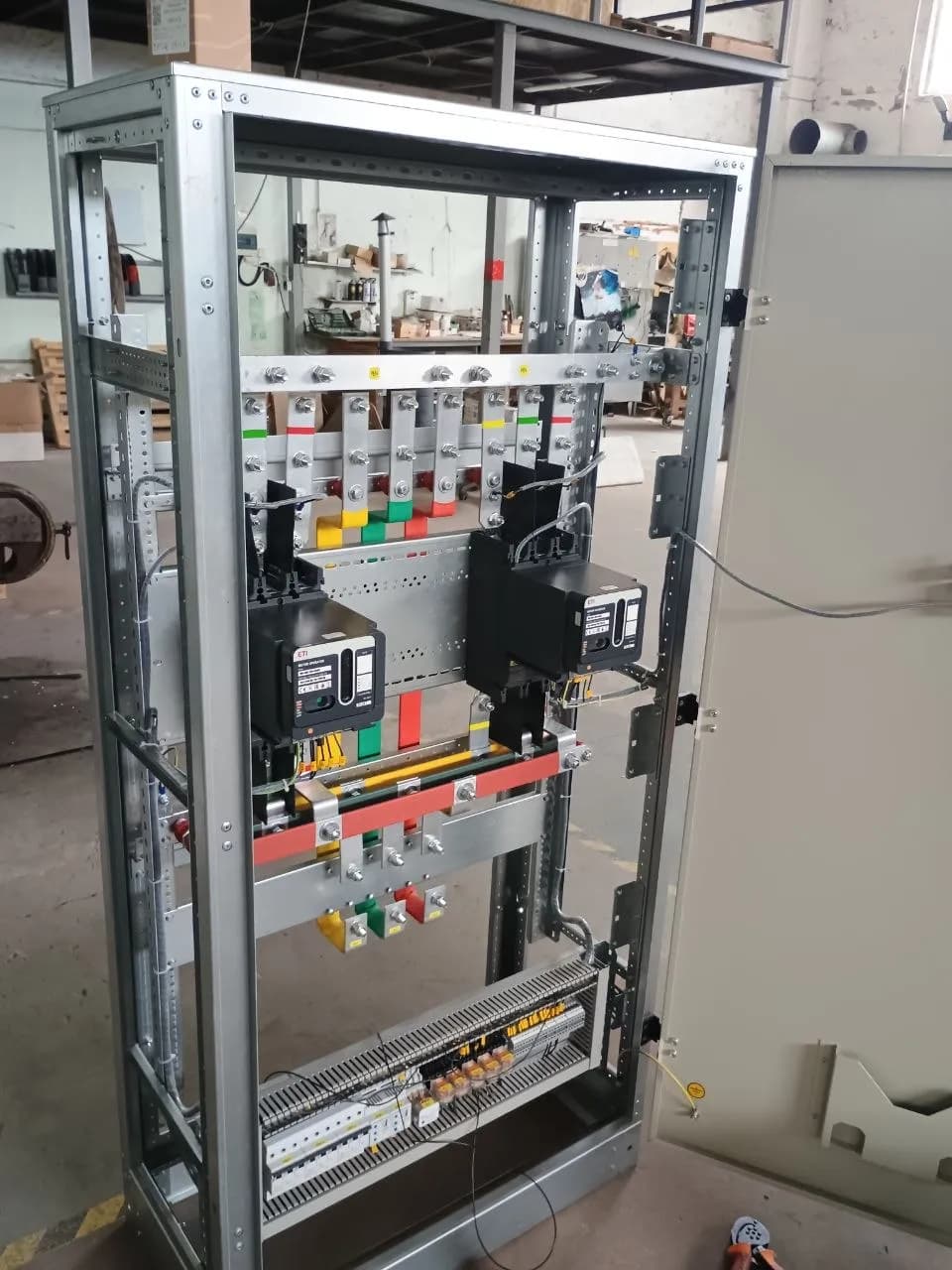
When the backup source is a generator, the AVR panel differs from an ordinary "two incomers" one:
- it has a separate time delay for starting the backup source and a second one for confirming the return of the main incomer; both are set during commissioning for the specific site;
- the transfer happens on confirmation that the generator is ready, not on a timer;
- interlocking of the incomers here is not a formality but a safety requirement: voltage from the generator must not reach the external grid under any circumstances;
- the switching devices are selected for the calculated and the starting current — these are air circuit breakers (ACB) or moulded case circuit breakers (MCCB).
Our AVR panels are built from 100 A upwards, and 250–630 A in the standard solutions; among the completed sites there is a 400 A AVR on a "grid — diesel generator" scheme with motor drives. The ready configuration and parameters are on the AVR cabinet page, and the drawings for designers are in the standard solution ShAVR 0.4 kV: backup from a diesel genset.
What to send us for a quotation
To get a configuration and a lead time we need five things: a single-line diagram or a list of loads; the calculated incomer current; the generator model and whether it has a controller and a remote start input; the number of incomers and the priority between them; and where the panel will be installed (indoors or outdoors). The full list is in the article on the technical specification for switchboard equipment.
Frequently asked questions
Can a generator be connected to a house without an AVR? Yes — through a changeover switch with mechanical interlocking, manually. That is an acceptable and safe solution if an interruption while someone walks over suits you. What must never be done is connecting a generator "backwards" into a socket, or with an ordinary cable and no interlocking: the voltage will go out into the external grid.
Will the generator start by itself if it only has a manual starter? No. Automatic starting is only possible with a genset controller, a remote start input, a starter battery and automatic charging for it. Without those the AVR panel has nothing to control.
Which transfer controller should I choose for a 250 kW generator? The choice is driven by the scheme rather than by engine power: how many sources there are, what the priority is, whether automatic return is required, and which signals are routed to the dispatch system. For a generator of that size the control logic is usually already built into its own controller, while the AVR panel is responsible for monitoring the grid, the time delays and safe transfer. The exact composition is selected from the site's single-line diagram.
How long will it take from the loss of the grid to power being back? It is a sum: the time delay that rides through short dips, the engine start and run-up, and then the transfer itself. For the classic "diesel + AVR" scheme the reference figure is 5–15 seconds. The exact sequence is set per project; if even seconds are unacceptable, a UPS is installed between the panel and the critical load.
LK Energy Group manufactures AVR panels at its own plant in Odesa — grid-to-grid units on two incomers, "grid — genset" schemes, and AVR sections within main distribution boards. Send us a single-line diagram or a list of loads and we will price the configuration and the lead time.
Need an engineer’s advice?
Have a task involving power supply, switchgear or solar plants — write to us and we’ll answer to the point.
+380 67 104 94 91