
Turnkey solar plant construction: stages and timelines
Author: Volodymyr Ledok, Production Technical Director at LK Energy Group.
He is responsible for manufacturing substation and switchboard equipment — KTP, KRU, KSO and NKU units that operate as part of industrial solar power plants. Factory testing of every substation before it is shipped to site is part of his remit.
Turnkey solar plant construction is the full cycle from design to commissioning delivered by a single contractor: site survey, technical conditions, design, equipment supply, construction and installation works, commissioning and paperwork. The customer gets a working plant and a single point of responsibility for the result, rather than a set of disconnected works from different companies. In this article we go through the stages that make up the construction of a solar power plant, the order they come in, and what the timeline and the cost actually depend on.
What “turnkey” means: EPC contracting in plain terms
In international practice the turnkey format is called EPC contracting: Engineering — design, Procurement — procurement and supply of equipment, Construction — construction and installation. One contract, one schedule, one warranty. The contractor is responsible not for individual works but for the end result: the plant is built, tested, registered and delivering the calculated output.
The alternative is the “fragmented” model: a designer separately, an equipment supplier separately, an installation crew separately. On paper such a scheme sometimes looks cheaper, but the interfaces between the parties become the place where responsibility gets lost: the designer points at the installers, the installers point at the “wrong” equipment, and plant downtime remains the customer’s problem. That is exactly why EPC has become the de facto standard for industrial sites.
Stages of solar plant construction
Stage 1. Pre-design work, technical conditions and design
It all starts not with the panels but with questions: how much does the enterprise consume, what is the load profile, where will the energy go — to self-consumption or partly into the grid. Next comes the survey of the site or the roof: a ground-mounted plant needs a topographic survey and geology, a rooftop one needs a check of the roof’s load-bearing capacity and the condition of the waterproofing.
If the plant interacts with the external grid, technical connection conditions are obtained from the distribution system operator. The design is then developed: module layout, calculation of the mounting structures, the single-line diagram, selection of inverters and of the transformer substation, relay protection, metering, earthing and lightning protection. This is the most critical stage of the whole cycle: a mistake in the design costs more than at any later step, because it drags rework of what has already been installed.
Stage 2. Civil and earthworks
For a ground-mounted plant this means geodetic setting-out, driving piles or laying foundations for the mounting structures, foundations for the inverter units and the substation, cable trenches, on-site roads, fencing, lighting and security systems. For a rooftop plant the stage looks different: strengthening the roof where required, installing ballasted or anchored mounting systems without breaching the waterproofing, and routing the cable runs.
Stage 3. Installation of modules, inverters and the substation
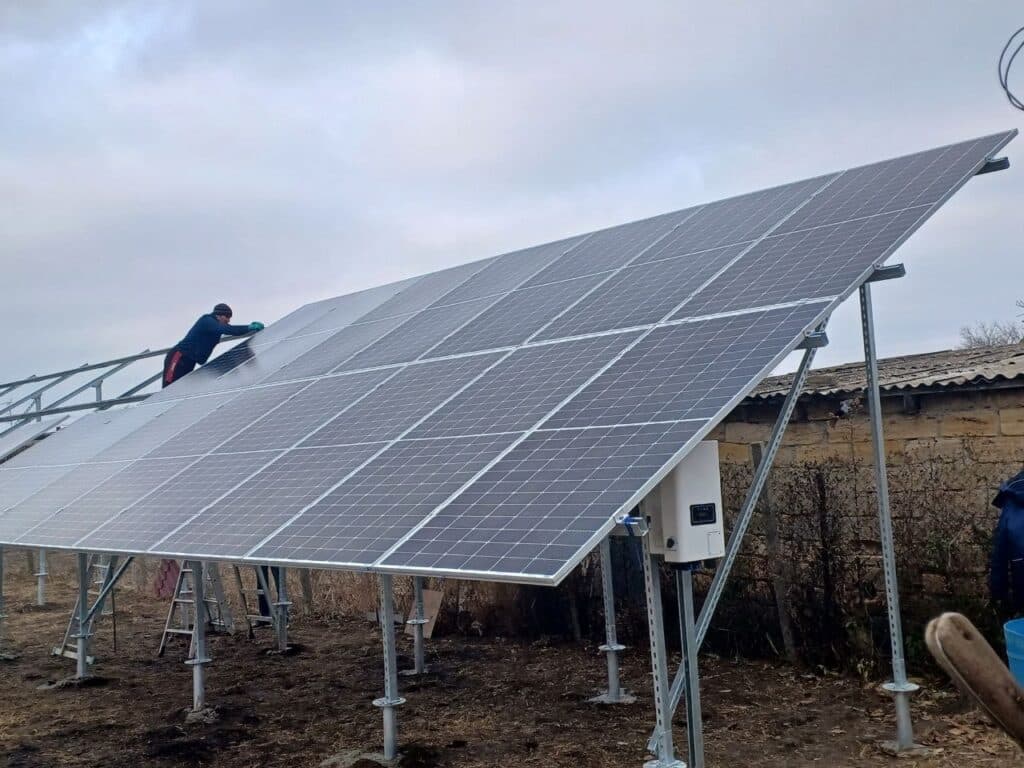
The most visible stage from the outside. The sequence is typical: mounting structures — solar modules — DC string wiring — inverters — AC cable lines — the transformer substation with its cubicles, metering and protections. An important detail that shortens the schedule: the substation is a factory-made product. While earthworks are under way on site, the KTP is already being assembled and tested at the plant, and it arrives on site as a finished block ready for connection.
Stage 4. Commissioning
Commissioning works answer two questions: is the plant safe, and does it deliver what the design specifies. This includes measuring insulation resistance and the earthing loop, checking string polarity and characteristics, setting up the inverters and the relay protection, testing the substation, checking the metering unit and the monitoring system, and trial runs under load. The results are recorded in test reports — which then become part of the as-built documentation.
Stage 5. Putting the plant into operation
The final stage is paperwork, but without it the plant cannot legally operate. The scope of the procedures depends on the type of site. Ground-mounted plants follow the general procedure for acceptance into operation — a declaration or a certificate depending on the consequence class. For solar plants on the roofs and facades of buildings the procedure is simplified: under Resolution of the Cabinet of Ministers No. 77 of 28.01.2026 such works do not require permit documents, and the facilities themselves are not subject to acceptance into operation — the mandatory condition is a technical inspection report on the building, prepared by a specialist holding the relevant qualification certificate. Contractual arrangements with the grid operator belong here as well. The stage ends with handover to the customer: as-built documentation, staff briefing, access to the monitoring system and the contractor’s warranty obligations.
Stages, content and timelines: summary table
| Stage | What it includes | Indicative duration |
|---|---|---|
| 1. Design and technical conditions | Survey, consumption analysis, technical conditions, design, approvals | Depends on the connection scheme; for grid-tied plants this is usually the longest “paperwork” stage |
| 2. Civil works | Piles and foundations, trenches, roads, fencing, roof preparation | Depends on the site area, the soils and the season |
| 3. Equipment installation | Structures, modules, inverters, cable lines, substation | Depends on the capacity; scales with the number of installation crews |
| 4. Commissioning | Testing, setting up protections and inverters, trial runs | The shortest stage, but the one that confirms the quality of all the previous ones |
| 5. Putting into operation | As-built documentation, registration, contracts, handover to the customer | Depends on the type of plant and on the procedure prescribed for it |
Timelines: what they actually depend on
An honest answer to the question “how long does it take to build a solar plant” is the schedule of a specific project, not a universal figure. The duration is affected by:
- Capacity and type of plant
- A rooftop plant of tens of kilowatts and a ground-mounted one of megawatts are different scales of work, even though the set of stages is the same.
- Technical conditions and grid connection
- The contractor does not fully control the timing of procedures on the grid operator’s side — which is why an experienced EPC starts the “paperwork” branch as early as possible and runs it in parallel with everything else.
- Equipment availability
- Modules and inverters in common sizes are usually held in stock, whereas the power transformer and the package substation are items manufactured for the specific project. They are most often what defines the critical path of the schedule.
- Seasonality
- Earthworks and concrete works are weather-sensitive; installation of structures and equipment goes on all year round.
- Running works in parallel
- The main source of acceleration: manufacturing of the substation, delivery of the modules and civil works on site should run at the same time rather than one after another.
What the cost depends on
Comparing “the price of a solar plant” without reference to a specific site is meaningless — which is why a serious contractor first asks about the site and the consumption, and only then names a budget. The main factors:
- Capacity
- Economies of scale apply: larger plants usually have lower specific costs per kilowatt of installed capacity — the project’s fixed costs are spread over a larger volume.
- Equipment class
- Modules, inverters and transformer equipment from different manufacturers differ noticeably in price and in service life. The cheaper line in the estimate is not always cheaper to own.
- Type of structures and the site
- A ground-mounted plant on piles, a ballasted system on a flat roof or fixings on a pitched roof mean different amounts of steel and different volumes of civil works. Difficult soils add to the cost of foundations.
- Storage system (BESS)
- Storage is a separate budget item that at the same time opens up new operating modes: peak shaving, backup, and managing self-consumption. The decision on BESS is taken by calculation, not by default.
- Grid connection
- The most underestimated factor. The distance to the connection point and the need to build a line or to reconstruct an existing substation can change the budget substantially — even between neighbouring sites the difference can be noticeable.
The role of our own substation manufacturing
The substation is the heart of any industrial solar plant: all the generated energy passes through it. LK Energy is not only an EPC contractor but also a manufacturer: we produce KTP, KRU, KSO units and switchboard equipment at our own plant in Odesa. For the customer this means three practical things. First, the substation is designed for the specific plant rather than adapted from a standard range. Second, its manufacturing runs in parallel with the civil works on site — without an external supplier sitting in the critical path of the schedule. Third, factory testing and installation are carried out by one team, so the warranty for the plant does not fall apart between several companies.
To see what this looks like on a real project, take a look at the case study 4.95 MW solar plant with a storage system: the full cycle from design to commissioning, with substation equipment of our own manufacture.
Frequently asked questions
How long does it take to build a solar power plant?
It depends on the capacity, the type of plant and the connection scheme. The longest items in the schedule are usually not the installation but the technical conditions with the grid connection and the manufacturing of the main equipment. A realistic timeline appears after the pre-design survey — which is why promising an exact date “over the phone”, without studying the site, should raise a red flag.
Can a solar plant be built in winter?
Yes. Installation of structures, modules, inverters and the substation goes on all year round. Weather restrictions mainly concern earthworks and concrete works, so a sound schedule places those in the warm season and uses the winter for design, deliveries and installation.
Who obtains the technical conditions and handles the paperwork?
In the turnkey format the contractor handles all the procedures — from the application for technical conditions to putting the plant into operation. What is needed from the customer is the title documents for the site or the land plot and a power of attorney for representation.
Planning to build a solar plant for your enterprise? See how we build turnkey industrial solar power plants — and leave a request: an engineer will inspect the site and show what the process will look like for your particular location, from survey to commissioning.
The full list of works the contractor takes on is on the service page “Turnkey solar plant construction”.
See also
Need an engineer’s advice?
Have a task involving power supply, switchgear or solar plants — write to us and we’ll answer to the point.
+380 67 104 94 91