
The KSO cubicle: design and how it differs from KRU
Author: Volodymyr Ledok, Production Technical Director at LK Energy Group.
He is responsible for manufacturing switchboard equipment — the assembly and quality control of NKU, KRU and KSO units and busbars. Every cubicle undergoes factory testing before shipment.
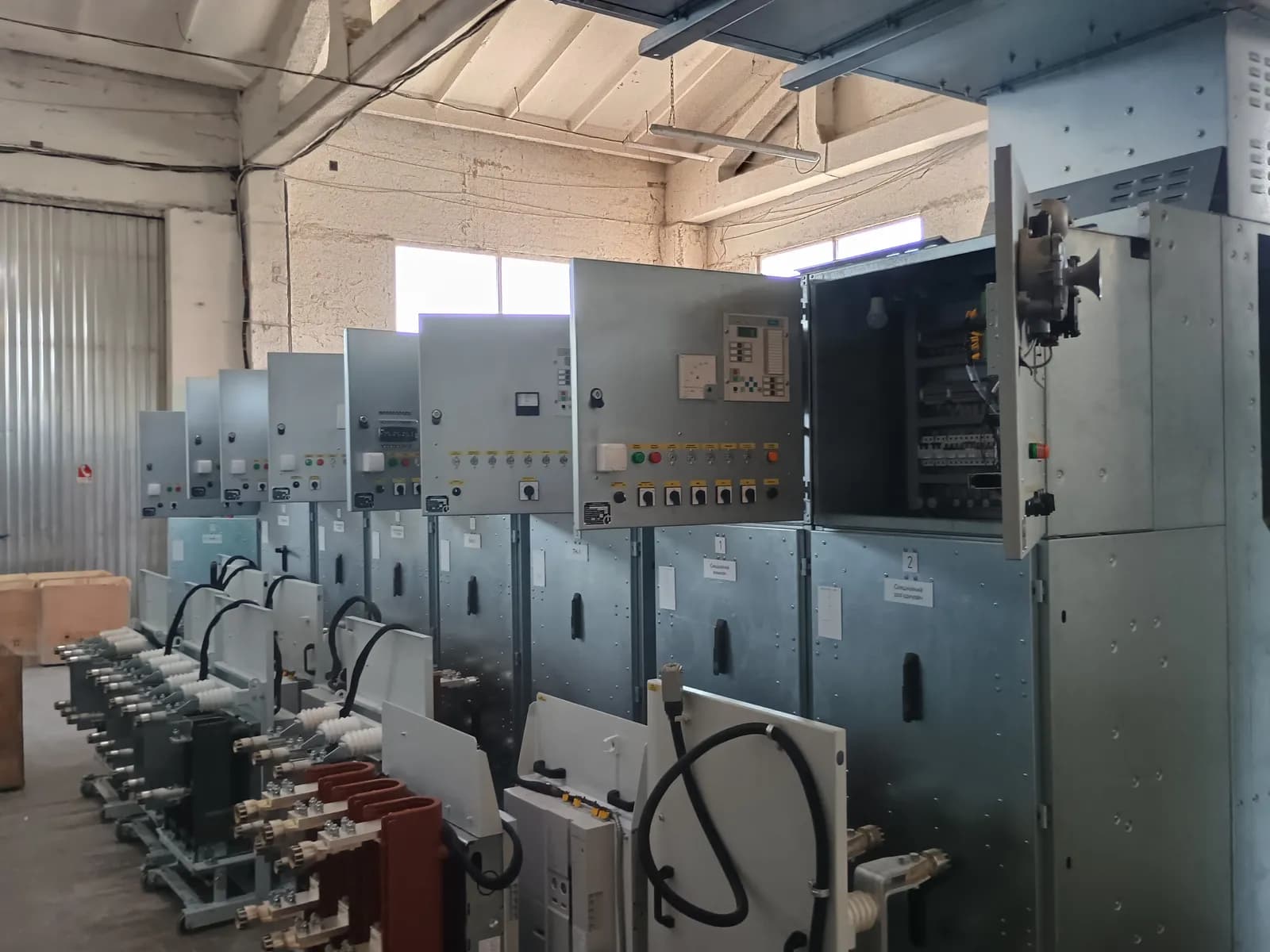
A KSO cubicle (single front-access switchgear cubicle) is a factory-built metal cabinet for 6–10 kV switchgear, inside which the switching apparatus, a section of busbars, instrument transformers and relay protection are already installed. A single cubicle is one connection: an incomer, an outgoing line, a sectionalising device or a voltage transformer. Several cubicles installed in a row and joined by busbars form the switchgear of a substation or of a distribution point. The main design feature, encoded in the name itself, is single front access: all operations are carried out from the front, so a row of KSO cubicles can be placed right against a wall.
The design of a KSO cubicle
Regardless of the manufacturer and the frame size, a KSO cubicle consists of the same functional parts:
- Metal enclosure (cabinet)
- A welded or bolted sheet-steel frame with front doors. The interior is divided into zones: the busbar zone, the apparatus (high-voltage) zone and the relay zone. The rear wall is solid — access from behind is not needed for work.
- Switching apparatus
- In modern KSO cubicles this is normally a fixed vacuum circuit breaker — mounted on the structure of the cubicle rather than on a withdrawable truck. For certain types of connection a load-break switch or only a disconnector is installed instead of a circuit breaker.
- Disconnectors and earthing switches
- They create a visible break in the circuit so that the connection can be safely taken out for maintenance. Mechanical interlocks prevent operations in the wrong order — for example, opening a disconnector under load.
- Busbars
- A section of the main busbars in the upper part of the cubicle. When a row is installed, the busbars of adjacent cubicles are joined by bolted contact connections into a single system.
- Instrument transformers
- Current transformers (and voltage transformers in VT cubicles) feed the metering, measuring and protection circuits.
- The relay protection compartment
- A relay cabinet with a microprocessor protection and automation device and the control and signalling circuits. The protection clears short circuits and overloads by tripping the circuit breaker.
KSO or KRU: what the difference is
Both abbreviations describe cubicles for the same 6–10 kV networks, and they get confused all the time. There is one fundamental difference, and everything else follows from it. In a KSO the circuit breaker is fixed: it is rigidly mounted in the cubicle, and to repair or replace it the connection is taken out of service and the apparatus is dismantled. In a KRU the circuit breaker is mounted on a withdrawable element (a truck): for repair or replacement the truck is rolled out of the cabinet and a spare one can be rolled into its place. The withdrawable element also acts as a disconnector — the visible break is created by the withdrawal itself, so separate disconnectors are usually not needed in a KRU.
| Criterion | KSO | KRU |
|---|---|---|
| Switching apparatus | Fixed circuit breaker (or load-break switch, disconnector) | Circuit breaker on a withdrawable element (truck) |
| Access for maintenance | Single front access — from the front only, can be placed against a wall | As a rule two-sided — access from the rear is also needed |
| Replacing the circuit breaker | Dismantling the apparatus inside the cubicle | Roll the truck out, roll a spare one in |
| Disconnectors | Separate devices with interlocks | The function is performed by the withdrawable element |
| Space in the room | Smaller row depth, a more compact indoor switchgear room | More space: the depth of the cabinet plus room to withdraw the truck |
| Cost | Lower, all other things being equal | Higher — the design is more complex |
| Typical use | Distribution points and substations of enterprises, indoor substations, central distribution points, switchgear of solar plants | Critical sites where the recovery time after a circuit breaker failure matters |
The practical conclusion is simple. If compactness and budget matter to the site, and redundancy is solved by the scheme (two sections, AVR), a KSO is installed. If the customer requires the minimum time to replace the switching apparatus and is ready to pay for a withdrawable element, a KRU is chosen. For most distribution points of industrial enterprises and for 6–10 kV transformer substations a KSO is quite enough — which is why it is the most widespread type of cubicle in such networks.
Configuration: which cubicles a switchgear assembly is built from
Switchgear based on KSO cubicles is assembled from cubicles of different purposes according to the single-line diagram of the project:
- Incoming cubicle — takes the supply from the feeding line or the power transformer; vacuum circuit breaker, current transformers, incomer protection.
- Sectionalising cubicle — divides the busbars into sections; it works in a pair with the section disconnector cubicle. On two-section distribution points this is exactly where AVR is implemented.
- Outgoing (feeder) cubicle — supplies an outgoing line to a transformer or to an adjacent distribution point; the line circuit breaker and protection.
- Voltage transformer cubicle — the VT for the measuring, metering and protection circuits of the section.
- Metering cubicle — instrument transformers and a meter for commercial metering.
Switching in modern KSO cubicles is done by vacuum circuit breakers: they need no maintenance of the arc-quenching medium and are designed for a long switching life. Protection and automation are microprocessor relay protection devices from Ukrainian manufacturers, typically RS83 or MRZS: overcurrent protection, instantaneous overcurrent trip, earth-fault protection, auto-reclosing and AVR — the set of functions is defined by the design. Rated currents, main circuit diagrams and the composition of the relay protection are selected for the specific technical specification.
Where KSO cubicles are used
Typical applications for 6–10 kV KSO cubicles:
- Distribution points of enterprises — receiving and distributing electricity across workshop substations;
- Transformer substations, including indoor ones — the 6–10 kV side, from the incomer to the protection of the power transformers;
- Industrial solar power plants — 10 kV switchgear that collects the power from inverter blocks with step-up transformers and exports it to the grid;
- municipal infrastructure facilities, pumping stations, and construction sites with their own substations.
Because access is from the front only, KSO cubicles fit well into compact indoor switchgear rooms and block-modular buildings, where every metre of room depth counts.
KSO-E of our own frame size: what we manufacture
LK Energy Group manufactures KSO-E single front-access switchgear cubicles of our own frame size 393 at the plant in Odesa — the company has been in business since 2005, and we have been developing our own manufacturing of switchboard equipment since 2015. Our own frame size means that the design of the cubicle has been worked out by our design department: we do not assemble other companies’ kits but cut, bend and weld the metal ourselves, install the apparatus and busbars, wire the secondary circuits and test the finished cubicles. Switching in KSO-E cubicles is by fixed vacuum circuit breakers and disconnectors; we do not use SF6 designs. For sites where the design specifically calls for a KRU, the range includes the KRU-E-2-10 package switchgear unit for 6–10 kV with a vacuum circuit breaker.
Frequently asked questions
Are a KSO cubicle and a KSO cell the same thing?
Yes. “Single front-access switchgear cubicle” is the full expansion of the abbreviation, which is why documentation uses both words. It refers to the same 6–10 kV cabinet for one connection.
How does a KSO differ from a KRU, in short?
In a KSO the circuit breaker is fixed and access is from the front only, while in a KRU the circuit breaker is on a withdrawable truck and access is normally needed from both sides. A KSO is more compact and cheaper; a KRU allows a circuit breaker to be replaced quickly by rolling in a spare truck.
Can a vacuum circuit breaker and microprocessor protection be installed in a KSO?
Yes, this is the standard modern configuration: a fixed vacuum circuit breaker plus a microprocessor relay protection device (RS83 or MRZS, for example) with overcurrent protection, instantaneous trip, earth-fault protection, auto-reclosing and AVR functions. The set of protections is defined by the design.
We will select the cubicles for your project.Send us a single-line diagram or a technical specification and we will work out the configuration of the switchgear based on KSO-E or KRU-E-2-10, agree the main circuit diagrams and the manufacturing timeline at our own plant in Odesa.
See also
Need an engineer’s advice?
Have a task involving power supply, switchgear or solar plants — write to us and we’ll answer to the point.
+380 67 104 94 91