
KRPZ 6–35 kV: a turnkey modular switchgear building
Author: Sviatoslav Yurdyk, Quality Engineer at LK Energy Group.
He is responsible for quality control of switchboard equipment in production — acceptance testing of cubicles and panels, checking the secondary circuit diagrams and the operation of the automation before shipment. Every KRPZ undergoes factory assembly and item-by-item checking before it is sent to site.
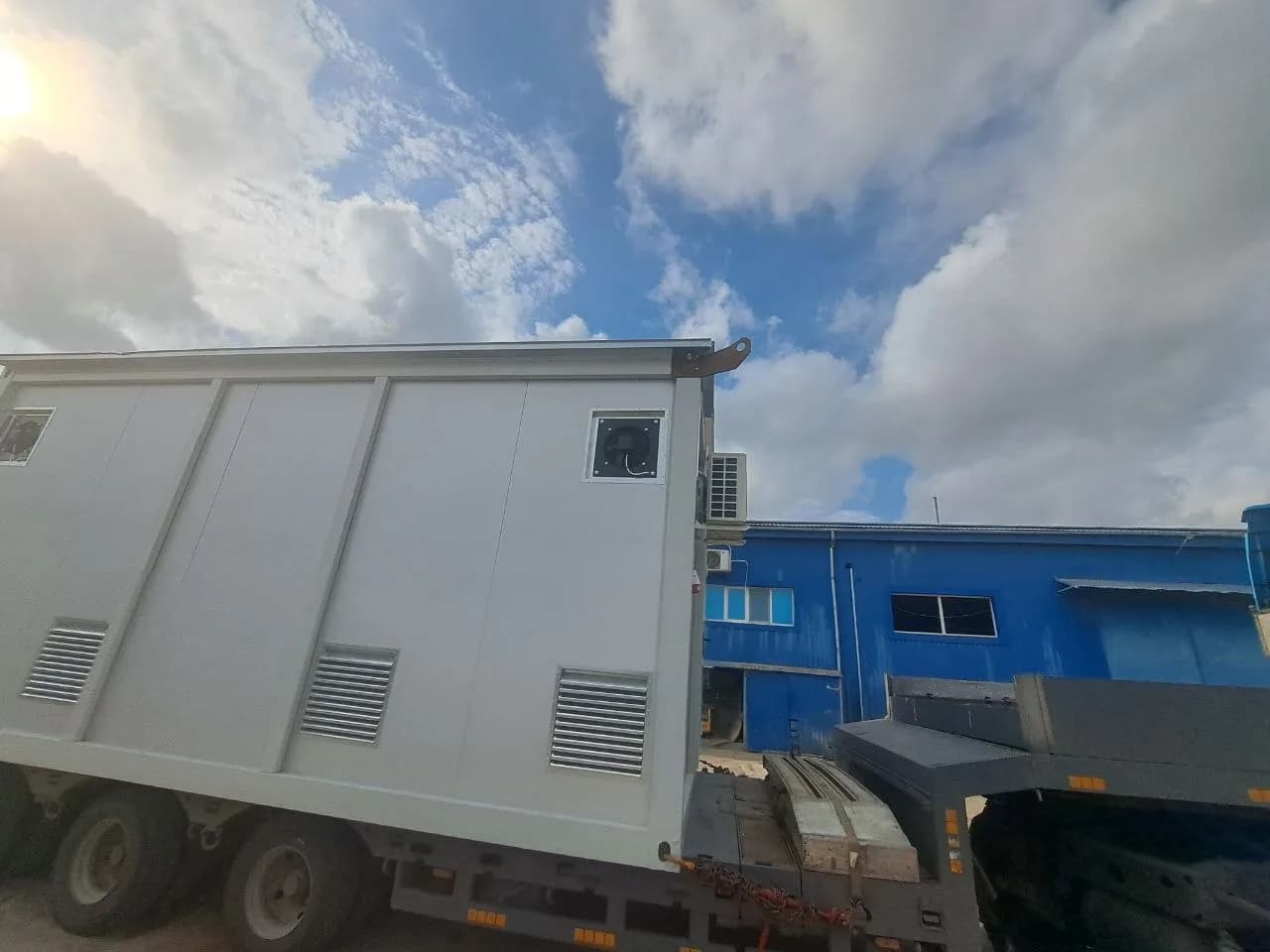
KRPZ (outdoor package switchgear in a modular building) is a 6–35 kV distribution point or substation that the factory manufactures together with its building. Instead of erecting a permanent structure on site and then spending months installing cubicles, busbars and boards inside it, the customer receives ready-made block modules: the medium-voltage switchgear, relay protection and, where required, power transformers and 0.4 kV boards are already installed inside. What remains on site is to prepare the foundation, join the modules and connect the cables. This is the solution for sites that need a full indoor distribution point, but where building a separate brick or framed structure for it would take too long or cost too much.
What a KRPZ is and how it differs from KRUN
Both KRPZ and KRUN solve the same task — placing medium-voltage switchgear directly on the site, without an existing building. The difference is in the format.
KRUN consists of separate insulated cabinets or blocks for outdoor installation: each cubicle (or group of cubicles) is protected by its own sealed enclosure and works in the open air in climatic version U1. Personnel service the apparatus from outside or from a narrow corridor inside the block.
KRPZ is a full modular building: an insulated structure with doors, maintenance corridors, lighting, ventilation and heating, inside which stands ordinary indoor equipment — KSO or KRU cubicles, ShchO-90 panels, auxiliary supply cabinets. The equipment inside needs no special “outdoor” version: the building creates the same microclimate for it as a permanent electrical room. Personnel work inside, in a space sheltered from precipitation and wind — which is more convenient for switching operations, inspections and repairs.
A practical rule of choice: when a few cubicles are needed without constant maintenance, KRUN is often enough; when the scheme is large (two sections, dozens of cubicles, transformers, 0.4 kV boards) or personnel work with the equipment regularly, a modular KRPZ building makes more sense.
| Parameter | KRPZ | KRUN |
|---|---|---|
| Format | A modular building with maintenance corridors | Separate insulated cabinets/blocks outdoors |
| Equipment inside | Indoor version (U3) — KSO/KRU cubicles, ShchO-90 | In a sealed outdoor enclosure (U1) |
| Maintenance | Personnel work inside the building | From outside or from a narrow corridor in the block |
| Typical composition | 6–35 kV switchgear plus, where required, transformers, 0.4 kV switchgear and auxiliary supplies — all in one structure | Usually only the medium-voltage switchgear |
| Scale of the scheme | Two sections, dozens of cubicles, several transformers | Limited by the dimensions of the transport block |
| Civil works | A foundation for the block modules | A foundation (frame, piles or slab) |
Design: a building that arrives ready-made
The basis of a KRPZ is a framed modular building of steel structures clad in insulated sandwich panels. The building is divided into transport block modules: at the factory the equipment is installed in each module and the busbars and secondary circuits are run, and on site the modules are joined on a common foundation into a single structure. The colour and the finish of the facades are to the customer’s specification.
Besides the switchgear itself, the building contains all the building services that in a permanent structure would have to be designed and installed separately:
- Ventilation
- Natural for the switchgear rooms, forced for the power transformer compartments, where heat has to be removed.
- Heating
- Electric heating of the rooms where required — so that condensation does not form on the insulation and apparatus in winter and personnel can work inside.
- Lighting
- Internal working lighting for the rooms and external lighting above the entrances.
- Auxiliary supplies
- Auxiliary transformers, operating current cabinets and supplies for the protection, heating and lighting circuits.
- Relay protection and metering
- Microprocessor relay protection terminals, current and voltage transformers, commercial metering meters; to the customer’s specification — telemechanics with data transmission to the control centre.
Configuration: what goes inside
The internals of a KRPZ are assembled to the single-line diagram of the specific site — this is not a standard “boxed” product:
- 6–35 kV cubicles
- KSO or KRU with vacuum circuit breakers: incomers, outgoing lines, sectionalising cubicles, voltage and auxiliary transformers. For two-section schemes — a section circuit breaker with automatic transfer switching (AVR) on the medium-voltage side.
- Power transformers
- If the KRPZ acts as a transformer substation, separate transformer compartments with forced ventilation are provided in the building. Several transformers can be accommodated in one structure — effectively one or two KTP units in a shared building.
- 0.4 kV boards
- ShchO-90 panels: incoming, a sectionalising panel with AVR, and distribution panels with circuit breakers for the outgoing feeders. The 0.4 kV switchgear stands in the same building — the cable links between the transformer and the board are minimal.
- AVR
- Automatic transfer switching can be implemented at both levels: a section circuit breaker with AVR in the medium-voltage switchgear and a ShchO-90 sectionalising panel with AVR in the 0.4 kV switchgear. Supply to the consumers is maintained when voltage disappears on either of the incomers.
An example from LK Energy practice — a standard KRPZ solution for four 630 kVA transformers: two two-transformer KTP units 6/0.4 kV in one modular building of 8700×8600 mm made of two sections, with 16 KSO cubicles with vacuum circuit breakers inside, 14 ShchO-90 panels, and AVR both on the 6 kV side and on the 0.4 kV side. This entire scheme arrived on site as factory-built blocks.
Where KRPZ units are used
- Solar power plants
- The power collection point of an industrial solar plant: the lines from the inverter substations are collected in the medium-voltage switchgear, from where the plant is connected to the grid. A solar plant on a field site has no buildings of its own — a modular structure covers both the switchgear and the room for relay protection, metering and telemechanics.
- Distribution points of 6–35 kV networks
- Distribution points and indoor substations of urban and industrial networks, and the reconstruction of existing substations, where replacing the old building with a ready-made module is easier than repairing it.
- Industry
- Main step-down and workshop substations of enterprises, supplies for pumping and compressor stations, grain elevators and logistics complexes — anywhere an indoor distribution point is needed and there is no spare building.
- Social and critical infrastructure
- Facilities with two independent incomers and AVR — hospitals, water utilities and communications facilities that need a backed-up supply in a compact form.
Turnkey manufacturing: from the single-line diagram to the finished building
The proper way to order a KRPZ starts with a single-line diagram and a questionnaire sheet: how many incomers and outgoing lines, whether transformers and 0.4 kV switchgear are needed, what the protection settings are, and what metering and telemechanics are required. Working from these inputs, the design department develops the layout of the building, divides it into transport modules and selects the cubicles and panels.
LK Energy manufactures KRPZ units at its own production facility in Odesa: the steel structures of the building, KSO cubicles with vacuum circuit breakers, ShchO-90 panels, and the secondary circuit and relay protection diagrams to the customer’s specification. The equipment is assembled and checked at the factory, so installation on site comes down to placing the modules on the foundation, joining them and connecting the cables.
Frequently asked questions
How does a KRPZ differ from a KRUN?
By format. KRUN consists of separate insulated cabinets or outdoor blocks, where each cubicle is protected by its own enclosure. A KRPZ is a full modular building with maintenance corridors, inside which stands indoor equipment: KSO/KRU cubicles, 0.4 kV boards, transformers. For large schemes and for sites with regular maintenance, a KRPZ is usually chosen.
Can power transformers be placed inside a KRPZ?
Yes. Separate transformer compartments with forced ventilation are provided in the building — the KRPZ then acts as a full transformer substation with medium-voltage switchgear and 0.4 kV boards in one structure. In one of LK Energy’s standard solutions, four 630 kVA transformers are accommodated in the building.
What civil works does a KRPZ require?
Only a foundation for the block modules — typically a piled one with a supporting frame of channel sections; it is developed by a design organisation from the manufacturer’s specification and drawings. Plus the cable entries. The building itself, with the equipment inside, arrives as finished transport modules that are joined on the foundation. No permanent construction is required.
LK Energy Group manufactures KRPZ package switchgear in modular buildings to the single-line diagram of your project — with KSO cubicles, ShchO-90 panels, AVR and factory checking. Send us a single-line diagram or a questionnaire sheet — get in touch and we will price the configuration.
See also
Need an engineer’s advice?
Have a task involving power supply, switchgear or solar plants — write to us and we’ll answer to the point.
+380 67 104 94 91