
ShchO-90 panels: specifications and applications
Author: Sviatoslav Yurdyk, Quality Engineer at LK Energy Group.
Verifies that in-house manufactured switchboard equipment complies with DSTU EN IEC 61439 — from incoming inspection of components to acceptance testing of finished products.
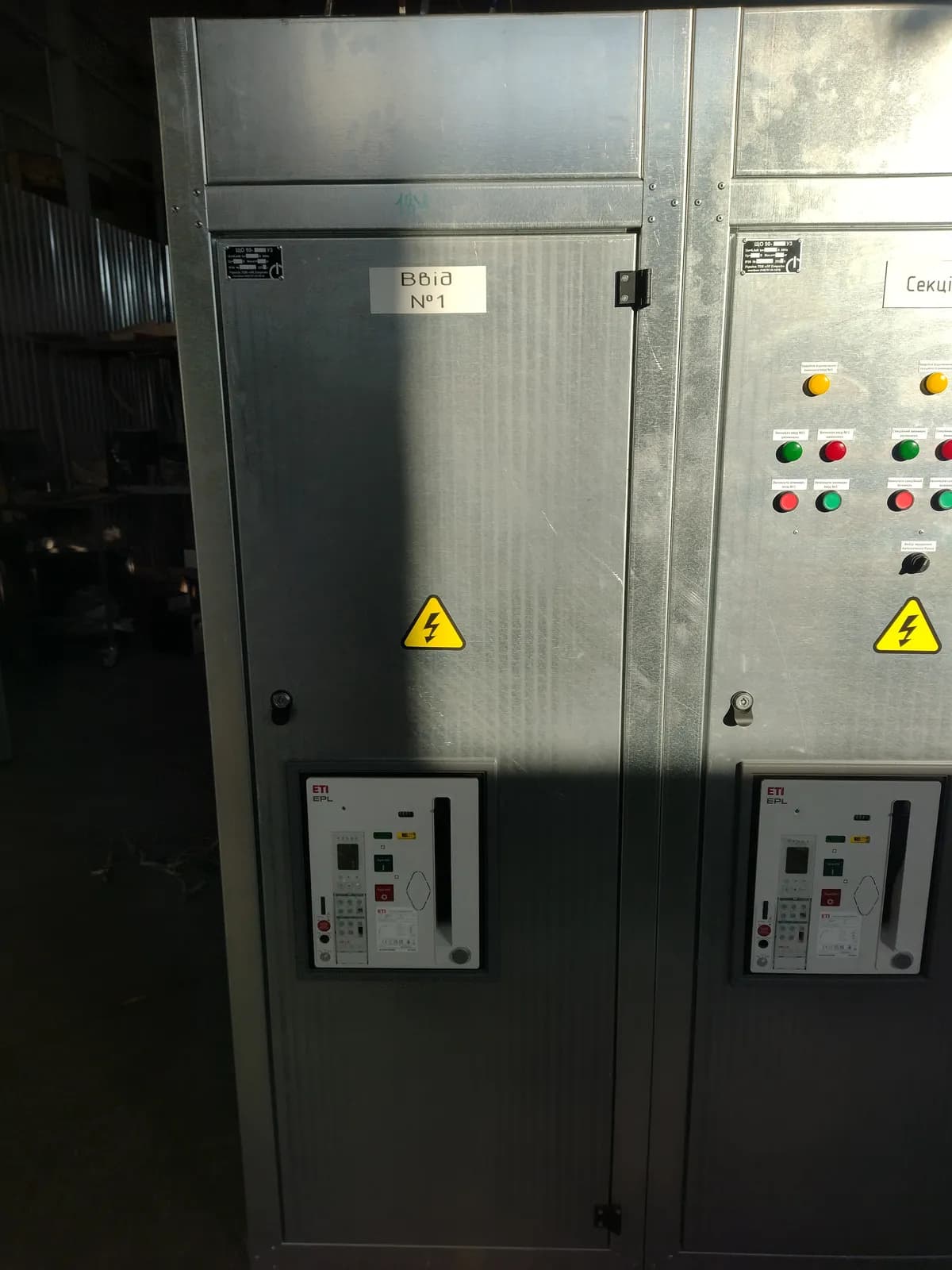
ShchO-90 is a series of panels for 0.4 kV front-access distribution switchboards, used to build up low-voltage switchgear assemblies: the RU-0.4 kV of transformer substations, incoming distribution units (VRP) and main switchboards of buildings. The panels are installed in a row against a wall, linked by common busbars and fitted with switch-disconnectors and circuit breakers for currents up to 4000 A. This article explains what ShchO-90 is, which panel types exist, how the design is arranged and on which sites this equipment is used.
What ShchO-90 is
The name stands for "front-access switchboards, series 90" — a design evolution of the earlier ShchO-70 series. "Front access" means that all devices, connections and secondary wiring circuits are reachable from the front of the panel: the switchboard is placed right against the wall, no rear passage is needed, and the switchgear room is used as compactly as possible.
In terms of standards classification, ShchO-90 belongs to NKU — low-voltage switchgear and controlgear assemblies for voltages up to 1 kV, whose requirements are set by DSTU EN IEC 61439. The key idea of the series is modularity: the switchboard is not designed from scratch but assembled from standard panels — incoming, outgoing and bus-section ones — to the single-line diagram of a specific site. The number and the set of panels are defined by the designer, while the manufacturer combines them into a single switchboard with a common busbar system, tests it and delivers it to site as a finished product. An example of a standard version is ShchO-90 distribution switchboard panels for currents up to 4000 A.
Technical specifications
- Rated voltage — 0.4 kV (380/400 V), three-phase 50 Hz network.
- Rated busbar current — up to 4000 A depending on the version; the busbar cross-section is selected according to the calculated load of the switchboard.
- Device ratings: incoming switch-disconnectors and circuit breakers — typically 630–4000 A, outgoing line devices — typically 100–630 A.
- Short-circuit withstand — determined by the busbar system version and the installed devices, and confirmed by testing to DSTU EN IEC 61439.
- Installation — indoors (switchgear rooms, RU-0.4 kV rooms of substations); servicing from the front.
- Dimensions — typical panel height 2000 mm; width and depth depend on the version and the installed equipment.
By function, the panels are divided into incoming (receiving supply from a power transformer or a network incomer), outgoing (distributing power across outgoing feeders), bus-section (connecting and separating the busbar sections) and panels with AVR equipment — automatic transfer of the standby supply. Current transformers, measuring instruments and commercial or technical metering meters are additionally installed in the panels.
ShchO-90 panel types
| Panel type | Purpose | Typical currents |
|---|---|---|
| Incoming | Receiving supply from a transformer or a network incomer; incoming switch-disconnector and/or circuit breaker, metering | 630–4000 A |
| Outgoing | Outgoing feeders to consumers; groups of circuit breakers, current transformers | 100–630 A per feeder |
| Bus-section | Connecting and sectionalising the busbars of a two-section switchboard | to the busbar rating |
| Bus-section with AVR | Automatic transfer of the load between sections when voltage is lost on one of the incomers | to the rating of the bus-section device |
| End | Closing the ends of the outermost panels of the switchboard | — |
A typical switchboard configuration for a two-transformer substation: two incoming panels from transformers T1 and T2, a bus-section panel with AVR between the two busbar sections, and outgoing panels for the outgoing lines with metering.
Design
Frame. The panel is based on a metal frame of folded profile with powder coating. At the front there are doors and removable false panels covering the devices and live parts; the rear and the sides are closed, since access there is not intended with front-access servicing.
Busbars. A common busbar system runs along the upper part of the panels — aluminium or copper, with a cross-section matching the rated current of the switchboard — together with the PE/PEN conductor. When the switchboard is assembled, the busbars of adjacent panels are joined into a single run; busbar bridges are used for the connection to the power transformers.
Equipment. Switching and protection are provided by switch-disconnectors and circuit breakers, and by air circuit breakers for high incoming currents. Measuring and metering circuits comprise current transformers, ammeters or multimeters and electricity meters. In bus-section panels with AVR, an automation circuit is installed: voltage monitoring relays and the control circuits of the bus-section device. The specific types and ratings of the devices are defined by the single-line diagram of the project.
Where ShchO-90 is used
- RU-0.4 kV of transformer substations — the classic application: the distribution switchboard of a ZTP or of a KTP 10(6)/0.4 kV is assembled from ShchO-90 panels as the RUNN — the low-voltage switchgear assembly.
- Building VRP units — incoming distribution units of residential and public buildings, where high incoming currents and a large number of outgoing lines are required.
- Main switchboards (GRShch) — main distribution switchboards of production facilities, shopping centres and administrative complexes.
- 0.4 kV distribution points at industrial sites, where the supply is distributed across workshops and separate structures.
An alternative to the panel layout is cubicle-type RUNN within packaged substations; the choice between them is defined by the project and by the room layout.
Manufacturing of ShchO-90 panels
ShchO-90 panels are a standard product of the LK Energy Group plant in Odesa. The full cycle is carried out at one facility: metal cutting and bending, powder coating, assembly of the busbar system, installation of equipment, and acceptance testing of every product with a passport.
To place an order, a single-line diagram or a filled-in questionnaire sheet is enough: it specifies, in table form, the ratings of the switch-disconnectors and circuit breakers, the release settings, the current transformers, the metering instruments and the purpose of every feeder. Based on this data, both individual panels and complete 0.4 kV switchboards are manufactured — including non-standard versions that do not fit the catalogue items.
Frequently asked questions
How does ShchO-90 differ from ShchO-70?
These are the earlier and the later series of the same 0.4 kV front-access switchboards. ShchO-90 is the more modern design base used in new projects; functionally the series are equivalent, so when old ShchO-70 switchboards are refurbished they are usually replaced with ShchO-90 panels to the same diagram.
How many panels are needed for a two-transformer substation?
The minimum typical configuration is two incoming panels (one from each transformer), a bus-section panel (with AVR if required) and outgoing panels matching the number of outgoing feeders. The exact set is defined by the single-line diagram: for example, a typical switchboard of a two-transformer ZTP may consist of seven panels.
Can panels be ordered to a custom diagram?
Yes. ShchO-90 is a design base, while the set of devices, ratings, bus sectionalising and metering are assembled to the single-line diagram of the specific site. It is enough to send the diagram or a filled-in questionnaire sheet — the manufacturer will select the panel versions and the equipment.
LK Energy Group is a manufacturer of ShchO-90 panels and 0.4–35 kV switchboard equipment with its own plant in Odesa. Specifications and versions are on the page of ShchO-90 panels for currents up to 4000 A, and the full catalogue is in the "Equipment" section. Send us a single-line diagram or a questionnaire sheet — we will work out a switchboard for your project.
See also
Need an engineer’s advice?
Have a task involving power supply, switchgear or solar plants — write to us and we’ll answer to the point.
+380 67 104 94 91