
How to choose a switchgear manufacturer: a buyer’s checklist
Author: Sviatoslav Yurdyk, quality engineer at LK Energy Group.
Acceptance of equipment at the factory (quality control department) and technical supervision at electrical installation sites.
The short answer (for those in a hurry)
Switchgear in Ukraine is sold by three different kinds of company: factories, which cut the steel and assemble the boards themselves; assemblers, which buy a ready-made enclosure and fit the equipment into it; and middlemen, who do nothing at all and pass your order further down the line. The price in the commercial quotation looks the same from all three — the difference shows up when the board has to be reworked because the design changed, when a device fails under warranty, or when the customer asks for the test report.
You can tell them apart with four questions before you sign: which technical specifications (TU) the product is built to, whether the company has its own accredited electrical testing laboratory, what comes in the document package with the board, and who is responsible for the warranty. But the main thing is not the company's status — it is what gets cut where you cannot see it: the same board to the same diagram appears on the market with a 30–50% price spread, and that difference comes from somewhere. Below is a list of exactly what gets trimmed and how each item surfaces within one to three years, followed by a nine-point checklist that removes these risks before you sign.
A 30–50% spread on an identical diagram is not "working more efficiently". Steel, copper and switchgear components cost roughly the same for everyone; so does the work of a designer and an assembler. If two quotations for the same board differ by half again, someone has taken that difference out of something — and almost always out of what cannot be seen at acceptance. The customer finds out about it not on the day of signing, but a year or three later, when the board starts running hot, rusting, or failing to interrupt what it was supposed to interrupt.
Factory, assembler, middleman: how to tell them apart
The quickest way is to ask not "are you a manufacturer?" but about operations. Building a board consists of four stages, and a company either has each of them or it does not:
- Design office. Who draws up the drawings for your single-line diagram — an in-house designer, or "we will fit it into a standard frame size"?
- Metalwork. Is the enclosure cut and bent in-house (guillotine, CNC turret punch, bending, forming, welding, painting), or bought ready-made?
- Assembly. Mounting the equipment, busbars, power and secondary wiring, labelling — an in-house shop or a subcontractor?
- Testing. Is there an accredited in-house electrical laboratory, or is the product taken "for a check" to an outside one?
This is not a formality. A company with its own enclosure production will change a frame size or add a cubicle when your design changes. A company that buys enclosures will say "that is not how it is done" in the same situation — not because it cannot be done, but because it has no metalwork of its own.
For reference: LK Energy has been building switchgear at its own factory in Odesa since 2015 (the company has been on the electrical installation market since 2005), with a full cycle from the design office to an accredited electrical laboratory; more than 3000 units of equipment have been produced since 2015.
What gets cut, and what nobody mentions
Below is what does occur on the market and what cannot be seen at acceptance: the board looks new, the devices click, the lamps come on. For each item, how it surfaces within one to three years. Where there is a standard or a figure from a datasheet, we name it; where it is an observation from our service practice, we say so.
1. Enclosure coating
What is done: painting over black steel instead of using galvanised steel — while the paint is intact, telling them apart is almost impossible.
How it surfaces: corrosion starts not on the flat surface but at cut edges, holes and fixing points, where the coating is thinnest. First blistering under the paint, then rust around the door perimeter. For an outdoor board or an unheated room this is a matter of one or two seasons (service observation).
Our standard, for comparison: galvanised steel with a zinc coating weight of 275 g/m²; in some products, steel galvanised by hot-dip immersion and then painted. Hot-dip galvanising and paint over black steel mean different service lives for the enclosure, not different tastes. As far as we know, in the Odesa region we are the only ones producing fully galvanised KTPGS substations in series; we do not claim this for Ukraine as a whole.
2. A busbar that only looks like a busbar
What this does NOT mean: "they used aluminium instead of copper". Copper or aluminium is chosen at the design stage, they serve different purposes, and high currents always call for copper — an aluminium busbar for such a current would be physically enormous. That is an engineering decision, not a saving.
What is actually done: instead of an electrical-grade busbar — one intended for electrical connections — a cheap aluminium alloy with a high impurity content is used, which is not intended for current-carrying joints. They look identical. The difference in material cost is up to 50%, and that is what later "explains" the cheap quotation.
So the question is not "copper or aluminium", but "which aluminium". The material grade is something a manufacturer either names or does not. For reference: in our own questionnaire for ShchO-90 panels the busbar material is stated by grade — AD31T, an electrical-grade aluminium alloy; the cross-section is left to the project. If a quotation gives no grade at all, that is exactly where you should ask.
How it surfaces: as heating in normal operation and at the joints. A hot busbar loosens bolted connections, a weak contact releases even more heat, and the process accelerates itself — ending in darkening and scorching of the contact group. It becomes visible when the load reaches its design value, that is a season or two after commissioning, not at acceptance under a small current.
How it is measured: heating and contact joints have standards — GOST 8024-90 (heating) and GOST 10434-82 (electrical contact joints). Our KSO datasheets state that the temperature of enclosure parts that can be touched does not exceed 50 °C. The question "to which standard was heating verified, and what is written in the report" settles the matter faster than any words about quality. And this is not our private opinion but a well-known picture in the industry: overheating and loosened contact joints are considered one of the main causes of switchgear failure.
3. Breaking capacity of the devices
What is done: devices are selected by rated current and price, identical throughout the board, without checking the short-circuit current at that particular point of the network.
How it surfaces: it does not — until there is a short circuit. The device works honestly as a switch for years. The difference shows up exactly once: when it has to interrupt a fault current it was never rated for.
What it looks like when done properly: in one of our substation orders the devices differ precisely by their position in the diagram — the incoming device of the 0.4 kV board rated 2000 A with a breaking capacity of 85 kA, the outgoing ones 50 kA, and in the auxiliary supply board 10 kA (datasheets from 2025). Fitting the cheapest device with a low breaking capacity everywhere is precisely the saving that appears in no document except the calculation.
The second half of the same saving is service life. A cheaper device may perform one interruption and never close again, or it may manage a hundred and die. At acceptance both click exactly the same way.
Service life is not a figure of speech, it is named in the document: our KSO datasheets list exhaustion of the switching and mechanical service life as grounds for the warranty to end. The figure for a specific device comes from its own manufacturer — and in a cheap device it is used up an order of magnitude faster (service observation).
4. Unbranded devices
What is done: devices of unidentified origin are fitted, outwardly similar to well-known series.
How it surfaces: a year or two later there is nothing compatible to replace them with, no service exists, and the declared characteristics are backed by nothing — no test report, no manufacturer to turn to. A board like this is not repaired, it is rebuilt.
5. A degree of protection that exists only in the quotation
What is done: a single impressive IP rating is written in the specification for the whole product.
How it really works: a substation does not have one degree of protection. The datasheet of our KTPM-400 pole-mounted substation lists three values: IP54 for the low-voltage distribution cabinet, IP23 for the power transformer, IP34 for the remaining components. For KSO and ShchO-90 the value is double: IP20 from the front and IP00 with the doors open. A single IP "for the whole product" is already a simplification, and it means nobody did the calculation.
Why a genuine IP is never free: in our YaVU boxes the IP54 version reduces the rated current by 15% compared with IP31 — a more sealed enclosure dissipates heat less well. So an honest high IP costs either current or money spent on heat removal. If a high IP in a quotation has affected nothing at all, it was most likely simply written there.
How it surfaces: condensation on the devices in an unheated room, dust and moisture outdoors; then corrosion of the contacts and leakage currents where there should be none (service observation).
6. Secondary circuits: cross-sections, ferrules, labelling
What is done: thinner wire in the secondary circuits, conductors without ferrules — simply twisted and clamped, labelling "you will figure it out".
How it surfaces: a conductor without a ferrule gradually unravels under the screw, the contact weakens, and heating and spurious protection trips appear — the worst kind of fault, because it is intermittent and takes a long time to trace. Missing labelling costs differently: any inspection or fault-finding turns into an investigation, and after a few years into "easier to rebuild from scratch" (service observation).
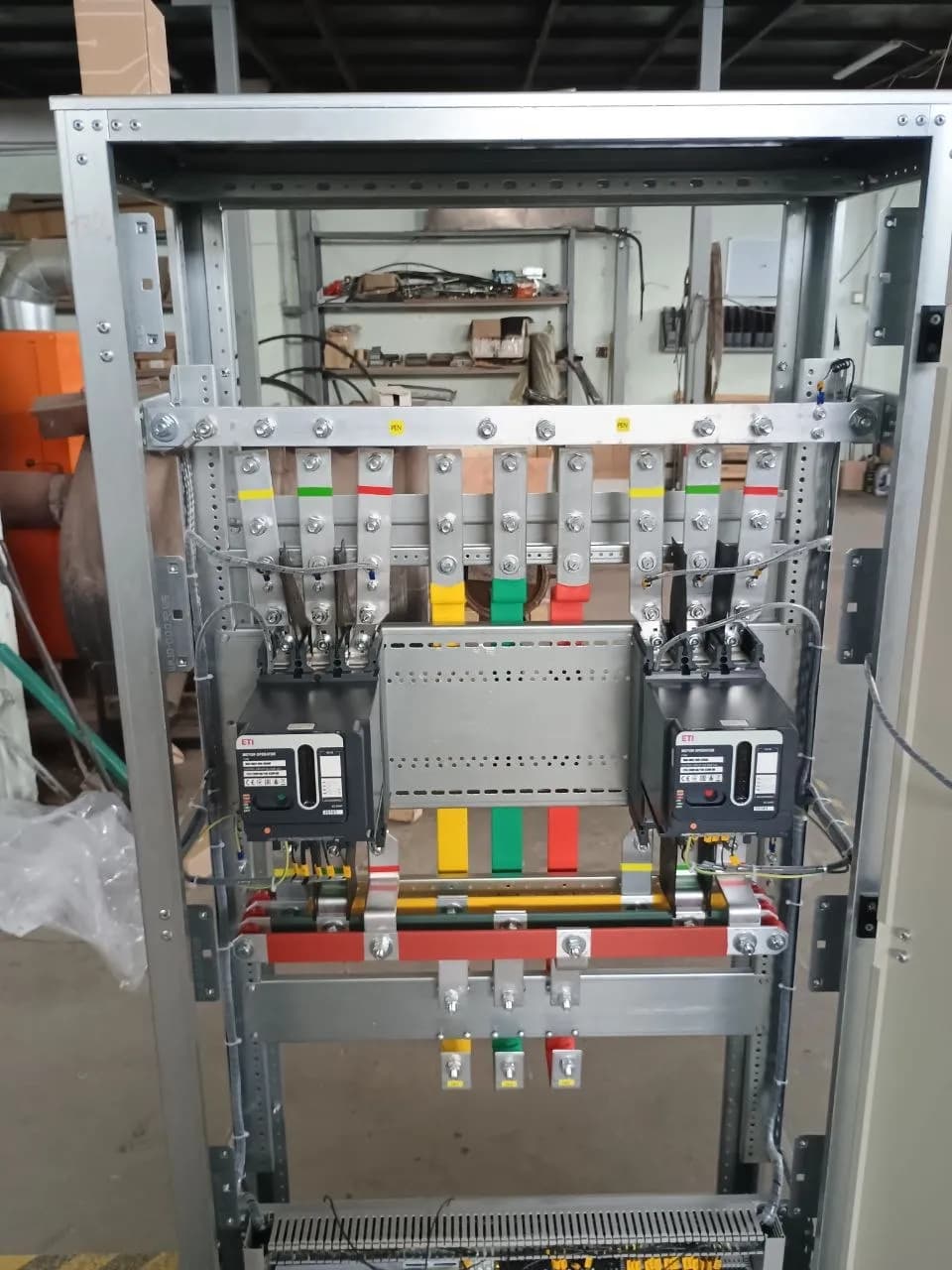
What the norm looks like: labelling is not only tags on wires. The KSO datasheet even specifies colour marking of the busbars: transverse stripes at least 20 mm wide, phase A yellow, B green, C red. Terminal blocks for external circuits are rated for one or two conductors with a total cross-section of up to 6 mm².
7. Terminal blocks in the secondary circuits
What is done: the cheapest terminal blocks are fitted — visually the same as proper ones.
How it surfaces: some of them break at the very first tightening — right there during assembly or commissioning. This shows up as a high reject rate before the product even reaches the customer; whatever did not break immediately gives a weak contact later in service.
8. Tests that never happened
What is done: the product is shipped without test reports, or with a report "for the file" that records no actual measurements.
How it surfaces: an assembly defect that testing would catch in half an hour travels to the customer and appears on site — in the worst case under load. And without a datasheet bearing the serial number and a test report, the customer has nothing to build a warranty claim on.
What exactly should be verified: dielectric strength of the insulation (GOST 1516.3-96), heating (GOST 8024-90), contact joints (GOST 10434-82). Our datasheets also carry specific measured values — for example, insulation resistance of 1000 MOhm. The question for the supplier is simple: to which standards was it tested, and what exactly is written in the report.
9. The parameters nobody asks about
What is done: nothing is said about anything outside the standard quotation checklist.
An example: sound level. The datasheet of our KTPM-400 pole-mounted substation gives it — no more than 60 dBA. For a substation next to housing this is the decisive figure (it is not quoted in the datasheets of our other types), yet it rarely appears in commercial offers: if a parameter is not named, nobody has guaranteed it.
10. What simply was not supplied
What is done: whatever the rules require but does not catch the eye at acceptance is dropped from the scope.
The clearest example is a substation. Two KTPGS units can be visually identical: the same enclosure, the same doors, the same nameplate. What is inside them, however, can be completely different.
Under the rules for the construction and operation of electrical installations, lighting inside a substation is mandatory, including standby lighting. Lighting has to be powered from somewhere — an auxiliary supply board is needed, and it in turn requires an auxiliary supply transformer. The transformer adds cost.
This is not a redundant piece of hardware: the auxiliary supply transformer has its own job — it powers the site itself, that is control circuits, signalling, lighting, heating of cabinets and drives, ventilation — rather than distributing power to consumers. In our questionnaires these items appear as separate lines: indoor and outdoor lighting, heating, ventilation. In other words, for us this is part of the product, not an option. Removing that chain is the simplest way to make a quotation cheaper, and the customer will not see it: the substation looks complete and works. It comes to light either at the first fault, or when it turns out that there is nowhere to power even the metering readout device from.
A case from our service practice. A solar power plant we took on for maintenance: out of four substations, auxiliary supply was present at only one — instead of four transformers the contractor had installed a single one. To take proper measurements we had to run a cable from one substation to the other three. The layout was simplified "at take-off", the rules were broken, in the quotation it simply looked cheaper — and it surfaced a year into operation, when we arrived on site.
And that was not the whole of the saving. Along with the auxiliary supply, forced ventilation had disappeared from the substations as well — there was nothing to power it from either. The result: every KTPGS on the site was running as hot as a frying pan. The pyrometer read up to 88 °C on the surface of the equipment inside the transformer compartment. A surface is always cooler than what it contains — so the oil inside the tank was hotter still: at the limit of the permissible 95 °C for the top oil layers under the Ukrainian rules for the technical operation of consumers' electrical installations (PTEES), or already beyond it. And all of this without a single fault and without a single signal to the customer — the service life was simply being consumed day after day. (We do not name the site or the contractor; 88 °C is our own pyrometer reading on site, 95 °C is the permissible top-oil temperature for transformers with natural circulation under PTEES.)
Why it works exactly this way. There is a clear list of what a substation must contain under the rules. A conscientious manufacturer does not breach it. Anyone who drops half of the regulated scope from a quotation will of course be cheaper — and what is being compared looks like two identical products while the contents differ. Most procurement looks only at price, and in many industries that works. In electrical engineering it does not: the price comes back years later, when the board has to perform as intended — and it does not, because someone saved at take-off. Cheap does not mean good.
How else it surfaces: heating and ventilation removed where conditions require them bring condensation in winter and overheating in summer; an enclosure sized right to the limit turns replacing a device into dismantling half the board (service observation).
11. How the warranty period itself is built
What is done: a period is quoted without saying what it is counted from.
How it should be written: in our datasheets the warranty has two limits — so many years from the date of commissioning, but no more than a year longer from the date of receipt. The second limit protects the manufacturer against a product that sat in a warehouse for a year, and shows the buyer that the period is real. The period differs by product type, so a contract should state not just a figure but both limits.
This is what the price is made of. The board comes out noticeably cheaper — but the quality has dropped. You cannot tell visually: only a technician will see it, and usually once it is already in service.
None of these points is visible while the board stands new and de-energised. All of them become visible in the second or third year — which is exactly why they are convenient to cut for whoever sells rather than maintains.
The buyer's checklist: nine points
1. Which TU the product is built to
Technical specifications are the document that entitles a product to be called what the quotation calls it. A serial manufacturer has different TU for different classes of product: one set for low-voltage assemblies up to 0.4 kV (boards, boxes, control cabinets), another for KSO cubicles, another for switchgear. If a quotation says "0.4 kV board" but gives no TU number, ask for the number. No number means there is nothing to discuss about compliance.
2. Whether there is an accredited in-house laboratory
A product is verified by testing, not by eye. The question is simple: is the laboratory in-house or external, and does the test report come with the delivery. An in-house laboratory also means speed: reworking after a remark does not wait in someone else's queue.
3. What document package travels with the board
The minimum that should be in the crate: a datasheet with the serial number, the main circuit diagram (and the secondary circuits diagram, if any), the test report, the packing list and the warranty card. The datasheet with a serial number matters most: years later it identifies the product when you need to order an identical cubicle or prove its origin.
4. Who is responsible for the warranty, and what exactly it covers
The warranty on the board and the warranty on the devices inside are different things. The enclosure is the board manufacturer's responsibility; a circuit breaker or a relay carries its own maker's warranty, with the board manufacturer acting as an intermediary in a claim. Ask separately: how long on the product, how long on the enclosure steelwork, and what counts as a breach of operating conditions. Our own commitment is 2 years on the product (up to 5 years by agreement) and 10 years on the enclosure steelwork, provided the transport, storage and installation conditions are observed.
5. What the enclosure is made of and how it is coated
Galvanised steel with a 275 g/m² coating, stainless steel, or black steel with stove-baked powder coating — these mean different enclosure lifetimes and different prices. For outdoor installation the coating matters more than almost anything else in the quotation.
6. Degree of protection and climatic version for your location
IP and climatic version are chosen not to be "as high as possible" but to suit the installation site: a switchroom in a heated building, an unheated room and outdoors are three different sets of requirements. Excess IP is money wasted; insufficient IP means condensation and corrosion.
7. Who approves design changes, and how they are recorded
Changes happen almost always. What matters is not that they occur but how they are recorded: an approval letter, a revised diagram, a reissued specification. A verbal "we will add a breaker" turns into an argument at acceptance.
8. How the delivery time is fixed
Lead time depends on complexity, on the devices specified and on the factory's workload — so a quotation either states it with conditions (what it is counted from, what counts as a delay by the device supplier), or does not state it at all. Do not compare two quotations by the promised time; compare them by what the contract says.
9. Whether you can visit the production
The simplest check of all. A factory can be shown. The question "may I come and see the shop floor" removes half the doubts without any documents at all.
Why a price means nothing without a questionnaire
A custom board has no price list, because it has no frame size until the diagram is known. Two quotations for a "ShchO-90" may differ twofold — and both be honest, if one has four outgoing panels with switch-fuses and the other has two and a different busbar rating.
That is why a proper manufacturer first sends a questionnaire or asks for the single-line diagram, and only then calculates. If a price is quoted straight away, without a single question about the diagram, what is being priced is not your board but "something roughly like it".
Frequently asked questions
Why do boards with identical diagrams differ in price by 30–50%?
Steel, copper and devices cost roughly the same for everyone, so a difference of half again does not come from efficiency but from what has been removed from the product. Most often what gets cut is what cannot be seen at acceptance: the thickness and coating of the steel, busbar cross-sections, the breaking capacity of the devices, ferrules and labelling in the secondary circuits, the real degree of protection, testing with reports. The board still looks new and works — the difference appears in the second or third year of service.
How can hidden savings be spotted before signing a contract?
Ask not about the price but about the specifics of the product: the steel grade and enclosure coating, the cross-section and material of the busbars, the breaking capacity of the devices with reference to the short-circuit current at your point, whether ferrules and labelling are used in the secondary circuits, what the declared IP actually consists of, which tests the product undergoes and what the report contains. The item that has been trimmed usually either has no answer, or the answer sounds like "that is not essential".
How do I check that a company really is a manufacturer and not a middleman?
Ask about operations rather than status. The four stages of building a board — design office, metalwork, assembly, testing — either exist within the company or they do not. In addition: the TU number for the product, an accredited in-house electrical laboratory, and the option to visit the production. A middleman will fail all three questions.
What documents should be delivered with the board?
A datasheet with the serial number, the main circuit diagram (and the secondary circuits diagram where applicable), the test report, the packing list and the warranty card. The datasheet with the serial number is the most important: years later it identifies the product when you need an identical cubicle, have to prove its origin, or make a warranty claim.
What warranty on switchgear counts as normal?
Separate the warranty on the product from the warranty on the enclosure steelwork. Our own commitment is 2 years on the product, up to 5 years by agreement, and 10 years on the steelwork provided transport, storage and installation conditions are observed. The warranty on the devices inside the board is that of their own manufacturer; the board maker acts as an intermediary in a claim, and this is worth writing into the contract as a separate clause.
Why do I need a questionnaire if I just want to know the price?
Because a custom board has no frame size until the diagram is known: the number of connections, the ratings, the devices, the enclosure version, the installation site. Without those, any figure is the price of somebody else's board. A questionnaire is the shortest way to give the manufacturer that data — and to get comparable offers from several companies.
Send us the diagram and we will price your board
LK Energy manufactures 0.4–35 kV switchgear at its own factory in Odesa: serial products and custom boards to your specification or single-line diagram. Every product passes quality control and testing in our own accredited electrical laboratory — the reports are handed over together with the product.
This material is for information only and is neither an offer nor a recommendation of any particular supplier. The scope of equipment, its version and the delivery time are determined from your single-line diagram or completed questionnaire.
See also: Switchgear manufacturing · All LK Energy services
See also
Need an engineer’s advice?
Have a task involving power supply, switchgear or solar plants — write to us and we’ll answer to the point.
+380 67 104 94 91