
Bolted Connections for Current-Carrying Busbars: Why Reliability Depends on Contact Pressure, Not Bolt Grade
Author: Volodymyr Ledok, Technical Director of Production at LK Energy Group.
Responsible for the production of switchgear equipment — assembly and quality control of LVSA (low-voltage switchgear and controlgear assemblies), KRU (medium-voltage switchgear), KSO (single-side-access switchgear cabinets) and busbar assemblies. Tightening contact connections to a specified torque and marking them is part of factory quality control.
Short answer (for those in a hurry)
For bolted connections of copper and aluminum current-carrying busbars, bolt grade is a lower bound (not below 5.8 per the standard), not a matter of "the stronger, the better." Joint reliability is determined not by bolt strength but by controlled and consistently maintained contact pressure. Grade 8.8 bolts are acceptable; galvanized grade 10.9 and 12.9 bolts should be avoided on busbars due to hydrogen embrittlement. The key tools for reliability are a torque wrench, a Belleville (disc spring) washer, and torque marking.
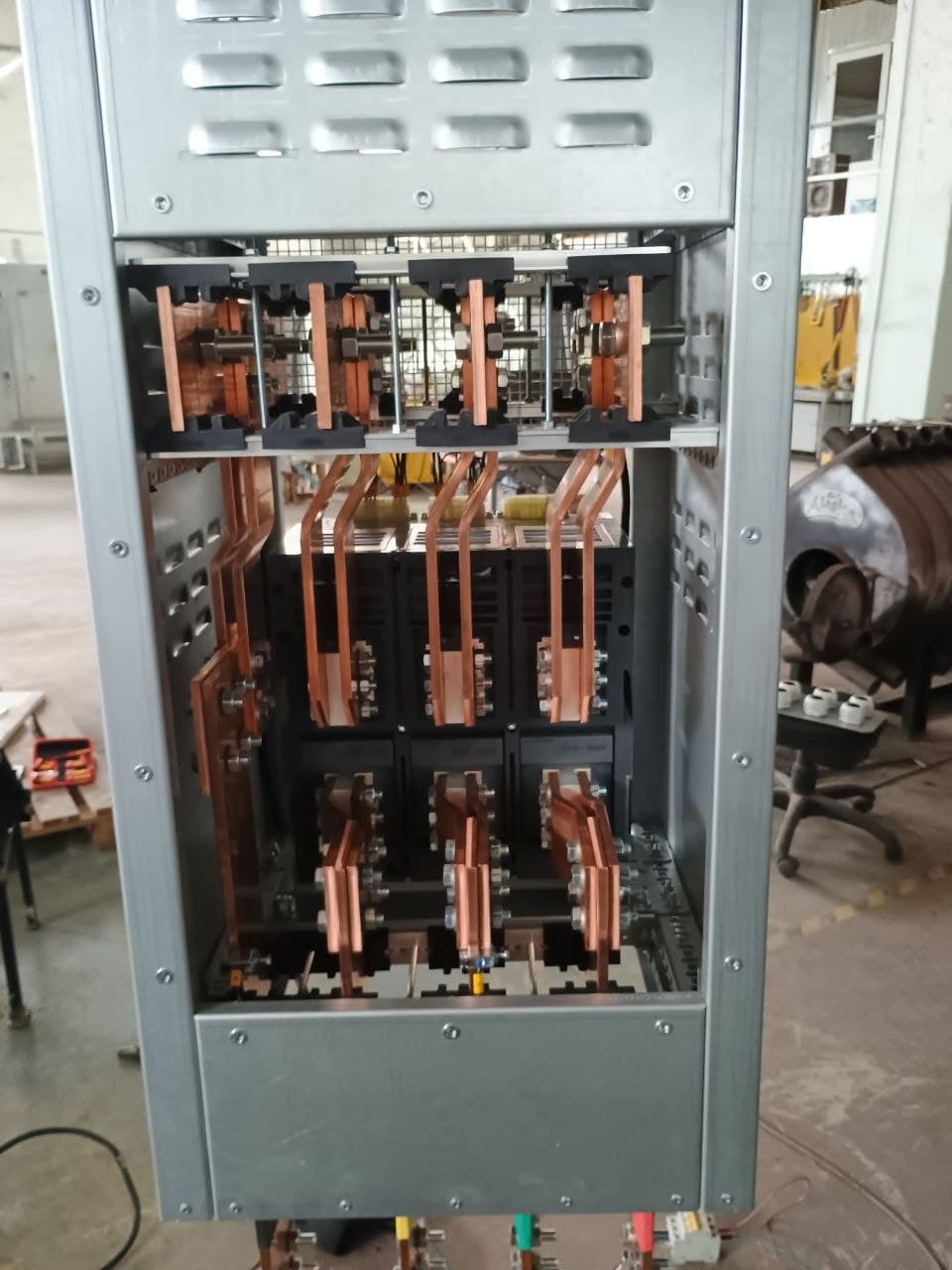
"Just use a stronger bolt" — the most expensive mistake in a switchgear cabinet
Intuition says: the stronger the bolt, the more reliable the connection. For a steel structure — true. For a current-carrying busbar made of soft metal — not true. Here the bolt doesn't "carry a load"; it performs one job: it creates and maintains the pressure that presses two busbars together. Chasing bolt strength without understanding contact physics can build in future overheating with your own hands.
How a bolted busbar joint actually works
Three things to accept before discussing strength grades:
- The bolt is a spring
- It works correctly only when slightly stretched within its elastic range and continuously clamps the stack. Under-tightened — no pressure; over-tightened past the yield point — it loses its spring action.
- Current flows not through the bolt but through the clamped busbar surfaces
- Steel conducts current 7–10 times worse than copper, so the bolt shank is a clamp, not a conductor. Strength grade has nothing to do with current flow.
- Contact is held by micro-spots
- Only about 1% of the visible area actually touches — the peaks of microscopic surface irregularities. The higher the pressure, the more of these spots there are and the lower the contact resistance. As pressure drops, resistance rises, and heating increases.
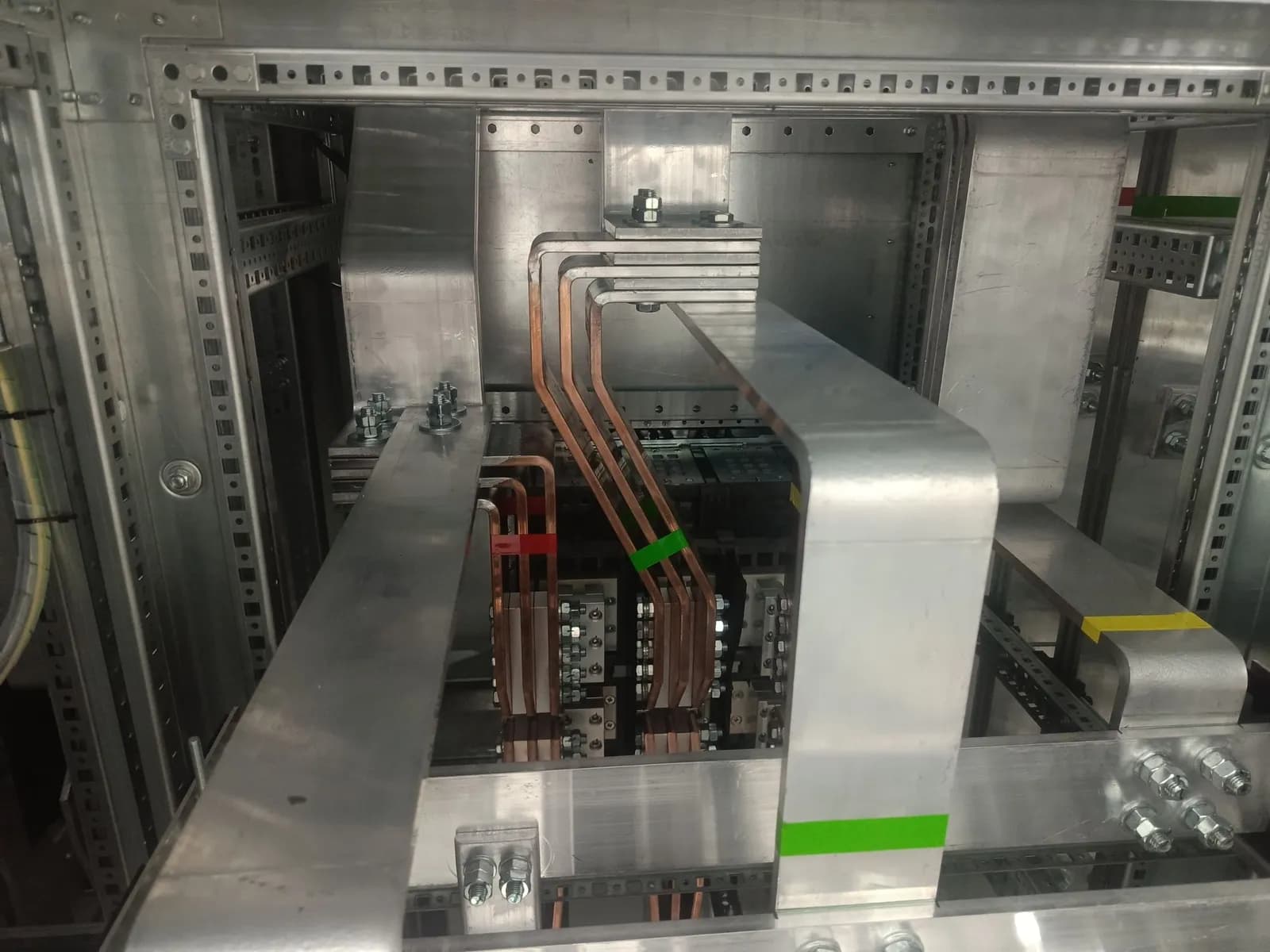
What happens if you put an 8.8 bolt "by the table" on aluminum
This is exactly where a "time bomb" is born. Right after installation everything looks flawless — problems begin under working load. Here is the correct physics, step by step.
Step 1. Over-tightening. If you tighten a bolt to a torque calculated for its strength, the large force presses into the soft aluminum — the busbar gets a permanent dent, the metal "flows." Important: it's not that grade 8.8 steel is "stiffer" (stiffness is the same in 5.8 and 8.8 — it's steel), but that its high yield threshold allows the installer to apply excessive force.
Step 2. The "pump" effect. Current flows — the busbar heats up. Aluminum and copper expand more than steel. As it expands, the clamped busbar pushes against the rigid stack, contact pressure spikes, and the soft metal is squeezed sideways (creep). When it cools, it contracts, but the squeezed-out metal doesn't return. Each heating-cooling cycle ratchets down the clamping pressure. This is the main real cause of busbar joint aging.
Step 3. Avalanche and burnout. What follows is an irreversible chain: the contact loosens → contact resistance rises → heating increases → deformation grows → the contact gets even worse → surfaces oxidize (and oxides don't conduct current) → the connection glows red-hot, melts the insulation, and burns out. A loosened contact is one of the leading causes of fires in electrical switchgear rooms.
What prevents thermal runaway is not bolt softness but a Belleville (disc spring) washer: it acts as an additional spring and "takes up the slack" in the joint as the metal expands and creeps.
Strength grade is a ceiling, not a target
- 5.8 — the lower bound per the standard
- This is a minimum, not the "only correct" grade.
- 8.8 — acceptable and standard
- Leading manufacturers apply it directly in factory-assembled switchgear — with a specified torque and a Belleville washer.
- 10.9 and 12.9 — these should not be used on busbars
- The real hydrogen embrittlement threshold is around 1000 MPa (35 HRC); grade 8.8 (800 MPa) sits below the threshold, while 10.9/12.9 are in the risk zone. A galvanized high-strength bolt under constant tensile stress can suffer delayed brittle fracture — the head can snap even without load. That's why only certified fasteners belong on busbars, and never 10.9/12.9.
An electrical nuance people forget: magnetic fasteners heat up
A steel bolt is ferromagnetic. In the strong alternating field of a high-current busbar, eddy currents and hysteresis losses are induced in it, and the fastener itself starts heating up. As a benchmark: per the IEEE standard, for a 5000 A busbar the induced heating in nearby steel is equivalent to roughly 250 A; a single conductor carrying more than ~200 A should not be encircled by a ferromagnetic part. That's why non-magnetic fasteners — stainless steel, brass, aluminum bronze — are used on high-current single-conductor busbars. Important: this factor distinguishes magnetic from non-magnetic material, not grades 5.8 from 8.8 (both are magnetic steel). And on DC busbars (solar power plants, BESS energy storage systems) this effect doesn't occur at all.
How we do it at LK Energy
Our production mostly uses aluminum busbars, so we build contact connections as a system, not by "tightening it harder":
- Fastener grade matched to the conductor, not "the stronger the better"
- A moderate grade prevents over-tightening and crushing the soft busbar.
- Belleville (disc spring) washer
- on every critical joint — maintains pressure through thermal cycles.
- Specified torque applied with a torque wrench
- repeatable force regardless of the installer.
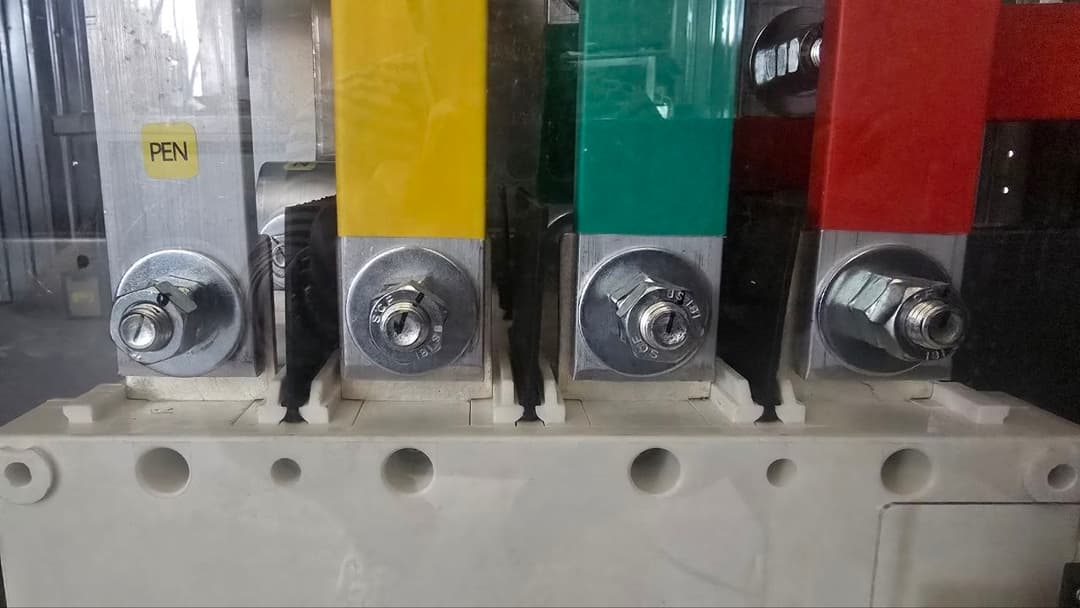
- Torque marking
- confirms the bolt is tightened and hasn't turned, and provides traceability in production.
Plus contact surface preparation: we clean the aluminum and apply a neutral grease, because aluminum oxide doesn't conduct current.
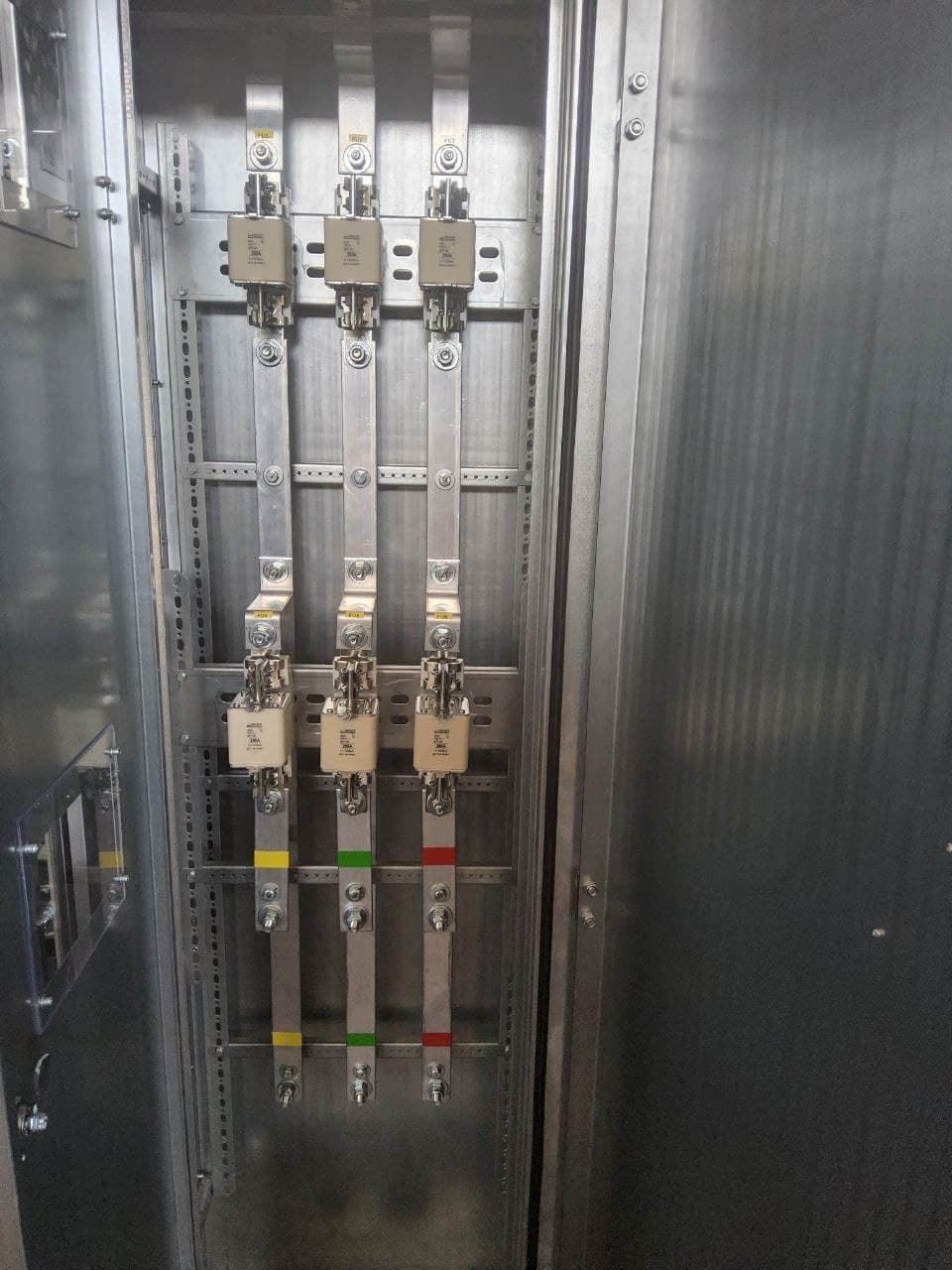
Why mark the tightening
Marking (a paint line or a control mark) isn't "electrical engineering" — it's quality control: it shows the connection is tightened and wasn't missed during assembly, and during inspection and maintenance a broken mark instantly reveals turning or loosening. In production it also provides traceability — who assembled the joint, with what tool, and at what torque.
Standards (Ukraine, 2026)
GOST 10434 was withdrawn in Ukraine in 2019; it is still used as a technical reference for bolted contact connections but has no legal force. The current basis for low-voltage switchgear and controlgear assemblies is DSTU EN IEC 61439 (Ukrainian national standard adopting the IEC standard), under which a connection's adequacy is verified by a heat-rise test. The standard sets the outcome (temperature rise limit, contact stability) and leaves fastener grade and torque to the manufacturer's instructions.
Frequently Asked Questions
Can grade 8.8 bolts be used on current-carrying busbars?
Yes, if tightened to the specified torque per the busbar table and fitted with a Belleville washer. Grade 8.8 is a standard fastener in factory-assembled switchgear. Galvanized grade 10.9 and 12.9 bolts should be avoided on busbars.
Why can't you just use a stronger bolt?
Because current is carried by the clamped busbar surfaces, not the bolt. Bolt strength doesn't improve the contact; instead, excessive force crushes the soft busbar and weakens the joint over time.
What tightening torque is used for M8, M10, M12 busbar bolts?
Approximately for aluminum — 22, 30, and 40 N·m; for copper — 17, 28, and 45 N·m. But exact values should only be taken from the datasheet: they depend on the busbar material, grease, and bolt grade.
Why is a torque wrench needed?
It provides repeatable force regardless of the installer. Tightening "by feel" produces a spread of tens of percent — a direct path to under- or over-tightening.
Why is a Belleville (disc spring) washer needed?
It compensates for thermal expansion and metal creep, maintaining clamping pressure through heating-cooling cycles. Without it, tension drops ratchet-style.
What is the danger of grade 10.9 and 12.9 bolts on busbars?
Hydrogen embrittlement: under constant tensile stress, sudden brittle fracture of the head is possible even without load.
Should tightened bolts be marked?
This is recommended quality-control practice: the mark shows the bolt is tightened and reveals turning during inspection.
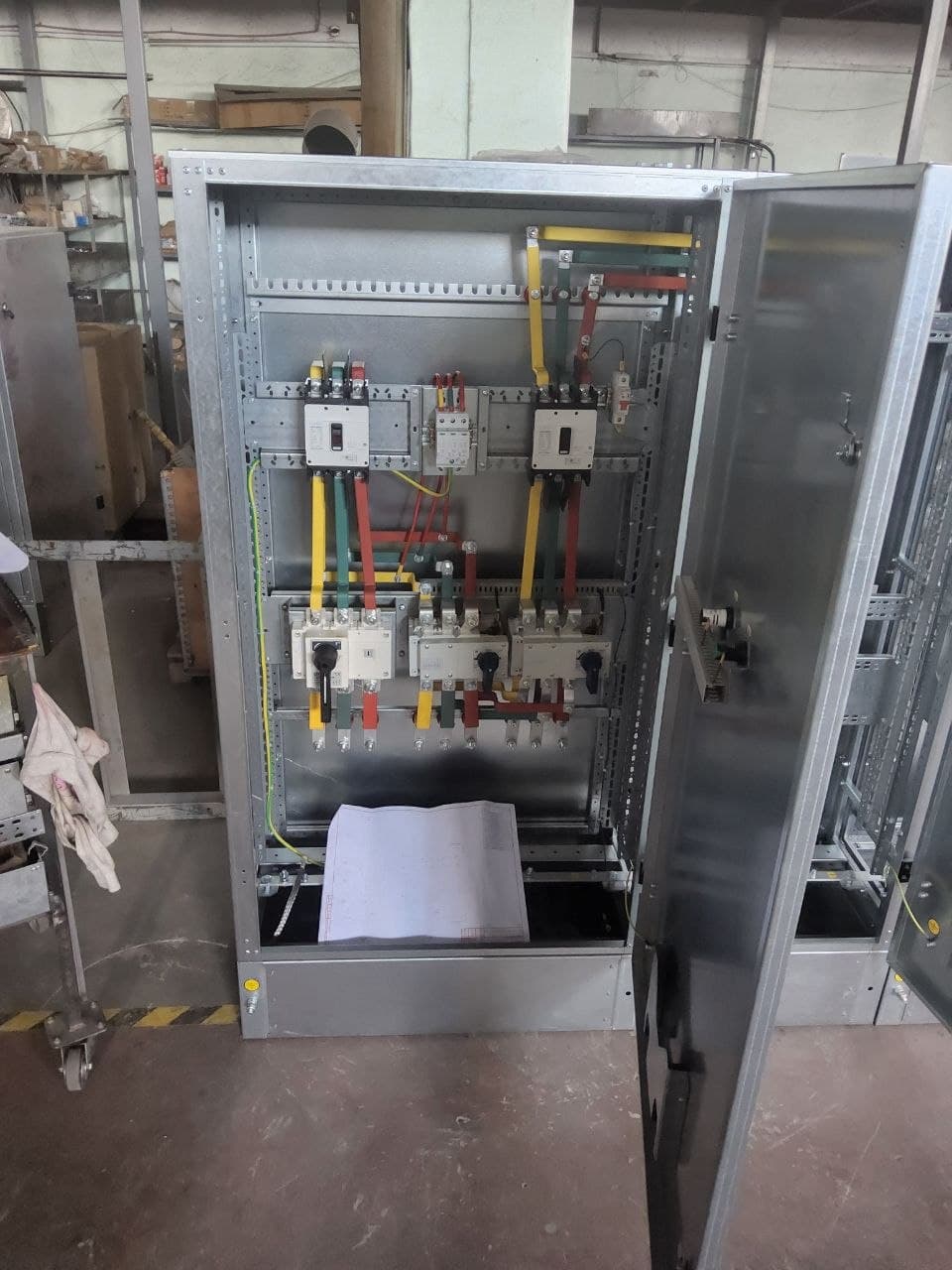
LK Energy Group manufactures switchgear equipment — LVSA (low-voltage switchgear and controlgear assemblies), KRU (medium-voltage switchgear), KSO (single-side-access switchgear cabinets) and busbar assemblies — with controlled tightening torque and marking of every critical connection. Have questions about the contact connections in your project — contact us.
Related equipment: ShchO-90 distribution switchboard panels for currents up to 4000A.
See also
Need an engineer’s advice?
Have a task involving power supply, switchgear or solar plants — write to us and we’ll answer to the point.
+380 67 104 94 91