
KTP, KTPN, KTPM: which transformer substation to choose
Author: Sviatoslav Yurdyk, Quality Engineer at LK Energy Group.
He checks that the switchboard equipment of our own manufacture complies with DSTU EN IEC 61439 — from incoming inspection of components to the acceptance testing of finished products.
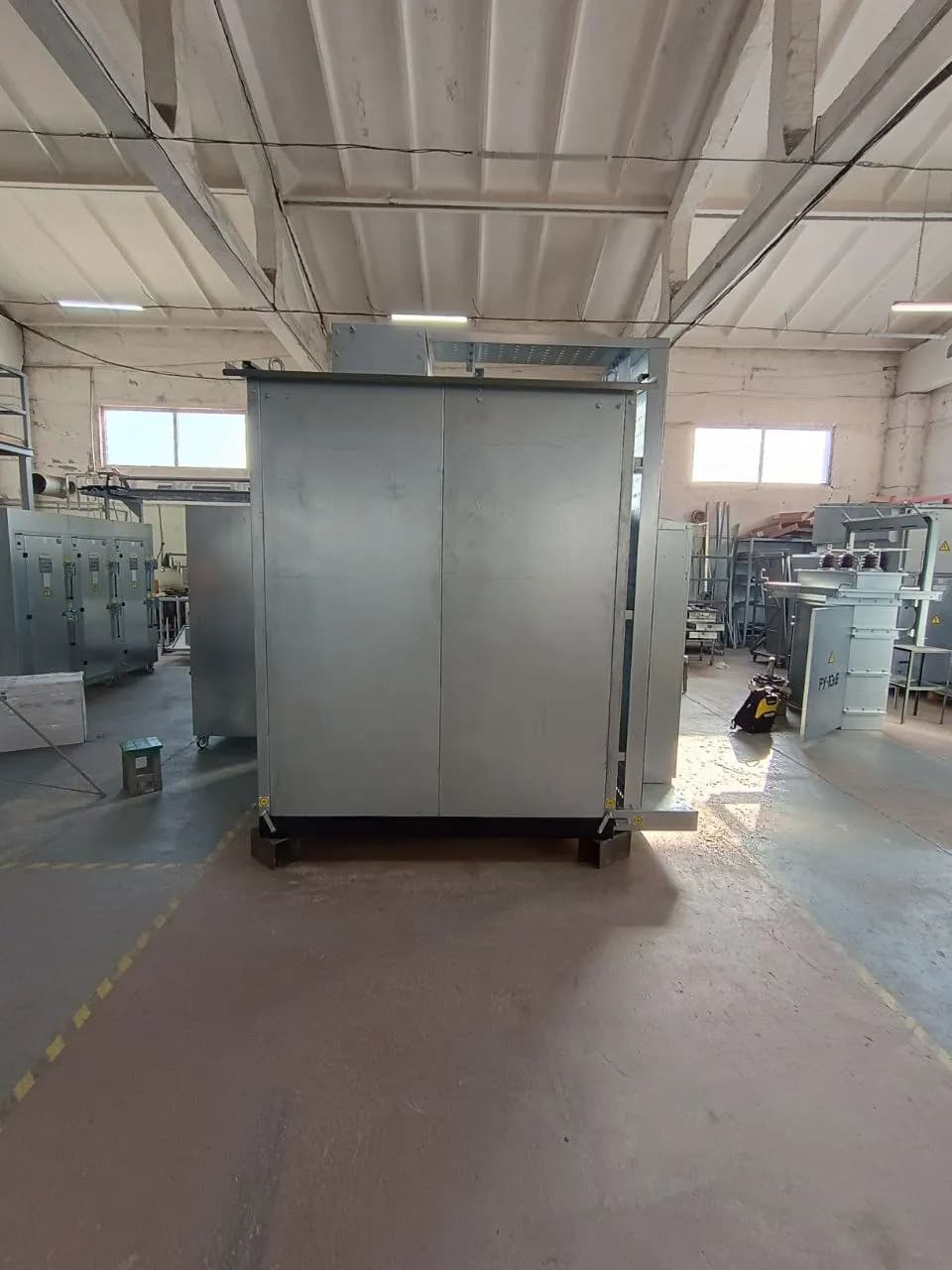
KTP (package transformer substation) is a fully factory-built electrical installation that takes in 6 or 10 kV, steps it down to 0.4 kV with a power transformer and distributes the electricity among consumers. The letters in the designation — KTPN, KTPM, BKTP — denote the constructional version: outdoor kiosk, pole-mounted, or concrete block-type. It is the version that determines where the substation can be installed, what capacity it will actually provide and how much its installation will cost. In this article we compare the four main types and look at the criteria for choosing yours.
What a KTP is and why it is needed
Distribution networks operate at 6–10 kV — transmitting energy at such voltages is economically efficient. But consumers — machine tools, pumps, lighting, sockets — are supplied at 0.4 kV. It is the 10(6)/0.4 kV transformer substation that provides the transition between these levels.
Any KTP consists of three functional parts:
- the high-voltage (HV) device — receives the 6–10 kV line: a disconnector or load-break switch, fuses or a vacuum circuit breaker, surge arresters;
- the power transformer — steps the voltage down from 6–10 kV to 0.4 kV; its rated capacity in kVA is what is meant by “the capacity of the substation”;
- the low-voltage (LV) switchgear — a 0.4 kV RUNN cabinet or panel with an incoming device, outgoing lines, metering and, where required, street lighting.
The word “package” means that all of this is assembled and tested at the factory as a single product. What remains on site is to place the substation on a foundation or a supporting structure, connect the HV and LV lines and carry out commissioning — without erecting a full substation building and installing apparatus piece by piece in place.
Types of KTP by version
Indoor KTP (workshop type)
An indoor KTP 10(6)/0.4 kV is installed in a room: in an enterprise’s workshop, in a built-in or attached switch room, or in a separate substation building. The enclosure protects personnel from touching live parts but is not rated for rain and snow — the room provides that protection. This is the most flexible version in terms of scheme and capacity: the HV device is made up of KSO cubicles, the transformers follow the standard capacity range, and the RUNN is assembled for any number of outgoing lines. Typical applications are industrial enterprises, pumping stations, the main substations of buildings, and also KTP units for solar power plants.
KTPN — outdoor
The letter “N” in the designation historically stands for outdoor installation. KTPN is a substation in a kiosk-type metal enclosure that is placed in the open air on a foundation. The enclosure withstands precipitation, dust and temperature swings; maintenance is carried out from outside, through the compartment doors. The 6–10 kV incomer is overhead or cable, and in the standard radial version the capacity is up to 400 kVA. KTPN is chosen when there is no separate room and building one is not worthwhile: villages and settlements, street networks, small production facilities and construction sites.
KTPM — pole-mounted
KTPM is the mast-type version: a cabinet with the transformer is installed on a foundation or a supporting frame (steel structure) at least 1600 mm high, with a maintenance platform. No substation building or kiosk enclosure is needed, but a base is. The incomer is overhead, from a 6–10 kV line; the transformer is protected by fuses, and the RUNN cabinet is of the outdoor type. The standard capacity range is from 25 to 400 kVA, in a radial configuration. This is the working solution for rural networks, farms, street lighting and remote or seasonal facilities — anywhere consumption is modest and an overhead line runs nearby.
BKTP — concrete block-type
A BKTP is a substation in a reinforced concrete enclosure made of separate block modules. The concrete enclosure provides vandal resistance, fire resistance and durability, while a layout with separate compartments for the 10 kV switchgear, the transformers and the 0.4 kV switchgear makes it possible to build two-transformer and through (transit) schemes with sectionalising. The incomer is cable. BKTP units are installed in dense urban development: residential complexes, retail and office centres, municipal infrastructure — where high capacity, two sections and a presentable appearance are required.
Comparison: what to install where
| Version | Installation | Typical capacity* | HV incomer | Typical application |
|---|---|---|---|---|
| KTP (indoor) | In a room: workshop, switch room, substation building | 100–2500 kVA | Cable | Enterprises, buildings, pumping stations, solar plants |
| KTPN (outdoor) | In the open air, a metal enclosure on a foundation | 25–400 kVA | Overhead or cable | Villages, street networks, small production facilities, construction sites |
| KTPM (pole-mounted) | On a foundation or supporting frame ≥1600 mm, with a maintenance platform | 25–400 kVA | Overhead | Rural networks, farms, lighting, remote facilities |
| BKTP (concrete) | In the open air, reinforced concrete block modules on a foundation | Project-specific, including two-transformer versions | Cable | Urban development, residential complexes, commercial facilities |
* The capacities are given for standard versions; the specific configuration — the transformer, the HV scheme, the set of outgoing lines — is determined by the questionnaire sheet.
How to choose: three questions
- Where will the substation stand? There is a suitable room, or one is envisaged by the design — an indoor KTP. There is no room and the plot is out of town — KTPN or KTPM. Dense urban development with cable networks and requirements for appearance — BKTP.
- What capacity is needed? The transformer capacity is chosen from the calculated load of the site with a margin for growth. All versions cover up to 250 kVA; 250–400 kVA — a KTPN or a KTPM (no STP); above 400 kVA it is an indoor KTP, a KTPGS (up to 1600 kVA) or a KTPMM (250–2500 kVA). For consumers of reliability categories I–II, two incomers and two transformers are provided — that is a two-transformer KTP or BKTP.
- What is the high-voltage incomer? If an overhead 6–10 kV line runs to the plot, KTPM or KTPN with an overhead incomer are the logical options. If the network is cable, then KTP, BKTP or KTPN with a cable incomer. Clarify the scheme separately: a radial substation is the end point of the line, while a through substation passes the line on in transit and allows the network to be sectionalised.
These three answers plus the 0.4 kV single-line diagram effectively make up the questionnaire sheet — the document the manufacturer uses to configure the substation for the specific site.
Turnkey manufacturing of KTP units
A KTP is not a catalogue item off the shelf: the HV device scheme, the transformer capacity, the composition of the RUNN and even the dimensions of the enclosure are different in every project. That is why it matters who manufactures the substation. LK Energy Group produces KTP, KTPN and KTPM units at its own plant in Odesa: metal cutting and bending, powder coating, assembly of HV devices based on KSO cubicles, and of RUNN cabinets and panels — plus acceptance testing of every product before shipment. The design office adapts the standard solution to your site: non-standard dimensions, a layout to fit an existing foundation, additional metering compartments. Where required we also take on the installation and commissioning.
Frequently asked questions
How does a KTPN differ from a KTP?
By the design of the enclosure and the place of installation. An indoor KTP requires a room that protects it from precipitation. A KTPN is a self-contained outdoor structure: a metal enclosure placed in the open air on a foundation, serviced from outside through the compartment doors. Electrically both perform the same function — transformation 6(10)/0.4 kV and distribution.
Which substation should be chosen for a village or a farm?
If the load fits within 25–400 kVA and there is an overhead 6–10 kV line nearby, a KTPM will do: a cabinet with the transformer on a foundation or supporting frame, with no substation building or kiosk enclosure. If a cable incomer, more outgoing lines or enclosed access to the equipment is needed, then a KTPN. The exact choice is made from the calculated load and the technical connection conditions. The price of a KTP depends on the rating, not on the enclosure type.
What are radial and through substations?
A radial substation is supplied by one 6–10 kV line and is its end point — this is how standard KTPM and KTPN units are built. A through (transit) substation passes the line through its HV device onwards to the next substations, which allows the network to be sectionalised and the supply to be backed up. A through (transit) scheme is offered by the KTPGS in a steel enclosure.
LK Energy Group is a manufacturer of 6(10)/0.4 kV package transformer substations: indoor KTP, outdoor KTPN and pole-mounted KTPM. The full catalogue with specifications is in the “Equipment” section. Send us a single-line diagram or a completed questionnaire sheet — we will select the version and price the substation for your site.
See also
Need an engineer’s advice?
Have a task involving power supply, switchgear or solar plants — write to us and we’ll answer to the point.
+380 67 104 94 91