
PKO-10 commercial metering point: a 10 kV metering unit
General information
What the product is
A commercial metering point (PKO-10) is an outdoor cubicle for commercial energy metering in overhead 10(6) kV distribution networks. It is installed where the supply demarcation point sits on the high-voltage side: between networks of different owners, at the intake of a plant or a pumping station, or on a spur to the customer's own substation.
Inside there are voltage and current instrument transformers, surge arresters and a metering compartment with a panel for the meter. The meter itself and the communication modem are supplied by the customer or by the distribution system operator: we prepare the metering panel, the test terminal block and the secondary circuits, which are sealed after installation.
Two versions we have built
- For an overhead-line pole: a unit of two separate modules, high-voltage and low-voltage; per the passport this version is IP54, climatic version U1, with a rated main-circuit current of 50 A and an electrodynamic withstand of 31.5 kA. It is mounted on an existing pole together with outdoor disconnectors; the low-voltage metering module is wall-mounted and its enclosure is set by the customer.
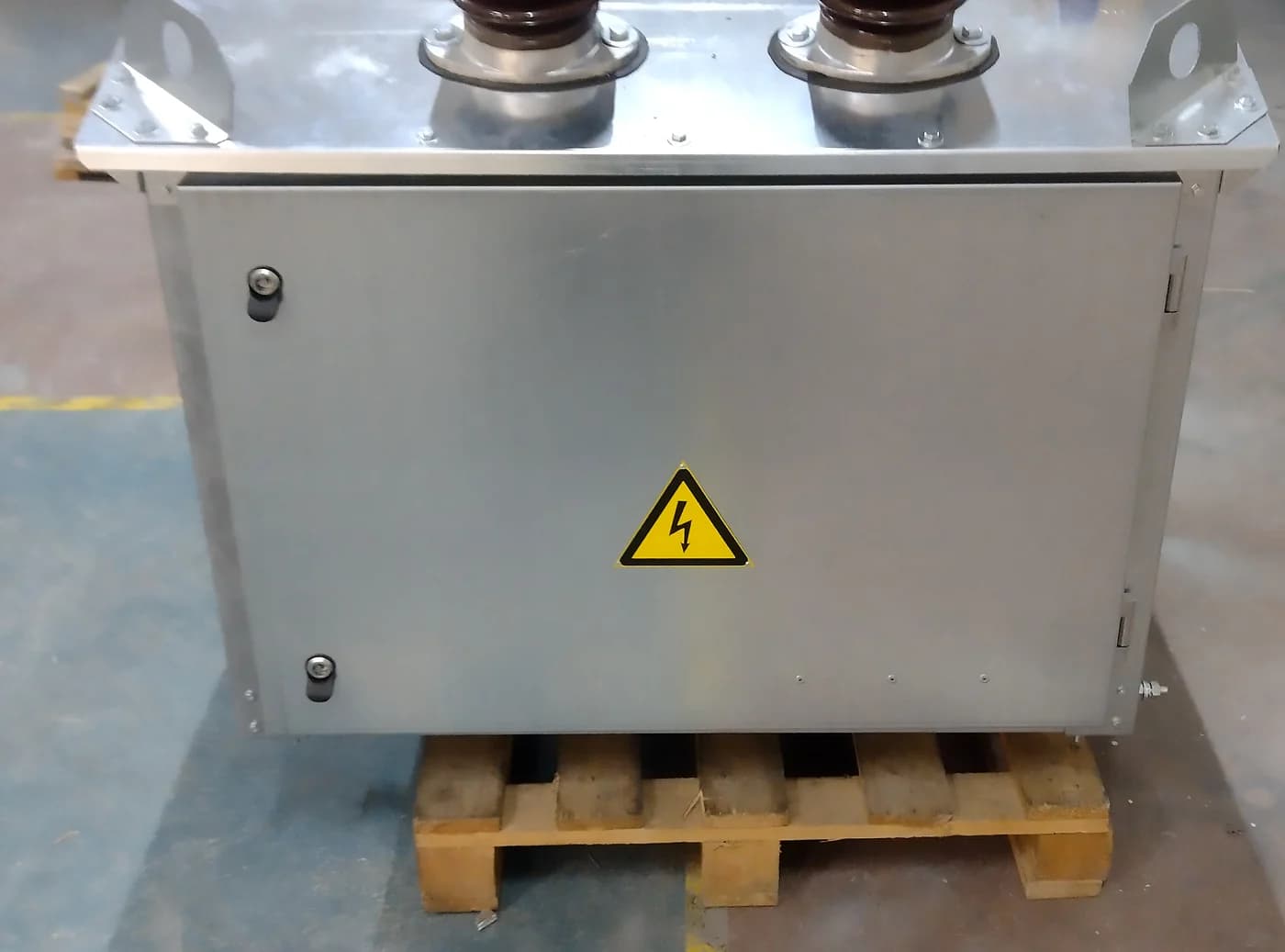
- A separate cubicle on support channels: the version documented in 2024 — an enclosure of 1000×1000×1100 mm, weight up to 250 kg, a rated main-circuit current of 630 A, incoming and outgoing bushings on the roof and corner lifting lugs.
What the unit does not include
There is no switching device inside a metering point — switching and the visible break are done by the outdoor disconnectors mounted on the same pole. If switchgear with circuit breakers is required, that is a different product: outdoor switchgear (KRUN-E); for metering at 0.4 kV we build metering intake boxes.
Experience
We have been building 10(6) kV commercial metering points since 2019; our electrical laboratory archive holds test reports for 18 high-voltage modules. The enclosures are cut, folded and welded from 1–2 mm galvanised steel (load-bearing plates and channels — 3 mm) at our own plant in Odesa, so the layout follows the actual installation site.
Structure and equipment
The enclosure
A welded enclosure of 1–2 mm galvanised steel, load-bearing plates and channels — 3 mm: walls, a sloping roof, a floor, support channels and anchor parts. The roof carries the incoming and outgoing bushings with terminals for the overhead-line drops, and the corners carry lifting lugs for crane slings. Protection is IP54; the doors are gasketed along the perimeter and the enclosure has an earthing bar.
In the pole-mounted version the unit consists of two modules: the high-voltage one is our welded galvanised steel enclosure, and the low-voltage one is a wall-mounted metering module whose enclosure is set by the customer (glass-reinforced plastic, IP54, in the delivered order). In a separate cubicle both parts are built into one galvanised enclosure.
What is inside
The equipment depends on the version.
- Voltage measurement
- voltage transformers of accuracy class 0.5 with a 100 V secondary: two single-phase units in the pole-mounted version, a three-phase group in a separate cubicle;
- Current measurement
- current transformers of accuracy class 0.5S with a 5 A secondary; their number (two or three) and the ratio follow the metering scheme and the requirements of the distribution system operator;
- Surge protection
- three surge arresters at the incomer in a separate cubicle; per the design documentation in the pole-mounted version;
- Metering
- in a separate cubicle — a section with an outer and an inner door, a viewing window for the meter and a metering panel; in the pole-mounted version — a wall-mounted metering module;
- Secondary circuits
- a sealable test terminal block, protective devices for the voltage circuits and marked conductors;
- Earthing
- an earthing bar on the enclosure and bonding links between removable parts.
How it differs from a 0.4 kV metering board
Metering on the high-voltage side is impossible without instrument transformers: a meter is never connected directly to a 10 kV network. A metering point is therefore not a "board with a meter" but a set of instrument transformers, surge protection and secondary circuits in an outdoor enclosure, to which the meter is simply connected.
What the customer prepares
The pole or the base, the drops from the overhead line, the outdoor disconnectors, the earthing loop and the meter with its modem. We issue the schematic diagram and the requirements for the installation site before the work starts.
Specifications
Main parameters of the metering point
The values come from the passports of delivered work; the actual version is set by the questionnaire.
| Parameter | Value |
|---|---|
| Purpose | commercial metering of active and reactive energy at the point of supply demarcation |
| Network | three-phase distribution networks, 50 Hz, 10(6) kV; overhead — for the pole-mounted version |
| Rated voltage, kV | 10; highest operating voltage — 12 |
| Rated current of main circuits, A | per the design documentation; in delivered work — 50 and 630 (main-circuit current, not a metering range) |
| Secondary circuits | 5 A current, 100 V voltage |
| Electrodynamic withstand, kA | 31.5 per the high-voltage module passport |
| Ingress protection | IP54 |
| Climatic version | U1, outdoor installation; operating temperature −40 to +40 °C |
| Weight, kg | up to 250 (the HV module in the pole-mounted version; a separate cubicle — up to 250 complete) |
| Dimensions (H×W×D), mm | 1000×1000×1100 in the documented version; others per the design documentation |
| Enclosure | the steel enclosures are welded of 1–2 mm galvanised steel (load-bearing plates and channels — 3 mm), made in-house; in the pole-mounted version the metering module is wall-mounted, IP54, with an enclosure to the customer requirements |
| Instrument transformers | pole-mounted — two single-phase voltage transformers of accuracy class 0.5; in a separate cubicle — a three-phase voltage transformer group of class 0.5; current transformers are of accuracy class 0.5S |
| Current transformer ratio | per the metering scheme; in delivered work — 10/5 and 50/5 |
| Surge protection | in a separate cubicle — three surge arresters at the incomer; in the pole-mounted version — per the design documentation |
| Switching device | not included: the unit is installed together with outdoor disconnectors |
| Meter and modem | fitted by the customer or the distribution operator; not part of the supply |
| Installation | on an overhead-line pole or on support channels; earthing via the enclosure earthing bar |
Final values are agreed at the questionnaire stage.
Manufacturing and documents
How we build
- the questionnaire: network voltage, load current, installation site, type of metering;
- the schematic diagram and the layout;
- cutting and folding of galvanised steel, welding of the enclosure;
- installation of the instrument transformers, surge arresters and secondary circuits;
- acceptance testing with a report from our electrical laboratory.
Scope of supply
- the PKO unit according to the contract and the questionnaire — 1 pc;
- the passport — 1 pc;
- the schematic diagram — 1 pc.
The acceptance test report is provided on request.
How to order
Send the network voltage, the calculated load, the installation site and the metering requirements of the distribution system operator. That is enough to quote the layout, the size and the price; the lead time is quoted together with the price.
Not intended for operation
- in environments with conductive dust, caustic vapours or gases that destroy metal and insulation;
- in places subject to heavy shaking, vibration or impact;
- on mobile installations.
Warranty
Product warranty — 2 years (extended to 5 years by agreement); enclosure metalwork — 10 years*. The design service life to write-off is 25 years, provided that components with a shorter service life are replaced.
*Indicative terms and conditions. The exact warranty period is stated in the supply contract.
Description and purpose
A PKO-10 commercial metering point is an outdoor cubicle for energy metering in 10(6) kV networks. Inside there are voltage transformers of accuracy class 0.5 and current transformers of accuracy class 0.5S, surge arresters and a metering compartment with a viewing window and a test terminal block; the meter and the modem come from the customer or the distribution system operator. We weld the steel enclosures ourselves from 1–2 mm galvanised steel, load-bearing plates and channels — 3 mm: IP54 protection, work from −40 to +40 °C. In delivered work — a pole-mounted unit of two modules (50 A, 31.5 kA withstand, HV module weight up to 250 kg) and a separate cubicle of 1000×1000×1100 mm rated 630 A with a three-phase voltage transformer group and three surge arresters. There is no switching device inside: the unit is installed together with outdoor disconnectors. We have been building them since 2019, 18 high-voltage modules with test reports. Price on request.
Find the right equipment for your site
Answer them and we will come back with a configuration and a ballpark price for your site.
FAQ
How does a commercial metering point differ from a 0.4 kV metering board?
Does the unit include a circuit breaker or a disconnector?
Who supplies the meter and the modem?
How is the unit installed on site?
What documents come with the metering point?
Price request:
PKO-10 commercial metering point: a 10 kV metering unit
Send us your single-line diagram or specification — we will estimate the configuration, lead time and price. Preliminary estimate within 24 business hours.
+380 67 104 94 91